In today’s digital world, communication happens faster than ever. Whether you’re sending a message, writing an article, posting on social media, or chatting with friends, you constantly use text-based communication. One concept that often appears in writing and online conversations is “in text meaning.”
But what exactly does in text meaning refer to? Why is it important in writing, education, SEO, and everyday messaging?
Understanding in text meaning can help you communicate more clearly, interpret messages correctly, and improve both academic and digital writing skills. In this guide, we’ll explore the definition, examples, types, importance, and practical uses of in text meaning, along with common misunderstandings and helpful tips.
What Is In Text Meaning?
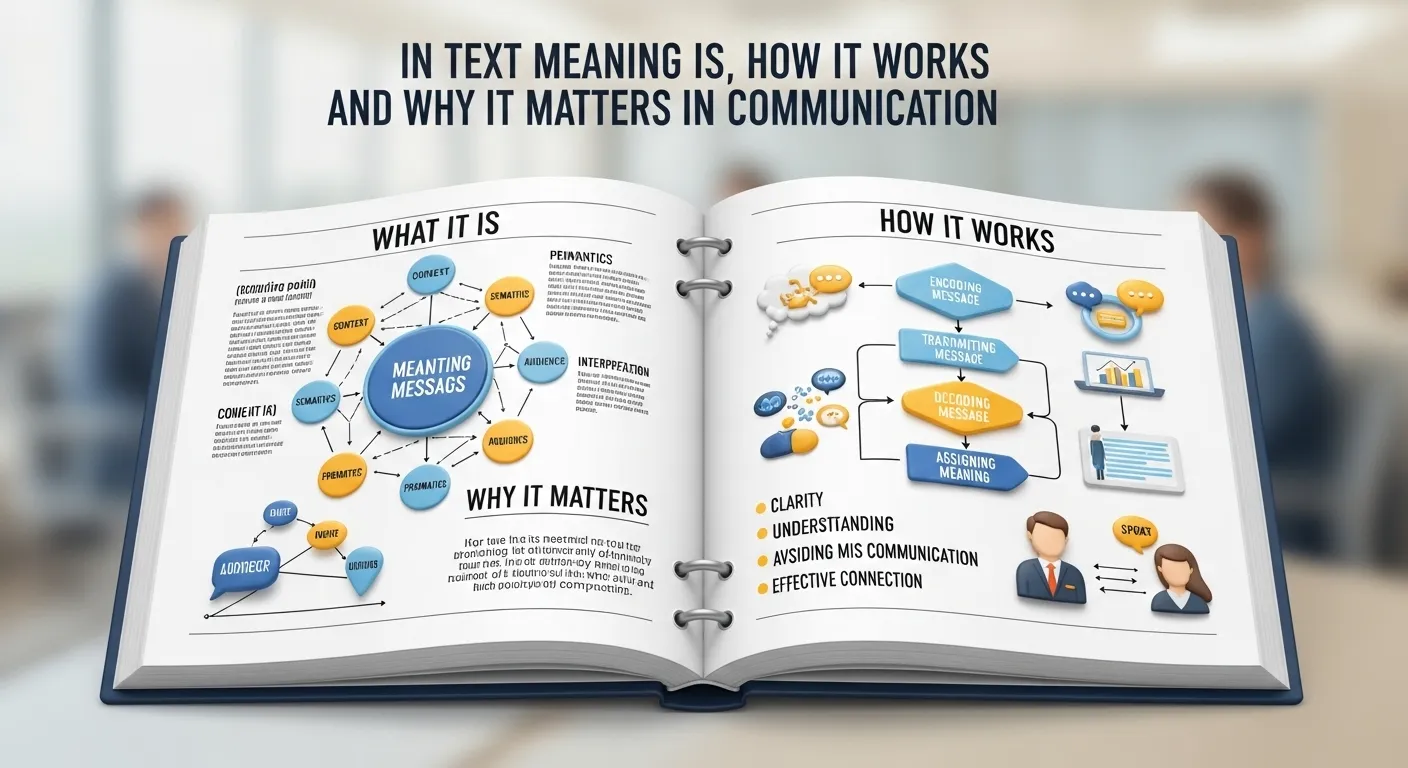
In text meaning refers to the meaning conveyed directly within a piece of written text, based on the words, context, and structure used by the writer.
In simple terms, it is the interpretation or understanding that readers get from the text itself.
Simple Definition
| Term | Explanation |
|---|---|
| In Text Meaning | The meaning derived from the words and context within a written passage |
| Context | The surrounding words or sentences that help clarify meaning |
| Interpretation | How a reader understands the message of the text |
Example
Consider the sentence:
“She finally saw the light after months of confusion.”
The in text meaning is not about literal light. Instead, it means the person finally understood something clearly.
The meaning becomes clear when you analyze the context within the text.
Why In Text Meaning Is Important
Understanding in text meaning plays a key role in reading comprehension, writing, academic research, and digital communication.
Here are some reasons it matters.
1. Improves Reading Comprehension
Readers must interpret words based on context and tone.
For example:
- “The project took off quickly.”
This doesn’t mean something physically flew away. Instead, it means the project became successful or progressed rapidly.
2. Helps Avoid Miscommunication
Misunderstanding text messages or emails often happens when people misinterpret in text meaning.
Tone, punctuation, and word choice can change meaning dramatically.
3. Essential for Academic Writing
In academic work, in-text meaning often relates to citations and references, helping readers understand sources used in a text.
Example:
(Smith, 2022)
This in-text citation shows the information comes from a specific source.
4. Important for SEO and Content Writing
Search engines analyze text meaning and context to understand web pages.
Writers often optimize content using:
- semantic keywords
- contextual phrases
- natural language patterns
These elements help search engines interpret the true meaning of content.
Types of In Text Meaning
Not all meaning inside text works the same way. There are different forms depending on context, tone, and writing style.
1. Literal Meaning
Literal meaning refers to the exact definition of words.
Example:
“The cat is sleeping on the sofa.”
This sentence means exactly what it says.
No hidden interpretation is needed.
2. Contextual Meaning
Sometimes the meaning changes depending on the context of surrounding words.
Example:
“He broke the ice with a joke.”
The phrase break the ice means:
- starting a conversation
- easing tension in a social situation
3. Implied Meaning
Implied meaning is suggested but not directly stated.
Example:
“It’s getting late.”
In many situations, this actually implies:
- time to leave
- the conversation should end
4. Figurative Meaning
Figurative language uses metaphors, idioms, and expressions to convey deeper meaning.
Examples include:
- “Time is money”
- “The classroom was a zoo”
- “Her smile lit up the room”
These expressions have symbolic meaning rather than literal meaning.
In Text Meaning in Academic Writing
In academic writing, the phrase “in text meaning” often appears when discussing in-text citations.
These citations show where information in the text comes from.
Example of In-Text Citation
APA style:
Social media affects attention spans (Johnson, 2021).
MLA style:
Social media affects attention spans (Johnson 45).
Why In-Text Citations Matter
They help:
- credit original authors
- avoid plagiarism
- support arguments with research
- allow readers to verify sources
Examples of In Text Meaning in Everyday Communication
Let’s look at real-life examples where in text meaning changes depending on context.
| Text Message | Possible Meaning |
|---|---|
| “Fine.” | Could mean agreement or annoyance |
| “Sure…” | Might indicate hesitation |
| “Okay.” | Could mean approval or passive disagreement |
| “We should talk.” | Often implies something serious |
Without tone of voice, readers must rely on in text meaning to interpret the message.
In Text Meaning in Digital Communication
Modern communication relies heavily on text-based platforms, including:
- SMS messages
- emails
- social media
- chat apps
- forums
Because these platforms lack facial expressions and tone, readers must interpret meaning carefully.
How People Add Meaning to Text
People often use:
- emojis
- punctuation
- capitalization
- abbreviations
Example:
| Text | Meaning |
|---|---|
| “OK.” | Might feel cold or formal |
| “OK!!!” | Shows excitement |
| “ok” | Casual agreement |
Small changes can dramatically affect how the text meaning is perceived.
How Context Shapes In Text Meaning
Context is the most powerful factor affecting text interpretation.
There are several types of context.
1. Linguistic Context
The surrounding words influence meaning.
Example:
“The bank was crowded.”
Bank could mean:
- financial institution
- riverbank
Only context clarifies meaning.
2. Social Context
The relationship between speakers changes meaning.
Example:
- A boss saying “Good job”
- A friend saying “Good job”
Tone and intention may differ.
3. Cultural Context
Some phrases have culture-specific meanings.
Example:
“Break a leg”
In theater culture, it means good luck.
Common Misunderstandings About In Text Meaning
Many people confuse in text meaning with other writing concepts.
Let’s clear up a few misconceptions.
Misconception 1: It Only Refers to Citations
Not true.
While in-text citations are part of academic writing, in text meaning also refers to interpretation within the written content.
Misconception 2: Words Always Mean the Same Thing
Words change meaning depending on:
- context
- tone
- audience
- situation
Misconception 3: Text Messages Are Always Clear
Without voice or facial expressions, text messages can easily be misunderstood.
How to Identify In Text Meaning
To understand meaning correctly, readers should analyze several elements.
1. Look at the Context
Check surrounding sentences.
2. Consider Word Choice
Words often carry emotional or implied meaning.
3. Pay Attention to Tone
Tone might be:
- serious
- sarcastic
- humorous
- formal
4. Identify Figurative Language
Expressions like idioms or metaphors change meaning.
Practical Tips for Writing Clear Text Meaning
If you want readers to understand your message clearly, follow these tips.
Use Clear Language
Avoid overly complex words unless necessary.
Provide Context
Explain ideas fully so readers don’t misinterpret them.
Avoid Ambiguous Phrases
For example:
Instead of:
“We’ll discuss it later.”
Say:
“We’ll discuss the project tomorrow morning.”
Use Punctuation Carefully
Punctuation can alter meaning significantly.
Example:
- “Let’s eat, grandma.”
- “Let’s eat grandma.”
One comma makes a huge difference.
Related Concepts to In Text Meaning
Understanding in text meaning becomes easier when you know related concepts.
Context Clues
Hints within a sentence that help define unfamiliar words.
Example:
“The desert was arid, meaning extremely dry.”
Semantics
The study of meaning in language.
Pragmatics
How meaning changes based on social context and intention.
Textual Analysis
A method used in literature and research to analyze meaning within texts.
Real-Life Applications of In Text Meaning
Understanding in text meaning is useful in many fields.
Education
Students interpret:
- literature
- essays
- textbooks
Marketing
Marketers carefully choose wording to influence readers.
SEO Content Writing
Search engines analyze semantic meaning and context to rank pages.
Legal Documents
Precise wording determines legal interpretation.
Table: Literal vs Contextual In Text Meaning
| Phrase | Literal Meaning | Contextual Meaning |
|---|---|---|
| Hit the books | Strike books | Start studying |
| Break the ice | Crack ice | Start conversation |
| Piece of cake | Dessert | Something easy |
| Under the weather | Physically under weather | Feeling sick |
FAQs About In Text Meaning
What does in text meaning mean?
In text meaning refers to the interpretation or message conveyed within a written passage based on words, context, and structure.
Is in text meaning the same as in-text citation?
Not exactly.
In-text citation refers to referencing sources inside academic writing, while in text meaning refers to understanding meaning from the text itself.
Why is context important in text meaning?
Context helps clarify how words are used and prevents misinterpretation by providing surrounding information.
Can text meaning change depending on the reader?
Yes. Personal experiences, cultural background, and emotions can influence how readers interpret a text.
How can writers make their text meaning clearer?
Writers can improve clarity by:
- using simple language
- providing context
- avoiding vague expressions
- using proper punctuation
What role do emojis play in text meaning?
Emojis help convey tone and emotion in digital communication, reducing the risk of misunderstanding.
Conclusion
Understanding in text meaning is essential for clear communication in both academic and everyday settings. Whether you are reading a book, writing an essay, sending a message, or creating online content, the meaning of text depends heavily on context, word choice, tone, and structure.
By learning how to interpret and convey meaning within text, you can:
- improve reading comprehension
- avoid miscommunication
- write more effective content
- communicate clearly in digital spaces
Remember that words rarely exist in isolation. Their true meaning emerges within the text itself, shaped by context and interpretation. Mastering this skill not only strengthens your writing but also helps you become a more thoughtful and attentive reader.