In today’s fast-moving digital world, people often shorten words and phrases when texting or posting online. If you’ve recently seen “ION” in a text message, comment, or social media post, you might have wondered what it actually means.
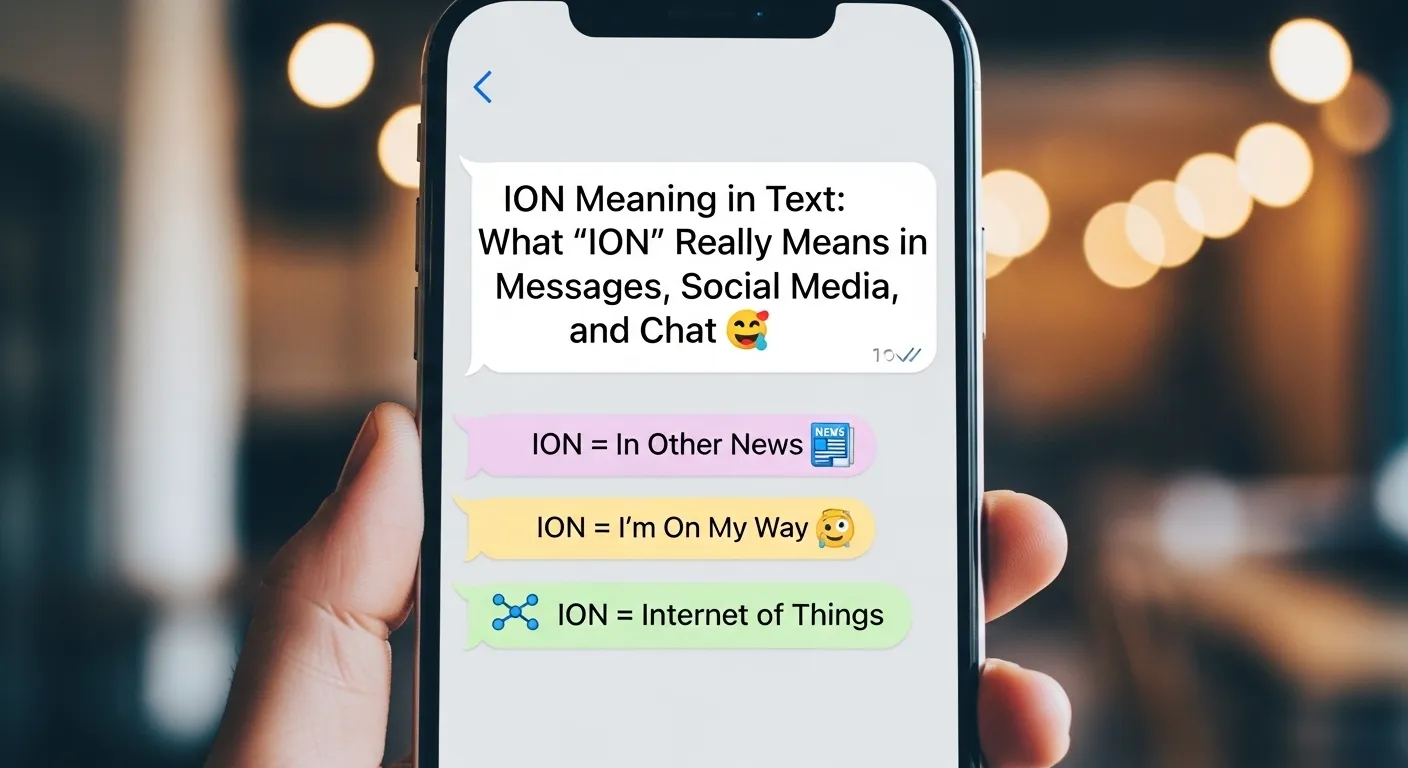
The ION meaning in text can be confusing because it has more than one interpretation depending on the context. Sometimes it means “I don’t,” while in other situations it can stand for “In Other News.” Understanding how and when people use it can help you communicate more naturally online.
In this guide, we’ll break down:
- The exact meaning of ION in text
- How people use it in messages and social media
- Real examples and conversations
- The difference between ION and similar slang
- Common misunderstandings
- Helpful alternatives and related abbreviations
By the end of this article, you’ll clearly understand what ION means in texting and how to use it correctly.
What Does ION Mean in Text?
The most common ION meaning in text is:
ION = “I Don’t”
People use it as a slang abbreviation for the phrase “I don’t.”
It became popular in casual texting, social media comments, and online chats, especially among younger users.
Example
- Friend: You want pizza tonight?
- You: ION want pizza today.
Meaning:
“I don’t want pizza today.”
Instead of typing “I don’t,” users shorten it to ION to type faster.
The Second Meaning of ION in Text
Although less common, ION can also mean:
ION = In Other News
This meaning is used when someone changes the topic of conversation.
Example
- ION, did you hear about the new movie release?
Meaning:
“In other news, did you hear about the new movie release?”
This usage is more common on Twitter (X), forums, and discussion threads.
Why People Use “ION” in Text Messages
Texting language evolves constantly. Abbreviations like ION exist because they make communication faster and more casual.
Here are a few reasons people use it.
1. Faster Typing
Typing ION takes less time than writing I don’t.
Example:
- ION think that’s a good idea.
2. Informal Online Culture
Platforms like:
- TikTok
- Snapchat
- Twitter/X
- Discord
encourage short, casual language.
3. Character Limits
Some platforms used to limit characters heavily, so users created shorter abbreviations.
4. Trendy Internet Slang
Using slang like ION helps users sound more relatable and modern in digital conversations.
Examples of ION Used in Text Conversations
Here are real-style examples showing how people use ION in everyday texting.
Example 1: Opinion
Friend: Are you going to the party tonight?
You: ION feel like going out.
Meaning: I don’t feel like going out.
Example 2: Disagreement
Friend: That movie was amazing!
You: ION think it was that good.
Meaning: I don’t think it was that good.
Example 3: Casual Chat
Friend: You want coffee?
You: ION drink coffee after 6.
Meaning: I don’t drink coffee after 6.
Example 4: Topic Change
Person: The weather is chaotic today.
You: ION, did you finish that assignment?
Meaning: In other news…
Where You’ll See “ION” Online
The ION meaning in text appears across many platforms.
Common places include:
- Text messages
- TikTok comments
- Instagram captions
- Snapchat chats
- Twitter/X posts
- Gaming chats
- Discord servers
Example Social Media Comment
“ION think that trend is funny anymore.”
Meaning:
“I don’t think that trend is funny anymore.”
ION vs Other Similar Text Abbreviations
Many people confuse ION with other slang. Here’s how it compares.
| Abbreviation | Meaning | Example |
|---|---|---|
| ION | I don’t | ION like that song |
| IDK | I don’t know | IDK what happened |
| IMO | In my opinion | IMO that movie is overrated |
| TBH | To be honest | TBH I liked the first one better |
| SMH | Shaking my head | SMH that was embarrassing |
Understanding these helps you decode internet conversations faster.
The Origin of “ION” in Texting
Like many slang terms, ION didn’t appear overnight.
Its roots likely come from:
- Urban texting culture
- African American Vernacular English (AAVE)
- Social media slang evolution
In spoken language, “I don’t” sometimes sounds like “ion.”
Example pronunciation:
“Ion know.”
Meaning:
“I don’t know.”
Over time, people began typing it the same way it sounds.
This pattern is common with slang like:
- finna (fixing to)
- gonna
- lemme
Common Misunderstandings About ION
Because ION is also a scientific word, some people misunderstand it.
Let’s clear that up.
Misunderstanding #1: It Always Means a Scientific Ion
In chemistry, an ion is a charged particle.
But in texting:
ION usually means “I don’t.”
Context makes the difference.
Misunderstanding #2: It Means “I On”
Some people mistakenly think it means “I on.”
That’s incorrect.
Correct meaning:
ION = I don’t
Misunderstanding #3: It’s a Typo
Many assume ION is just a misspelling.
In reality, it’s intentional slang.
How to Use ION Correctly in Text
Using ION in messages is simple.
Follow these guidelines.
1. Use It in Casual Conversations
Good for:
- Friends
- Social media
- Informal chats
Example:
ION wanna go out tonight.
2. Avoid It in Professional Communication
Do not use ION in:
- Work emails
- Formal messages
- School essays
Write the full phrase instead:
I don’t agree with the proposal.
3. Use Context
Make sure the sentence clearly shows you mean “I don’t.”
Example:
- ION see the problem.
Popular Variations of ION
Online slang often evolves into new variations.
Here are a few related phrases.
Ion know
Meaning:
I don’t know.
Example:
Ion know what happened.
Ion care
Meaning:
I don’t care.
Example:
Ion care what people say.
Ion even
Meaning:
I don’t even…
Example:
Ion even like that show.
Other Popular Internet Slang Like ION
If you’re learning texting language, these are also common.
Frequently Used Slang
- BRB – Be right back
- LOL – Laughing out loud
- BTW – By the way
- TTYL – Talk to you later
- FR – For real
- ONG – On God
These abbreviations help keep online conversations quick and casual.
When NOT to Use ION
Even though it’s popular, ION isn’t appropriate everywhere.
Avoid using it in:
- Professional emails
- Academic writing
- Job applications
- Business messages
Example:
❌ ION agree with your proposal.
✔ I don’t agree with your proposal.
How Slang Like ION Shapes Digital Communication
Internet slang like ION reflects how language evolves.
Key trends include:
- Shorter phrases
- Faster communication
- More casual tone
- Speech-based spelling
Digital language often mirrors how people talk in real life.
Because of this, new slang appears every year.
Table: Quick Summary of ION Meaning
| Term | Meaning | Example |
|---|---|---|
| ION | I don’t | ION like that song |
| ION (alt) | In other news | ION, did you see the update? |
| Ion know | I don’t know | Ion know what happened |
| Ion care | I don’t care | Ion care about the drama |
Frequently Asked Questions (FAQs)
1. What does ION mean in texting?
The ION meaning in text usually stands for “I don’t.” It’s a casual abbreviation used in messages, social media posts, and online chats.
2. Does ION ever mean something else?
Yes. In some contexts, ION can mean “In Other News,” especially when someone is switching topics.
3. Is ION slang or an acronym?
It’s generally considered internet slang, though technically it functions like an abbreviation of “I don’t.”
4. Is ION the same as ion in science?
No. In science, an ion is a charged atom or molecule. In texting, ION means “I don’t.”
5. Who uses ION the most?
It’s most commonly used by:
- Teenagers
- Social media users
- Online communities
- Casual texters
6. Is ION grammatically correct?
No. It’s informal slang, so it shouldn’t be used in formal writing or professional communication.
7. How do you pronounce ION in texting?
It’s usually pronounced like “eye-on.”
But when representing “I don’t,” it mimics the spoken pronunciation “ion.”
Final Thoughts
The ION meaning in text is simple once you know the context.
Most of the time, it means:
ION = “I don’t.”
People use it to type faster and keep conversations casual on social media and messaging platforms.
Occasionally, it can also mean “In other news,” especially when switching topics.
Key takeaways:
- ION usually means “I don’t.”
- It’s common in texts, social media, and online chats.
- It’s part of modern internet slang.
- Avoid using it in formal or professional communication.
As online language continues to evolve, slang like ION helps people communicate quickly, creatively, and casually in the digital world.