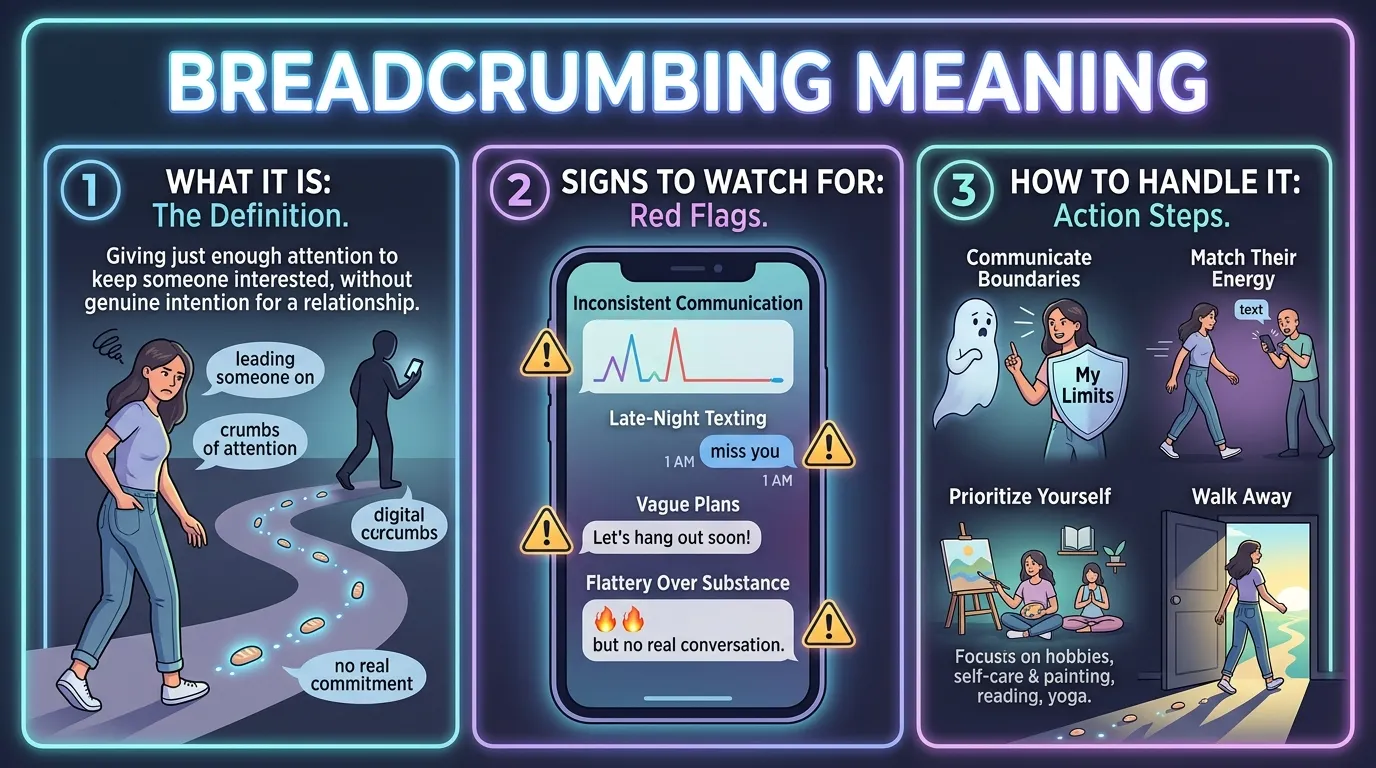
In today’s world of online dating, social media, and instant messaging, new relationship terms seem to appear every year. One term that has gained significant attention is breadcrumbing. If you’ve ever felt like someone was giving you just enough attention to keep you interested but never actually committing to anything meaningful, you may have experienced it firsthand.
Understanding breadcrumbing meaning is important because it can affect your emotional well-being, confidence, and relationships. Whether it happens in dating, friendships, or even professional settings, recognizing the signs can help you avoid confusion and make healthier decisions.
In this guide, we’ll explore the meaning of breadcrumbing, why people do it, common signs, examples, psychological effects, and practical ways to respond.
What Is Breadcrumbing?
Breadcrumbing refers to the act of sending small, intermittent signals of interest to someone without any genuine intention of developing a meaningful relationship.
The term comes from the idea of dropping tiny breadcrumbs along a path. Instead of offering real commitment, attention, or emotional investment, the person provides just enough interaction to keep another person interested.
Simple Definition
Breadcrumbing meaning: A behavior where someone gives occasional messages, likes, compliments, or attention to keep another person emotionally invested while avoiding a deeper connection.
Examples include:
- Sending random late-night texts
- Liking your social media posts but never making plans
- Flirting without pursuing a relationship
- Disappearing for weeks and suddenly reappearing
- Giving mixed signals about their intentions
The Origin of the Term Breadcrumbing
The concept became popular with the rise of social media and online dating platforms. While similar behaviors existed long before smartphones, technology made it easier for people to maintain minimal contact with multiple individuals.
Dating apps, messaging platforms, and social networks created opportunities for people to stay on someone’s radar without investing much effort.
As a result, breadcrumbing became a widely recognized form of modern relationship behavior.
How Breadcrumbing Works
A breadcrumber typically follows a predictable pattern:
- Shows interest initially.
- Creates excitement and hope.
- Pulls away unexpectedly.
- Returns with a text, comment, or compliment.
- Repeats the cycle.
This creates emotional uncertainty.
The recipient often thinks:
- “Maybe they’re busy.”
- “Maybe they’re interested but shy.”
- “Maybe something will happen eventually.”
Unfortunately, the relationship rarely progresses beyond occasional attention.
Common Signs of Breadcrumbing
Recognizing the signs can save you time and emotional energy.
1. Inconsistent Communication
One day they’re texting constantly.
The next week they disappear entirely.
Communication feels unpredictable and confusing.
2. They Never Commit to Plans
A breadcrumber may say:
- “We should hang out sometime.”
- “Let’s plan something soon.”
But when it’s time to make actual plans, excuses appear.
3. Frequent Social Media Interaction
They may:
- Like your photos
- Watch every story
- Leave emojis in comments
Yet they rarely engage in meaningful conversation.
4. Mixed Signals
They might flirt heavily one day and act distant the next.
This inconsistency often leaves people wondering where they stand.
5. Conversations Stay Surface-Level
Discussions rarely move beyond:
- Small talk
- Casual compliments
- Random check-ins
They avoid deeper emotional topics.
6. They Contact You When Convenient
You may only hear from them when:
- They’re bored
- They’re lonely
- Another relationship isn’t working out
Their attention often serves their needs rather than mutual connection.
7. Long Gaps Followed by Sudden Messages
A classic breadcrumbing text might be:
“Hey stranger! How have you been?”
This often arrives after weeks or months of silence.
Examples of Breadcrumbing
Example 1: Online Dating
You match with someone on a dating app.
They send:
- “Good morning!”
- “You’re amazing!”
- “We should definitely meet.”
But every time you suggest a date, they cancel or disappear.
Example 2: Social Media
Someone regularly likes all your posts and stories.
They occasionally send heart emojis or compliments.
However, they never try to build a real friendship or relationship.
Example 3: Ex-Partner Contact
An ex reaches out every few months.
They reminisce about old memories and flirt a little.
Yet they never discuss reconciliation or taking concrete steps forward.
Example 4: Workplace Breadcrumbing
A colleague hints at mentorship or collaboration opportunities.
They repeatedly suggest future projects but never follow through.
Why Do People Breadcrumb Others?
Understanding motivations can help explain the behavior.
Seeking Validation
Many breadcrumbers enjoy knowing someone is interested in them.
The attention boosts their self-esteem.
Fear of Commitment
Some individuals like emotional connection but avoid responsibility and commitment.
Keeping Options Open
In dating, people sometimes maintain several potential romantic interests simultaneously.
Breadcrumbing helps them keep those options available.
Loneliness
A person may reach out whenever they feel lonely, even if they don’t want a serious relationship.
Narcissistic Tendencies
Some people enjoy controlling attention and emotions.
They may intentionally keep others invested for personal satisfaction.
Boredom
Occasional flirting and messaging can provide entertainment without requiring genuine effort.
The Psychology Behind Breadcrumbing
Breadcrumbing can create a powerful emotional cycle.
Psychologists often compare it to intermittent reinforcement, where rewards arrive unpredictably.
Think of it like:
- Occasional compliments
- Random messages
- Unexpected attention
Because these rewards are inconsistent, people often become more emotionally invested.
This unpredictability can make it difficult to walk away.
The brain begins anticipating the next “breadcrumb,” creating a cycle of hope and disappointment.
Emotional Effects of Being Breadcrumbed
Being breadcrumbed can have significant emotional consequences.
Confusion
Mixed signals make it difficult to understand someone’s true intentions.
Anxiety
You may constantly wonder:
- Why haven’t they replied?
- Are they interested?
- Did I do something wrong?
Lower Self-Esteem
Repeated uncertainty can damage confidence and self-worth.
Emotional Dependency
Some people become attached to the occasional attention they receive.
Wasted Time
Months or even years can pass waiting for a relationship that never develops.
Breadcrumbing vs. Genuine Interest
Many people struggle to distinguish between the two.
| Breadcrumbing | Genuine Interest |
|---|---|
| Inconsistent communication | Consistent communication |
| Empty promises | Follow-through actions |
| Avoids commitment | Discusses future plans |
| Mixed signals | Clear intentions |
| Minimal effort | Meaningful effort |
| Sporadic attention | Reliable engagement |
A useful rule:
Interest is shown through actions, not just words.
Breadcrumbing vs. Ghosting
These terms are often confused.
Breadcrumbing
- Occasional contact continues.
- The person never fully disappears.
- They provide small signs of interest.
Ghosting
- Communication stops completely.
- No explanation is provided.
- The person disappears entirely.
While ghosting is abrupt, breadcrumbing often creates prolonged emotional confusion.
Breadcrumbing vs. Benching
Another related dating term is benching.
Benching
Someone keeps you as a backup option while pursuing others.
Breadcrumbing
Someone gives occasional attention without necessarily intending any future relationship.
The behaviors often overlap but aren’t exactly the same.
Modern Technology and Breadcrumbing
Technology has made breadcrumbing easier than ever.
Social Media Platforms
Features like:
- Story views
- Reactions
- Likes
- Emojis
Allow people to maintain minimal contact effortlessly.
Dating Apps
Many users maintain conversations with multiple matches simultaneously.
This can lead to breadcrumbing behaviors.
Messaging Apps
Quick texts require very little effort while keeping communication open.
Examples include:
- “Hey”
- “What’s up?”
- “Thinking of you”
Without meaningful follow-through.
How to Tell If You’re Being Breadcrumbed
Ask yourself these questions:
Do They Consistently Follow Through?
If promises rarely become actions, that’s a warning sign.
Are You Doing Most of the Work?
Healthy relationships involve mutual effort.
Is Communication One-Sided?
Do you always initiate conversations?
Are Their Intentions Clear?
People who genuinely care typically communicate their intentions openly.
Has Progress Been Made?
If months pass without relationship growth, breadcrumbing may be occurring.
How to Respond to Breadcrumbing
If you suspect breadcrumbing, consider these strategies.
1. Recognize the Pattern
Awareness is the first step.
Look at actions rather than words.
2. Set Clear Boundaries
Communicate what you want from the relationship.
Examples:
- Consistent communication
- Honest intentions
- Mutual effort
3. Ask Direct Questions
Try asking:
- “What are you looking for?”
- “Where do you see this going?”
Clear answers can reveal true intentions.
4. Stop Chasing
Avoid constantly initiating contact.
Observe whether they make genuine efforts.
5. Focus on Self-Worth
Remember that someone else’s inconsistent behavior does not determine your value.
6. Move On If Necessary
If patterns don’t change, it may be healthier to invest your energy elsewhere.
Can Breadcrumbing Be Unintentional?
Yes.
Not everyone who breadcrumbs has malicious intentions.
Some people:
- Are emotionally unavailable
- Have poor communication skills
- Feel uncertain about relationships
- Don’t realize their behavior affects others
However, intentional or not, the impact can still be harmful.
The important factor is how the behavior affects you.
How to Avoid Being Breadcrumbed
Know What You Want
Clear relationship goals make it easier to spot incompatibility.
Watch Actions Closely
Consistency matters more than occasional romantic gestures.
Don’t Ignore Red Flags
Repeated cancellations and mixed signals often reveal important information.
Maintain Healthy Boundaries
Protect your emotional energy.
Value Mutual Effort
Healthy relationships involve equal participation from both people.
Healthy Alternatives to Breadcrumbing
Instead of breadcrumbing, healthy communication includes:
- Honest intentions
- Consistent contact
- Respectful boundaries
- Clear expectations
- Open conversations
Strong relationships thrive on transparency rather than uncertainty.
Frequently Asked Questions
What does breadcrumbing mean in dating?
Breadcrumbing in dating refers to giving occasional attention or flirtation to keep someone interested without pursuing a genuine relationship.
Is breadcrumbing toxic?
It can be. While not always intentional, breadcrumbing often creates confusion, anxiety, and emotional frustration.
Why do people breadcrumb?
Common reasons include seeking validation, avoiding commitment, loneliness, boredom, or wanting to keep options open.
How can I tell if someone is breadcrumbing me?
Look for inconsistent communication, lack of commitment, mixed signals, and repeated promises without action.
Is breadcrumbing the same as ghosting?
No. Ghosting involves complete disappearance, while breadcrumbing involves occasional contact that keeps hope alive.
Can a breadcrumber change?
Yes, if they become aware of their behavior and genuinely commit to healthier communication patterns.
Should I confront someone who is breadcrumbing me?
Direct communication can be helpful. Asking clear questions about intentions often provides valuable clarity.
Conclusion
Understanding breadcrumbing meaning can help you navigate modern relationships with greater confidence and awareness. Breadcrumbing occurs when someone provides small, inconsistent signs of interest without genuine commitment, often leaving the other person feeling confused and emotionally invested.
The key signs include mixed signals, sporadic communication, empty promises, and a lack of relationship progress. While people breadcrumb for various reasons—such as validation, fear of commitment, or loneliness—the emotional impact can be significant.
To protect yourself, focus on actions rather than words, establish healthy boundaries, communicate openly, and prioritize relationships built on consistency and mutual respect. Remember that genuine interest is demonstrated through effort, reliability, and clear intentions—not occasional breadcrumbs of attention.
By recognizing the pattern early, you can make informed choices, protect your emotional well-being, and invest your energy in relationships that offer real connection and value.