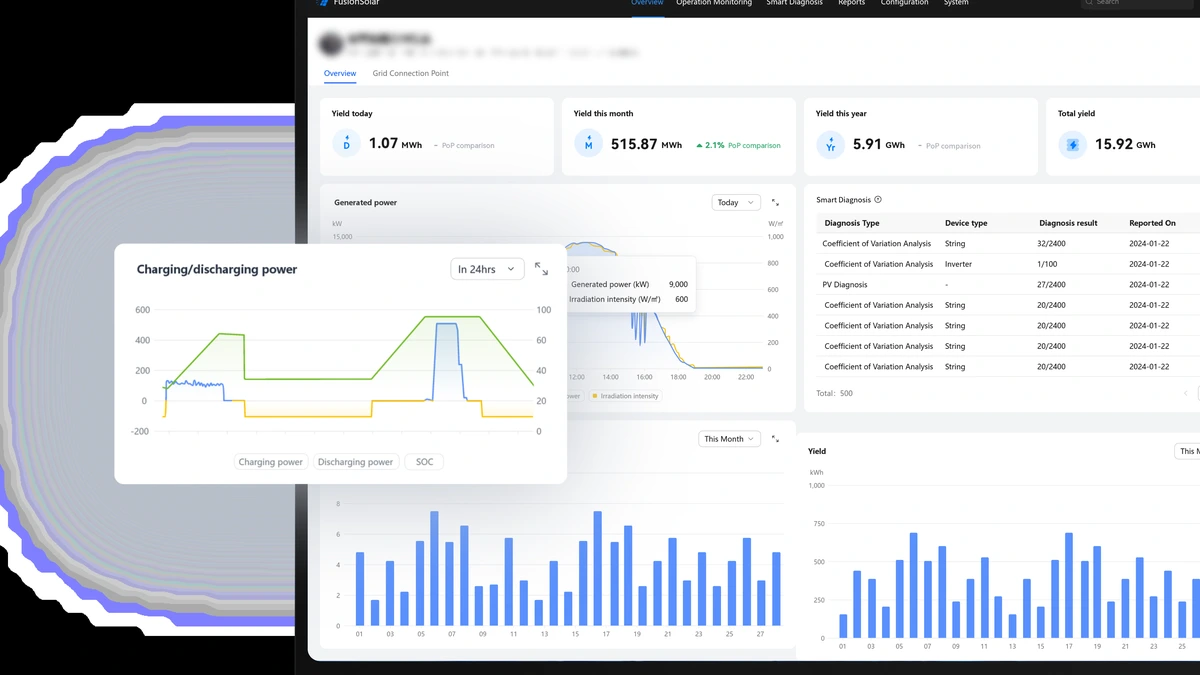
For a project integrating PV with battery storage, equipment decisions must follow the required service and the conditions of the actual site. A PV monitoring system converts electrical measurements and equipment events into a usable view of plant performance. The FusionSolar Smart PV Power Plant Management System describes visibility from the plant level down to sub-arrays, devices and modules, together with alarm prioritization and diagnostic workflows. In this context, PV monitoring system brings together specific components and controls rather than a single isolated device.
PV-plus-storage sites require visibility into both solar generation and battery status to interpret power at the grid connection. Equipment ratings, control policies and the responsibilities of the operating team should therefore be aligned before commissioning. A design assumption should be documented when it cannot yet be confirmed by measurements.
What the platform measures
Plant energy should be interpreted with irradiance, weather, available capacity and curtailment in mind. A drop in output is not automatically a hardware fault; it may follow shading, an imposed export limit or reduced sunlight.
A device hierarchy that matches the actual electrical single-line diagram helps an operator trace an alarm from a plant overview to the affected inverter, string or module. Incorrect asset mapping undermines even a sophisticated dashboard.
Fault diagnosis and alarms
Alarm rules should separate safety events, production loss, communications faults and routine maintenance notices. Escalation can then reflect equipment criticality and the expected value of a site visit.
Diagnostic workflows benefit from synchronized timestamps and relevant operating histories. Comparing inverter channels under similar irradiance can help identify a localized issue without treating weather-driven variation as a fault.
Operations and reporting
Operations staff need measured energy, availability, inverter efficiency and unresolved incidents in one coherent record. These are practical inputs for maintenance scheduling and contract reporting.
Monitoring data can support predictive checks when patterns recur, such as rising device temperature or intermittent communication. An anomaly is a reason for investigation, not a substitute for a verified failure diagnosis.
Commissioning and data quality
Network redundancy, data retention and communication protocols become important for large or remote sites. Missing data should be clearly flagged rather than silently treated as zero generation.
The operator should reconcile reported production with revenue meters and energy-balance expectations. Reliable performance reporting depends on both software visualization and the integrity of source measurements.
Site documentation should identify equipment models, permitted operating ranges, control priorities and conditions requiring intervention. Model-specific ratings and configuration options need to be checked before they become contractual performance targets.
These considerations show why PV monitoring system should be specified by its architecture, operating limits and interfaces. The main purpose of PV monitoring is to connect granular equipment data with a maintenance decision. Visibility, fault prioritization and validated data quality make plant information useful beyond a colorful dashboard. The final selection still depends on applicable standards, actual site conditions and model-specific documentation.