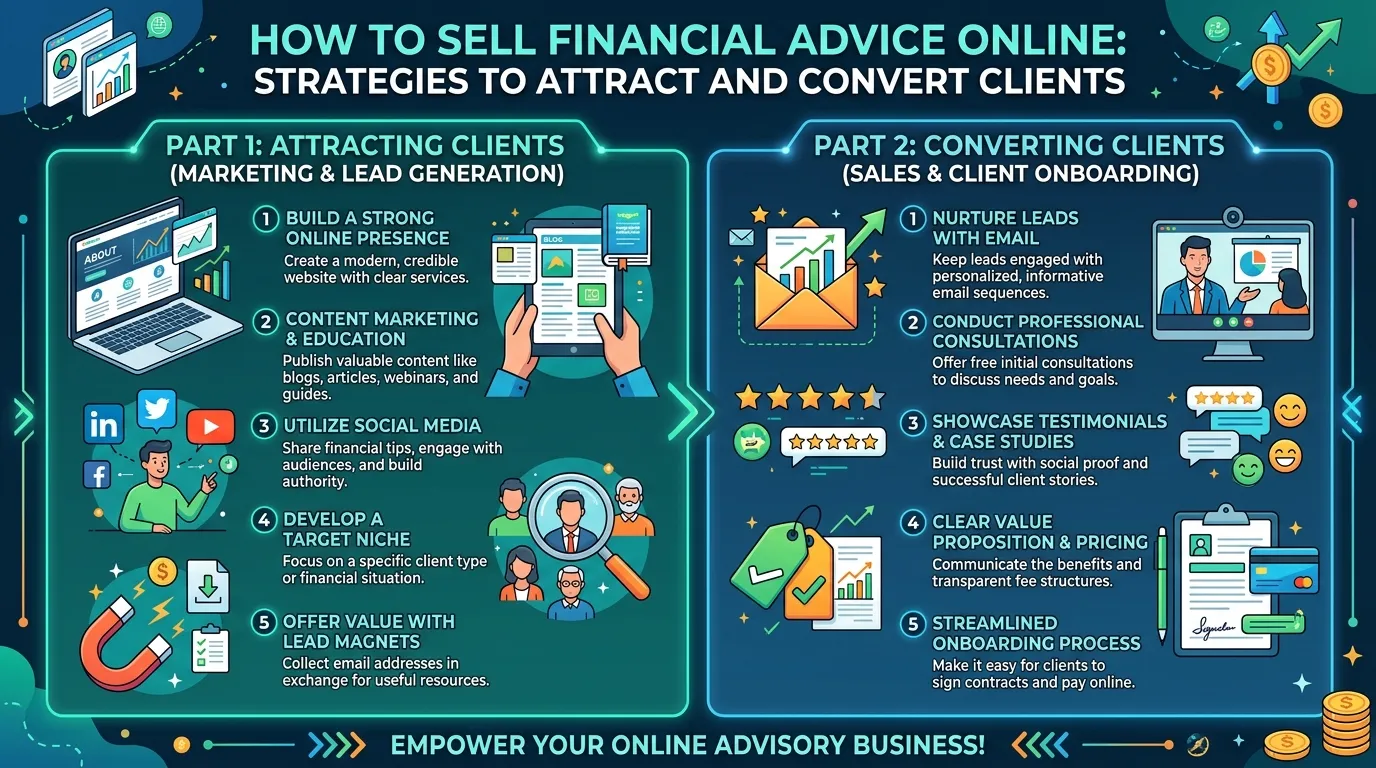
Financial advice is one of the strangest things a person can sell. Unlike a car or a kitchen renovation, a client can’t test-drive a retirement plan or see the finished product before committing. They’re being asked to hand over trust, money, and often deeply personal fears about the future — based almost entirely on how confident, credible, and genuinely invested you seem in their outcome.
This is why the advisors who struggle most aren’t necessarily the ones with weaker technical skills. They’re the ones treating advice like a product to be pitched rather than a relationship to be earned. Meanwhile, the advisors who build thriving practices have learned something counterintuitive: the best way to sell financial advice is to stop selling it in the traditional sense, and instead build systems that make trust visible, provable, and easy to act on.
That’s what this article is about. We’ll walk through a complete, practical framework — from understanding how prospects actually think and decide, to niching your expertise, building content and referral engines, running a consultative sales process, and staying compliant while you do it. Whether you’re a solo advisor building your first client base or part of a larger firm looking to sharpen your growth strategy, the goal is the same: turning strangers into confident, long-term clients by leveraging trust as your core competitive advantage.
Understanding Your Buyer Before You Try to Sell
Before you write a single piece of marketing copy or sit down for a discovery call, it helps to understand what’s actually happening in a prospect’s mind. Financial decisions are rarely made on logic alone — they’re tangled up with anxiety, identity, and fear of making an irreversible mistake. Someone Googling “how to invest an inheritance” at midnight isn’t just looking for information; they’re looking for reassurance that they won’t screw it up.
This is why financial advice is often described as an “experience good” — its value can’t be fully judged until after it’s been delivered, sometimes years later. Since prospects can’t evaluate your competence upfront, they rely on proxies instead: how clearly you communicate, how much you seem to understand their specific situation, and whether other people like them have trusted you before.
Most buyers also move through a fairly predictable journey. They start unaware that they have a problem worth solving, become problem-aware (realizing they’re behind on retirement, or unsure what to do with stock options), then solution-aware (learning that financial advisors exist for this), then advisor-aware (comparing specific options), and finally decided. Each stage requires different messaging — educational content works early, while proof and direct outreach work later.
Along the way, objections shift too. Early on, it’s usually “Do I even need help?” Later, it becomes “Can I trust this person?” or “Is this worth the fee?” And often, underneath it all, a quieter objection lingers: “What if I make the wrong choice by hiring someone?”
One of the most effective ways to navigate this journey is by building buyer personas around life events rather than demographics alone. A 45-year-old going through a divorce has different needs, timelines, and emotional stakes than a 45-year-old who just sold a business. Anchoring your understanding — and eventually your marketing — around these trigger moments makes every subsequent step in this framework sharper and more relevant.
Niching Down: The Foundation of Efficient Growth
It’s tempting to market yourself as a generalist — someone who can help “anyone with money.” In practice, this usually backfires. When you try to speak to everyone, your messaging becomes vague, your content becomes generic, and prospects struggle to see themselves in what you offer. The advisors who grow fastest tend to do the opposite: they narrow their focus dramatically, often to a single type of client.
Niching isn’t about turning away business — it’s about becoming the obvious, unmistakable choice for a specific group of people. A prospect searching for help almost always prefers a specialist over a generalist, even if the specialist is objectively no more skilled. “I help tech employees navigate RSUs and ISOs” is more compelling than “I help people with their finances,” because it signals immediate understanding of a specific, high-stakes situation.
Choosing the right niche usually means finding the overlap between three things: your existing expertise or network, a market large enough to sustain a practice, and a client type you genuinely enjoy working with. Common examples include physicians (with irregular income and heavy debt loads), small business owners preparing to sell, recent widows or widowers, pre-retirees within five years of leaving the workforce, or LGBTQ+ households navigating unique planning considerations.
The compounding benefit of niching shows up everywhere else in this framework. Your content becomes easier to write because you’re answering the same handful of questions repeatedly. Your referral partners become obvious — divorce attorneys, business brokers, or oncologists, depending on your focus. And prospects self-select before they even reach out, meaning your discovery calls convert at a much higher rate because you’re not spending time explaining why you’re a fit.
Content Marketing as Trust Infrastructure
If niching tells prospects who you serve, content marketing proves that you understand them. Long before someone books a call, they’re often reading blog posts, watching videos, or listening to podcasts trying to answer a specific question — “Should I max out my 401(k) or pay down debt?” or “What happens to my RSUs if I get laid off?” Every piece of content that answers one of these questions well is doing sales work quietly, in the background, without ever feeling like a pitch.
The goal of educational content isn’t to turn prospects into experts — it’s to demonstrate expertise and empathy simultaneously. A well-written blog post signals “I’ve seen this exact situation many times, and I know how to think about it.” That signal builds more trust than almost any direct claim you could make about your own qualifications.
Different formats serve different parts of the journey. Blog posts and articles are highly searchable and work well for problem-aware prospects typing questions into Google. Video and podcast content build a different kind of trust — a parasocial familiarity where prospects feel like they already know you before the first meeting, since they’ve heard your voice and watched how you explain things. Email newsletters keep you present in a prospect’s life over the long consideration cycles typical of financial decisions, without requiring them to keep coming back to your website.
Search visibility matters more than most advisors expect. Learning the basics of SEO — targeting long-tail, question-based keywords your niche is actually searching, along with local search terms — often outperforms paid advertising over time, because it keeps working long after a piece of content is published. Local search matters especially for advisors, since many prospects still prefer someone they could plausibly meet in person, even if most interactions happen over video.
Finally, one piece of good content rarely needs to be a one-time investment. A single article on RSU taxation strategy can become a video walkthrough, a slide carousel, a newsletter excerpt, and a talking point for a webinar. Advisors with limited time shouldn’t be creating five new ideas a week — they should be finding five ways to extend the life of their best ideas.
Social Proof and Reputation Systems
Content marketing tells a prospect what you know. Social proof shows them that other people trusted you with something as personal as their financial future — and it worked out. Because financial advice can’t be evaluated in advance, prospects lean heavily on the experiences of people who came before them. This is why testimonials, reviews, and case studies carry outsized weight in this industry, even more than in most other service businesses.
Client testimonials are powerful, but advisors need to handle them carefully. Under the SEC Marketing Rule, testimonials and endorsements are permitted, but they come with specific disclosure requirements — whether the person was compensated, whether they’re a current client, and any material conflicts of interest. The safest approach is building a simple, repeatable compliance process for collecting and publishing testimonials, rather than treating each one as a one-off request.
Case studies offer a way to show your process without needing to name real clients. A well-written, anonymized case study — “A 52-year-old business owner came to us three years before an planned exit, unsure how to structure the sale for tax efficiency” — lets prospects see themselves in the story and understand exactly how you think, without exposing any individual’s private financial details.
Beyond direct testimonials, reputation lives in a handful of other places prospects check before ever reaching out: your Google Business Profile, third-party rating platforms, and any media mentions or guest appearances you’ve done. A steady stream of genuine reviews does more for conversion than almost any paid ad, because prospects trust other consumers more than they trust marketing copy. Similarly, being quoted in an article or appearing as a guest on a niche-relevant podcast lends a level of third-party credibility that’s very difficult to manufacture through your own channels alone.
None of this needs to be flashy. The advisors who build strong reputational proof usually do it through consistency — asking for reviews at the right moment, keeping case studies updated, and showing up periodically in spaces their niche already trusts.
Referral Engines: Your Highest-ROI Channel
If social proof convinces prospects from a distance, referrals convince them before they even arrive. A referred prospect isn’t starting from zero — they’re arriving with a built-in layer of trust, borrowed from whoever sent them. This is why referred clients tend to convert faster, negotiate less on fees, and stay longer than clients acquired through cold marketing channels.
Yet most advisors treat referrals as something that happens to them rather than something they build deliberately. A strong referral engine starts with simply asking — at the right moment, in the right way. The best time is usually after a clear win: a successful plan review, a client expressing genuine relief or gratitude, or a milestone like a successful retirement transition. A well-timed, specific ask (“Do you know anyone else going through a similar business sale who might benefit from a conversation?”) performs far better than a vague, generic request tacked onto an email signature.
Beyond client referrals, centers of influence represent one of the most underused channels in financial services. CPAs, estate attorneys, divorce attorneys, and real estate agents often sit at the exact moment a client needs financial advice — and most of them don’t have a trusted advisor to refer to. Building genuine relationships with a handful of these professionals, rather than a large but shallow network, tends to produce a steady, compounding stream of qualified introductions over time.
Client appreciation events — dinners, educational workshops, or small gatherings — serve a dual purpose here. They deepen loyalty with existing clients while creating a natural, low-pressure setting for those clients to bring a friend or colleague who might benefit from an introduction. Where compliant, some advisors formalize this further with structured referral programs, though any incentive-based referral arrangement needs to be reviewed against SEC and FINRA rules before being offered.
The common thread across all of this is intentionality. Referrals rarely become a reliable engine by accident — they become one when an advisor treats asking for them as a normal, expected part of doing great work, not an awkward afterthought.
The Consultative Sales Process
By the time a prospect books a call, most of the hard work of building trust has already happened through content, referrals, and reputation. This means the sales conversation itself shouldn’t feel like a pitch — it should feel like the natural next step in a relationship that’s already begun. Advisors who treat discovery calls as a chance to diagnose rather than sell tend to close more business, because prospects can tell the difference between someone trying to understand them and someone trying to close them.
A good discovery call starts with listening, not talking. Rather than launching into a description of services, effective advisors ask open-ended questions about the prospect’s situation, goals, and worries, and let the conversation reveal where the real pain points are. Structured questioning frameworks — similar to consultative sales methods used in other high-trust industries — help here: understanding the prospect’s current situation, the specific problem driving them to seek help now, the implications of leaving that problem unaddressed, and what a good outcome would actually look like for them.
This diagnostic approach naturally sets up the second meeting, where the plan or proposal gets presented. The strongest presentations lead with clarity, not jargon — showing the prospect that you’ve genuinely understood their specific situation, rather than delivering a generic pitch deck. Visualizing their own numbers, timeline, and goals back to them is often more persuasive than any list of credentials or services.
Objections at this stage are rarely really about the objection itself. “I need to think about it” often means “I’m not fully convinced this is worth the cost,” and “I want to compare other options” often means “I haven’t yet seen enough proof that you’re different.” Handling these well means resisting the instinct to get defensive or oversell, and instead asking a clarifying question that surfaces the real concern underneath.
Finally, closing well doesn’t require pressure tactics. Because the earlier stages of this framework have already built trust, closing typically works best as a calm, clear next step — outlining exactly what happens if they move forward, removing ambiguity, and making the decision feel like a natural continuation of a conversation that already feels comfortable.
Digital Presence and Paid Acquisition
Everything discussed so far — content, social proof, referrals — eventually funnels prospects toward one place: your website. For many advisors, this is the most underbuilt part of their entire marketing system. A prospect who was referred by a friend or found you through a podcast will almost always check your website before reaching out, and a confusing or generic site can undo trust that took months to build elsewhere.
The strongest advisor websites make three things obvious within seconds: who you serve, what makes you different, and what to do next. A homepage that opens with “Comprehensive financial planning for individuals and families” tells a visitor almost nothing. A homepage that opens with “Helping tech professionals turn equity compensation into long-term wealth” immediately signals fit — or lack of it — which is exactly what you want. Every page should end with a clear, low-friction call to action, typically a short discovery call rather than a hard sales pitch.
Once the site itself is solid, paid acquisition can accelerate what organic content and referrals are already doing. Paid search tends to work well for advisors because it captures prospects who are already searching with clear intent — someone typing “financial advisor for stock options Seattle” is much further along than someone scrolling social media. Paid social, by contrast, is better suited to building awareness among people who haven’t yet realized they need help, using more educational or story-driven ad content rather than direct offers.
Retargeting — showing ads to people who’ve already visited your site or engaged with your content — tends to produce strong returns, since it’s reaching an audience that has already expressed some interest. Lookalike audiences, built from your existing client list, can help paid platforms find new prospects who resemble your best clients. As with testimonials, any paid advertising involving performance claims, client outcomes, or comparisons needs to be reviewed against SEC and FINRA marketing guidelines before it goes live.
Webinars and workshops sit in an especially useful middle ground between content and direct sales. A live session on a specific topic — “Navigating a Business Sale: Tax and Timing Considerations” — lets prospects experience your expertise directly, in real time, while giving you a natural, low-pressure way to invite attendees into a follow-up conversation.
Technology and Systems That Scale Trust
Everything covered so far — content, referrals, sales conversations — becomes difficult to sustain without systems behind it. As a practice grows, the risk isn’t running out of leads; it’s letting good leads fall through the cracks because follow-up depends on memory rather than process. This is where technology stops being optional and starts being part of the trust-building system itself.
A CRM is the backbone of this. Beyond simply storing contact information, a good CRM tracks where each prospect is in their journey, flags when it’s time for a follow-up, and gives visibility into the health of the overall pipeline. Advisors without a CRM often lose prospects not because of a bad pitch, but because a promising lead went three weeks without a response and quietly moved on to someone else.
Marketing automation extends this further by allowing nurture sequences to run in the background, segmented by persona. A prospect who downloaded a guide on RSU taxation shouldn’t receive the same follow-up emails as one who attended a retirement planning webinar — automation makes this kind of relevant, personalized follow-up possible without manually managing every contact by hand.
Client-facing technology matters just as much as internal systems. Financial planning software and client portals aren’t just operational tools — during the sales process itself, showing a prospect a live projection of their own numbers, updated in real time as you talk through scenarios, is often more persuasive than any brochure or pitch deck. It makes the abstract concept of “financial planning” feel tangible and immediate.
More recently, AI tools have started playing a role in drafting content, summarizing meeting notes, and personalizing follow-up communication at a scale that wasn’t previously possible for smaller practices. Used well, these tools free up an advisor’s time for the parts of the job that genuinely require a human — the relationship itself. Used carelessly, they risk producing generic, impersonal output that undermines the very trust this entire framework is built on. Any AI-assisted content, especially anything client-facing, should go through the same human review and compliance process as content written entirely by hand.
Compliance-Aware Marketing
Everything covered in this article — testimonials, paid ads, content claims, referral incentives — has to operate within a regulatory framework, and getting this wrong can cost far more than a bad marketing campaign ever would. For registered investment advisors, the SEC’s Marketing Rule governs most of what’s been discussed: it permits testimonials and endorsements, but requires clear disclosures about compensation, conflicts of interest, and whether the person is a current client. It also places strict limits on performance claims, hypothetical results, and any comparison that could be misleading without full context.
Advisors who are also registered representatives face an additional layer of oversight through FINRA, which has its own rules around communications with the public, including social media posts, seminars, and advertising. The specifics vary depending on registration type, so it’s worth confirming with a compliance professional exactly which rules apply to your situation rather than assuming SEC guidance alone covers everything.
A few categories of claims deserve particular caution. Guarantees of returns or outcomes are almost never appropriate, given the inherent uncertainty of markets and financial planning. Cherry-picked results — highlighting a single successful case while omitting less favorable ones — can be considered misleading even if every individual claim is technically true. Comparisons to other advisors, products, or market indices need to be presented with enough context that they don’t create a false impression of superiority.
Rather than treating compliance as a final check before publishing, the most sustainable approach is building it into the marketing process itself. This might mean a standing relationship with a compliance officer or outside consultant, a simple review checklist for anything client-facing, and a habit of asking “could this be misread as a promise?” before any piece of content goes live. Advisors who build this rhythm early tend to move faster over time, not slower — because compliance becomes a known, repeatable step rather than a source of last-minute anxiety.
Pricing and Positioning the Offer
By the time a prospect is evaluating fees, they’ve already been influenced by everything that came before — the content that built credibility, the proof that built confidence, and the conversation that built rapport. But how you present pricing still matters enormously, because it’s often the moment where abstract trust gets tested against a concrete number.
Fee transparency itself functions as a trust signal. Advisors who clearly explain how they charge — whether it’s a percentage of assets under management, a flat annual fee, hourly billing, or a subscription model — tend to face less resistance than those who reveal pricing only after multiple meetings. Ambiguity around cost creates anxiety, and anxious prospects hesitate. Clarity, even when the number itself is substantial, tends to be received better than vagueness.
The framing of the fee matters as much as the fee itself. Presenting cost as a percentage or dollar amount in isolation invites prospects to compare you against the cheapest available option. Presenting it in terms of outcomes — the tax inefficiencies avoided, the retirement timeline accelerated, the peace of mind of not managing this alone — repositions the conversation around value rather than cost. This isn’t about obscuring the fee; it’s about making sure the prospect is weighing it against the right thing.
Different fee models also send different signals about who you serve. AUM-based pricing works well for asset-heavy clients but can feel disconnected from value for those with modest portfolios but complex needs. Flat-fee or subscription models have grown popular precisely because they remove the perception of a conflict of interest between growing a client’s assets and growing the advisor’s revenue, which can be a meaningful differentiator in certain niches, particularly younger or more skeptical prospects.
Finally, tiered service models allow a practice to serve a wider range of clients without diluting its core brand. A niche-focused advisor might offer a comprehensive, high-touch tier for larger clients alongside a lighter, more self-directed tier for those earlier in their financial journey — as long as the distinction is presented clearly, so prospects don’t feel like they’re getting a lesser version of the “real” service.
Onboarding: Where the Sale Is Either Reinforced or Undone
Closing a new client isn’t the finish line — it’s the start of the period where that decision either solidifies or starts to wobble. The first 90 days after signing matter disproportionately, because this is when a new client is most sensitive to signs that they made the right (or wrong) choice. Marketing and sales can build trust up to the point of a decision, but onboarding is where that trust either gets confirmed by experience or slowly eroded by silence and disorganization.
Setting clear expectations early prevents most onboarding problems before they start. New clients should know what happens next, roughly when it will happen, and what’s expected of them, without having to ask. Vague timelines (“we’ll be in touch soon”) create low-grade anxiety that compounds if follow-up is delayed, while specific ones (“you’ll receive your account paperwork by Thursday, and we’ll walk through your plan together on the 15th”) create a sense of competence and control.
Quick wins matter more than they might seem to on paper. A small, visible action taken early — consolidating a scattered set of old accounts, catching an overlooked beneficiary designation, or identifying an immediate tax-saving opportunity — gives a new client tangible proof that hiring you was the right call, long before the bigger, slower-moving parts of a financial plan start to show results.
Communication cadence during this period should be more frequent than clients might expect, not less. Buyer’s remorse tends to grow in silence; a client who doesn’t hear from their advisor for a month after signing starts to wonder if they made a mistake, even if nothing has actually gone wrong. Regular, even brief, check-ins during onboarding signal attentiveness and reduce the odds of a client quietly disengaging.
Done well, onboarding also plants the seed for the next referral. A new client who feels genuinely well cared for in their first few months is far more likely to mention their advisor unprompted to a friend or colleague than one who has to chase down updates. In this way, onboarding isn’t just the end of the sales process — it’s the beginning of the next one.
Measuring What Matters
With so many moving parts — content, referrals, paid ads, discovery calls, onboarding — it’s easy to lose track of what’s actually driving growth. Advisors often default to vanity metrics like website traffic or social media followers, which feel productive but say little about whether the business is actually growing. Building a small set of meaningful metrics matters more than tracking everything possible.
Cost per lead is a useful starting point, but only when paired with lead quality. A cheap lead from a broad paid campaign that never converts is often more expensive, in practice, than a costlier lead from a well-targeted referral source that closes reliably. This is why lead-to-client conversion rate matters just as much as acquisition cost — it reveals whether the leads coming in are actually a fit for your niche and offer, or whether targeting needs adjusting upstream.
Client lifetime value ties these numbers together by showing what a client is actually worth over the full relationship, not just the first year. This is especially important in financial advice, where relationships often span decades and where referrals generated by a single satisfied client can be worth more than the client’s direct revenue alone. Tracking lifetime value helps justify spending more to acquire the right clients, rather than optimizing purely for the cheapest possible lead.
Referral rate deserves its own dedicated tracking, separate from general conversion metrics, since it reflects something different: how many existing clients are actively vouching for you. A declining referral rate, even amid steady overall growth, can be an early warning sign that satisfaction is slipping in ways that haven’t yet shown up elsewhere.
One persistent challenge in all of this is attribution. Financial decisions often unfold over long consideration cycles, with a prospect reading a blog post, attending a webinar, and getting a referral all before ever reaching out — making it hard to credit any single channel with the eventual conversion. Rather than chasing perfect attribution, most advisors are better served by a simple, consistent dashboard tracking the handful of metrics above over time, watching for trends rather than obsessing over precision in any single number.
Common Mistakes That Erode Trust
Most of the damage done to an advisor’s reputation doesn’t come from a single dramatic failure — it comes from small, repeated missteps that chip away at trust over time. Understanding these patterns matters as much as understanding the tactics that build trust in the first place, since avoiding the mistakes is often easier than executing the strategy perfectly.
Over-promising is the most damaging of these, and often the least intentional. An advisor might not explicitly guarantee a return, but subtle language — “this strategy typically outperforms,” or leaning on a single strong past result — can create an impression of certainty that markets simply don’t allow. Prospects and clients remember the confidence of the claim far more than the caveats attached to it, which is why even well-intentioned overstatement tends to backfire eventually.
Generic, jargon-heavy messaging is a quieter but equally common problem. Marketing that could apply to any advisor, anywhere, signals that the practice hasn’t done the work of understanding its niche deeply. Prospects can usually sense when messaging was written to sound impressive rather than to genuinely address their specific situation, and the disconnect undermines the very expertise the advisor is trying to demonstrate.
Inconsistent follow-up shows up throughout the funnel, but it’s especially costly at the transition points — right after a discovery call, right after signing, right after a major life event. A single missed or delayed follow-up rarely ends a relationship on its own, but a pattern of inconsistency teaches prospects and clients not to expect reliability, which is corrosive to a business built entirely on trust.
Finally, many advisors focus disproportionately on acquiring new clients while existing clients quietly receive less attention over time. This is often unintentional — growth naturally pulls focus toward the top of the funnel — but it’s precisely backwards from where the highest-leverage relationships usually sit. Existing clients are the source of referrals, testimonials, and long-term revenue; neglecting them to chase new leads tends to shrink the very engine that made growth possible in the first place.
Conclusion
There’s no single tactic in this article that will transform a financial advisory practice overnight. That’s the point. Selling financial advice isn’t a marketing problem to be solved with a clever campaign or a viral post — it’s a trust problem, solved gradually, through consistent behavior repeated over years rather than weeks.
The pattern running through every section here is the same: niche down so your message actually lands, educate before you pitch, prove your value through the experiences of others, build referral relationships deliberately rather than passively, run sales conversations that diagnose before they prescribe, and treat onboarding as the real beginning of the relationship rather than the end of the sale. None of this works in isolation. A brilliant discovery call can’t overcome vague positioning, and a strong referral network can’t compensate for onboarding that leaves new clients feeling forgotten.
What makes this approach demanding is also what makes it durable. Tactics can be copied by a competitor within a week. A reputation built on genuine expertise, consistent follow-through, and clients who talk about you unprompted takes years to build — and that’s exactly why it’s defensible once it exists.
For advisors willing to play that longer game, the reward is a practice that grows less dependent on constant new-lead generation and more powered by its own momentum: satisfied clients referring others, content compounding in search results, and a reputation that does a growing share of the selling before a prospect ever picks up the phone.