
There’s a particular kind of disorientation that comes after betrayal — the moment you realize the story you thought you were living in wasn’t quite true. Maybe it was a partner’s lie, a friend’s broken confidence, a family member’s long pattern of letting you down, or a colleague who took credit for your work. Whatever the shape of it, betrayal has a way of pulling the floor out from under you. Suddenly the person or situation you once felt safe with becomes a source of uncertainty, and the trust you extended so naturally now feels like it cost you something.
If you’re reading this, you may be somewhere in that aftermath — angry, grieving, doubting your own judgment, or simply exhausted by the mental replay of what happened and why. You might be wondering whether trust is even possible again, either with this person or with anyone.
Here’s what’s worth knowing at the outset: trust can be rebuilt, but it isn’t a switch you flip or a decision you make once and move past. It’s a process — sometimes slow, rarely linear, and different for every person and every relationship. This article walks through what betrayal actually does to us, how to know whether rebuilding trust is right for your situation, and the practical, honest steps for getting there — whether that’s with someone else, or first and foremost, with yourself.
Understanding Betrayal Itself

Before we can talk about rebuilding trust, it helps to get clear on what betrayal actually is — because it’s broader than the scenario most people picture first (usually infidelity). At its core, betrayal is the violation of an implicit or explicit agreement with someone you depended on to keep it. That can look like a partner’s affair, but it can just as easily be a friend gossiping about something you shared in confidence, a parent who was emotionally unavailable when you needed them most, a business partner who made decisions behind your back, or a coworker who threw you under the bus to protect themselves.
What unites these situations isn’t the specific act — it’s the relationship context. Betrayal, by definition, requires closeness. A stranger can hurt you, disappoint you, even deceive you, but it doesn’t tend to land the same way, because you never expected loyalty from them in the first place. It’s the people we let in — the ones we’ve built expectations of safety and reliability with — who have the power to betray us. That’s part of why it cuts so deep: it’s not just the harmful act itself, but the shattering of an assumption you didn’t even realize you were relying on.
Psychologist Jennifer Freyd’s research on “betrayal trauma” offers a useful lens here. Her work explores why betrayal by someone we’re dependent on — a caregiver, a partner, an institution — can produce trauma responses distinct from other kinds of harm, partly because our survival or wellbeing is tied to staying connected to that person, which can complicate our ability to even recognize or respond to the betrayal in the moment.
Understanding this broader picture matters because it validates experiences that don’t always get named as betrayal — a withholding parent, a friend who disappears when you need them. If it broke an expectation of loyalty or care, it counts, and it deserves the same thoughtful process of healing.
The Psychological and Physical Impact
Betrayal doesn’t just live in your thoughts — it registers in your body and nervous system, often in ways that can feel confusing or even alarming if you don’t know what’s happening. When someone we trust betrays us, the brain can respond much like it would to physical danger, activating the same fight, flight, freeze, or fawn responses that evolved to protect us from threat. That’s why betrayal can leave you feeling jumpy, on edge, or unable to settle, even in situations that have nothing to do with what happened.
Emotionally, the aftermath tends to be a mix rather than one clean feeling. Shock and disbelief often come first — a sense that this can’t be real, or a mind that keeps replaying events looking for a moment it “should have” seen coming. Anger and blame — at the person who betrayed you, at yourself, at circumstances — frequently follow, sometimes cycling for a long time. Shame is common too, even though the betrayal wasn’t your doing; many people quietly wonder what they did to deserve it or what’s “wrong” with them for not noticing sooner. Obsessive thinking, or an inability to stop turning the situation over in your mind, is one of the more exhausting symptoms, and it’s not a sign of weakness — it’s the brain trying to make sense of something that broke its model of a trusted relationship.
Physically, this often shows up as disrupted sleep, appetite changes, anxiety, a racing heart, or hypervigilance — a heightened alertness to any sign of further threat, even from people who had nothing to do with the betrayal. For some, the symptoms are severe and persistent enough to resemble post-traumatic stress: intrusive memories, avoidance, emotional numbness, or a nervous system that stays stuck in “on alert” mode long after the event itself.
None of this means something is wrong with you. It means your mind and body are responding, in a very human way, to a real rupture in safety.
The Stages of Processing Betrayal
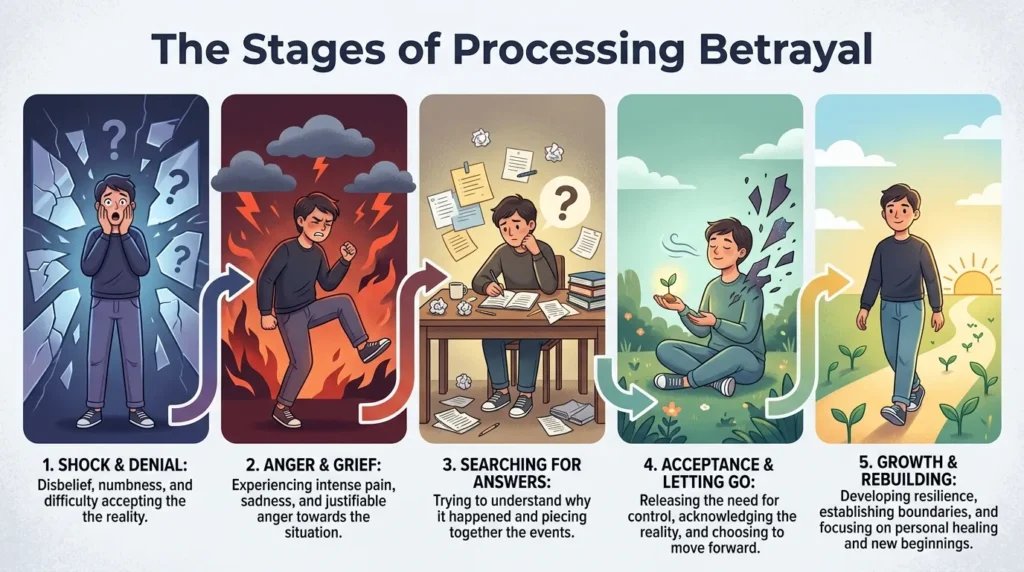
Healing from betrayal rarely moves in a straight line, but many people pass through recognizable phases as they process what happened. Thinking of these as stages — rather than a strict sequence — can help make sense of feelings that otherwise seem erratic or contradictory.
Denial and disbelief often come first. Even with clear evidence, the mind resists accepting that someone trusted could do this. This isn’t weakness; it’s a protective mechanism, giving you time to absorb something too big to process all at once.
Anger and blame tend to follow, and can be directed outward at the person who betrayed you, or inward at yourself for “missing the signs.” Anger, while uncomfortable, is often a necessary and even healthy part of the process — it signals that a boundary was crossed and can fuel the motivation to protect yourself going forward.
Bargaining shows up as the “what if” spiral — what if I had been more attentive, what if I’d asked the right question sooner, what if I’d done something differently. This stage is the mind’s attempt to find a version of events where the outcome could have been controlled, even though betrayal is ultimately the choice of the person who committed it, not a failure on your part.
Depression or grief often sits underneath the anger once the initial adrenaline fades. This is where the real loss becomes clear — not just of trust, but sometimes of the relationship, the future you imagined, or your prior sense of certainty about the world.
Acceptance and integration is the eventual stage where the betrayal becomes part of your story without controlling it. This doesn’t mean approval or forgetting — it means the event no longer has the same grip on your daily emotional state.
It’s worth repeating: these stages rarely move in tidy order. You might feel acceptance one day and find yourself back in anger the next. That back-and-forth is normal, not a sign you’re doing it wrong.
Rebuilding Trust in Yourself First
Before trust can be rebuilt with anyone else, it often needs to be rebuilt with yourself — and this is a step many people skip or rush past, even though it’s foundational to everything that follows. Betrayal has a way of making people doubt their own perception. Thoughts like “how did I not see this?” or “I should have known better” are common, and they chip away at something more fundamental than trust in another person: trust in your own judgment.
This self-doubt is worth naming directly, because it’s not actually evidence that your judgment failed. People who are skilled at deception — whether consciously manipulative or simply avoidant about their own actions — are often skilled precisely because they’re good at not getting caught. Missing signs of a well-hidden betrayal isn’t a character flaw or a failure of intuition; it’s a natural result of trusting someone who worked to keep things hidden.
Reconnecting with your own judgment is a gradual process, and it tends to happen through small, repeated experiences rather than one moment of realization. Journaling can help here — not just to process emotions, but to track moments where your instincts turned out to be right, even in small everyday situations unrelated to the betrayal. Over time, this rebuilds evidence that your internal compass still works.
It also helps to separate self-blame from self-responsibility. Self-blame says, “This happened because I failed somehow.” Self-responsibility says, “I can’t control what someone else chose to do, but I can decide how I respond, what I need going forward, and what boundaries I want to set.” The second framing keeps agency in your hands without placing guilt where it doesn’t belong.
This isn’t about achieving total certainty in your judgment again — some healthy caution is a reasonable outcome of what you went through. The goal is closer to this: trusting yourself to notice red flags, trusting yourself to act on what you notice, and trusting yourself to handle whatever comes next, even if it’s hard.
Should You Rebuild Trust With This Person? (Assessment)
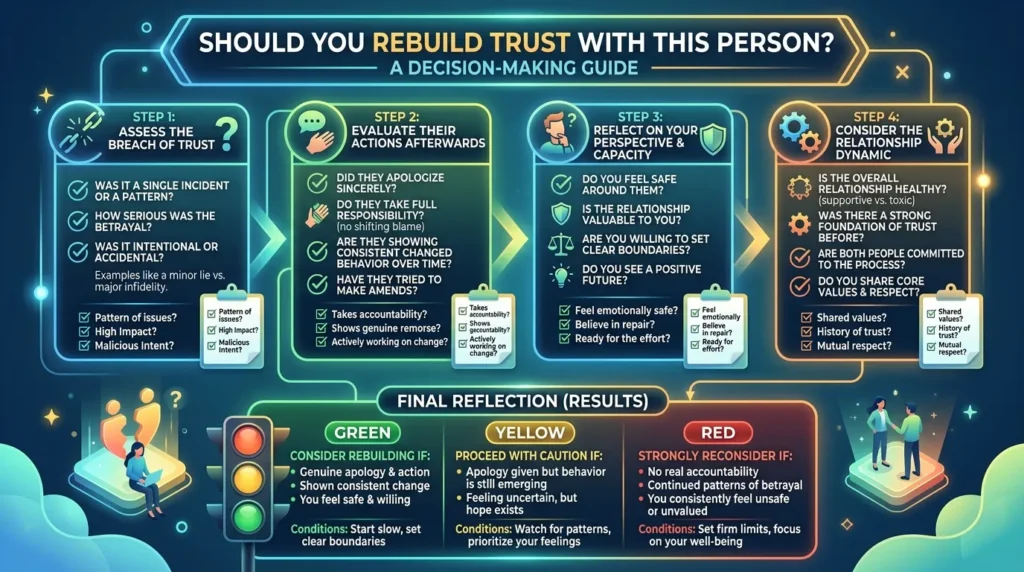
Not every betrayal should lead to rebuilding trust with the person who caused it — and giving yourself honest permission to consider that is an important part of the process. Before deciding how to move forward, it helps to assess the situation clearly, separate from the emotions swirling around it.
A useful starting point is accountability. Has the person acknowledged what they did, specifically and without minimizing it? There’s a real difference between “I’m sorry you’re hurt” and “I’m sorry I did this, and I understand why it hurt you.” The first deflects; the second takes ownership. Genuine accountability doesn’t come with conditions, excuses, or subtle attempts to make you responsible for their choice.
Pattern versus one-time event matters too. A single lapse, met with real remorse and changed behavior, is a different situation than a repeated pattern of the same betrayal happening again and again with new promises each time. If this is the fifth “last time,” that history is data worth taking seriously.
It’s also worth distinguishing genuine change from performative apology. Genuine change tends to show up as consistent action over time — showing up differently in the situations that matter, being transparent without being asked, respecting new boundaries without resentment. Performative apology often looks good in the moment but doesn’t hold up under time or pressure; it may include grand gestures, but little follow-through in the ordinary, unglamorous moments where trust actually gets rebuilt.
There are also clear red flags suggesting trust shouldn’t be rebuilt: continued dishonesty even in small things, gaslighting (denying your reality or memory of events), refusal to take responsibility, or a pattern of betrayal across multiple relationships that suggests this is a character trait rather than a mistake.
Finally, it helps to separate three things people often collapse into one: forgiveness, reconciliation, and reconnection. Forgiveness is something you can do for your own peace, regardless of what the other person does next. Reconciliation means restoring some form of relationship. Reconnection means returning to how things were before. You can choose any one of these without the others — forgiving someone doesn’t obligate you to reconcile, and reconciling doesn’t mean going back to exactly what existed before the betrayal.
The Practical Process of Rebuilding Trust (When You Choose To)
If you’ve decided that rebuilding trust is worth attempting — with a partner, friend, family member, or colleague — the process itself tends to follow a few consistent principles, regardless of the relationship type.
Radical transparency is usually the starting point. This means the person who broke trust needs to be willing to over-communicate for a while — sharing information proactively rather than waiting to be asked, answering questions honestly even when the answers are uncomfortable, and generally accepting that privacy norms may need to shift temporarily while trust is being rebuilt. This isn’t meant to be permanent surveillance; it’s a bridge that allows verification to replace blind faith for a period of time.
Trust also needs to be rebuilt in small, verifiable increments rather than all at once. Expecting full trust to return immediately — or expecting yourself to “just get over it” — usually backfires. Instead, look for a series of small moments where the person follows through on what they said they’d do. Each kept commitment adds a small deposit back into the relationship; each broken one resets progress. This incremental approach also protects you from the vulnerability of extending total trust again before it’s warranted.
Time plays a real role here, and it can’t be rushed or forced by willpower alone. Healing and trust-rebuilding happen on their own timeline, which is often longer than either person wants. Pressuring yourself — or being pressured by the other person — to “be over it” on a specific schedule tends to suppress the process rather than complete it.
Clear boundaries and expectations going forward are essential. This might mean explicit agreements about behavior, check-ins, or access to information that wouldn’t have been necessary before. Boundaries aren’t punishment; they’re the structure that makes it safe to extend trust incrementally.
Throughout this, actions matter more than words. Promises and apologies are a starting point, but what actually rebuilds trust is the accumulation of consistent behavior over time — especially in situations where the person could have reverted to old patterns and chose not to.
Finally, expect triggers and setbacks along the way. A song, a date, an offhand comment can bring the original pain rushing back, even after real progress has been made. This doesn’t mean the rebuilding has failed — it means healing isn’t linear, and a bad day doesn’t erase the progress that came before it.
Special Contexts
While the core principles of rebuilding trust stay consistent, the specifics look different depending on the relationship in question.
Romantic relationships after infidelity
This is often the most emotionally charged context, because infidelity tends to threaten not just trust but identity — many people report feeling like they no longer know who their partner is, or who they themselves are in the relationship. Rebuilding here usually requires both individual processing (often for both partners) and joint work, since the betrayed partner needs space to grieve while the relationship itself needs new agreements to move forward. Couples counseling, specifically with a therapist experienced in infidelity, tends to be more effective than trying to navigate this without support, largely because conversations can easily spiral into blame or defensiveness without a neutral facilitator.
Friendships
Betrayal between friends — gossip, disloyalty, abandonment during a hard time — can be surprisingly disorienting because friendships often lack the built-in structures (like couples therapy or family mediation) that other relationships have for repair. Rebuilding trust here often depends heavily on a direct conversation naming what happened, since friendships can otherwise drift into unspoken resentment rather than resolution.
Family relationships
Betrayal rooted in childhood or long family history — an emotionally absent parent, favoritism, a sibling’s long-term dishonesty — carries added complexity because these patterns are often woven into your earliest sense of what relationships are supposed to look like. Rebuilding trust with family sometimes means accepting a different, more limited relationship than you’d hoped for, rather than a full return to closeness, and that can be its own form of healthy resolution.
Workplace relationships
Betrayal from a colleague or boss — being thrown under the bus, having credit for work taken, broken promises about roles or pay — requires a more boundaried approach, since the relationship exists within a professional structure rather than a personal one. Here, rebuilding trust often means relying more on documented agreements and formal processes (written commitments, HR involvement when appropriate) rather than purely relational repair, since the stakes and structure of the relationship are different.
When Professional Support Helps
While many people navigate betrayal with the support of friends, family, or their own reflection, there are situations where professional support meaningfully changes the outcome — and recognizing when to seek it is itself a valuable skill.
Individual therapy is often useful regardless of what happens with the relationship in question. A therapist can help process the trauma of betrayal itself, work through the self-doubt and self-blame that often follow, and support the rebuilding of self-trust discussed earlier. This kind of support isn’t contingent on reconciling with the person who betrayed you — it’s about your own healing, independent of what they do next.
Couples or relationship counseling becomes relevant when both people are choosing to rebuild together, particularly after infidelity or a significant breach of trust. A skilled therapist can help structure conversations that might otherwise collapse into blame or defensiveness, and can help both partners navigate the uneven timeline of healing — since the betrayed partner and the partner who betrayed them are often moving through very different emotional processes at different speeds.
Certain therapeutic approaches are particularly suited to betrayal trauma. EMDR (Eye Movement Desensitization and Reprocessing) is often used to help process traumatic memories that feel “stuck,” particularly when intrusive thoughts or flashbacks are present. Attachment-based therapy can help address how betrayal interacts with earlier attachment patterns, especially when the current situation echoes earlier relational wounds. A therapist can help determine which approach fits your specific situation.
Professional support is also valuable simply for assessing whether a relationship is salvageable at all. It’s difficult to evaluate this clearly from inside the emotional intensity of the situation, and an outside, trained perspective can offer clarity that’s hard to reach alone — without pushing you toward either reconciliation or separation, but helping you see the situation as it actually is.
There’s no fixed threshold for “bad enough to need therapy.” If the betrayal is significantly affecting your daily functioning, relationships, or sense of self, that’s reason enough to consider support — healing doesn’t have to be a solo project.
Trusting Again Without Losing Yourself
One of the quieter challenges of rebuilding trust is doing so without swinging to an extreme in either direction. Betrayal can push people toward two very different, equally limiting responses: becoming closed off and guarded with everyone, or overcorrecting into a kind of anxious over-trust, desperate to prove the past won’t repeat itself.
Becoming closed off often feels protective in the short term — if you don’t trust anyone fully, no one can betray you again. But this response, left unchecked, tends to cost more than it saves. It can quietly erode the depth of every relationship going forward, including ones with people who have done nothing to deserve that guardedness. Isolation might feel safe, but it isn’t the same as healing.
The opposite extreme — over-trusting, or trying too hard to prove you’ve “moved past it” — carries its own risk. Some people, uncomfortable with the vigilance betrayal has created, push themselves to trust again before it’s genuinely warranted, ignoring valid red flags in an effort to seem healed or to avoid feeling paranoid. This isn’t real trust; it’s often anxiety wearing the costume of trust.
The healthier middle ground is what might be called healthy vigilance — staying attentive to real information without treating every inconsistency as evidence of impending betrayal. This is different from hypervigilance, which scans constantly for threat regardless of actual signals. Healthy vigilance says: I notice things, I trust my judgment about what I notice, and I don’t need to catastrophize every small thing to stay safe.
It also helps to hold trust as an ongoing practice rather than a single decision made once and then finished. Trust isn’t a light switch you flip back on; it’s closer to a muscle you rebuild through repeated use, small risk, and observed outcomes over time.
Throughout all of this, maintaining your own identity and boundaries matters as much as rebuilding trust itself. Who you are, what you need, and what you won’t accept shouldn’t dissolve in the effort to repair a relationship — a version of trust that requires losing yourself isn’t one worth rebuilding toward.
Signs You’re Healing
Healing after betrayal is rarely a single moment of realization — it tends to show up gradually, in small shifts that are easy to miss unless you’re looking for them. Knowing what these signs look like can offer reassurance during a process that often feels endless from the inside.
One of the clearest markers is a decrease in intrusive thoughts about the betrayal. Early on, the mind often replays events on a loop, searching for clarity or closure. As healing progresses, these thoughts don’t necessarily disappear completely, but they lose their grip — they occur less often, feel less urgent, and no longer hijack your entire day when they do surface.
Another sign is the growing ability to be present rather than constantly scanning for threat. In the aftermath of betrayal, it’s common to stay on alert — watching for signs of dishonesty, monitoring for patterns, bracing for another blow. Healing shows up as moments where that vigilance quiets down, where you can be in a conversation, a relationship, or simply your own thoughts without the background hum of threat detection running underneath.
A renewed capacity for vulnerability is a particularly meaningful sign, because vulnerability is often the first casualty of betrayal. This doesn’t mean vulnerability returns exactly as it was before — it may look more intentional, more selective, or more boundaried. But its presence at all, even in small doses, signals that trust is becoming possible again, both in yourself and in others.
Finally, many people describe simply feeling like themselves again — though often a changed version of themselves. This isn’t about returning to who you were before the betrayal, as if it never happened. It’s about integrating the experience into your story without it defining or controlling your present. You may carry new wisdom, new boundaries, or new caution, but the weight of the betrayal no longer sits at the center of how you move through the world.
These signs won’t all arrive at once, and they may come and go before settling. That unevenness doesn’t mean healing has stalled — it means it’s happening the way healing actually happens.
Conclusion
Trust, once broken, rarely comes back exactly the way it was — and that’s not necessarily a loss. What gets rebuilt is often something different: more intentional, more informed, shaped by everything you learned about yourself and the relationship along the way. That’s not a lesser version of trust. In many ways, it’s a more resilient one.
There’s no universal timeline for this process, and no single “right” way to move through it. Some people rebuild trust with the person who betrayed them; others rebuild only with themselves, and that’s a complete outcome too — not a failure to reach some other endpoint. What matters isn’t how closely your path matches anyone else’s, but whether it’s honest, and whether it’s yours.
If you take one thing from this article, let it be this: healing from betrayal isn’t about erasing what happened or pretending it didn’t hurt. It’s about slowly, carefully, proving to yourself that you can trust your own judgment again, that you can extend openness without abandoning your boundaries, and that whatever comes next, you’ll be able to handle it. Trust can be rebuilt. Just let it happen at the pace it actually needs.