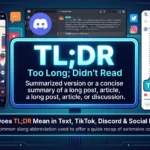
Have you ever seen TDLR in a text, comment, meme, or social media post and wondered what it means? If so, you’re not alone. TDLR meaning slang is closely connected to the much more common internet abbreviation TLDR, but the extra letter can change the tone and, in some contexts, the meaning.
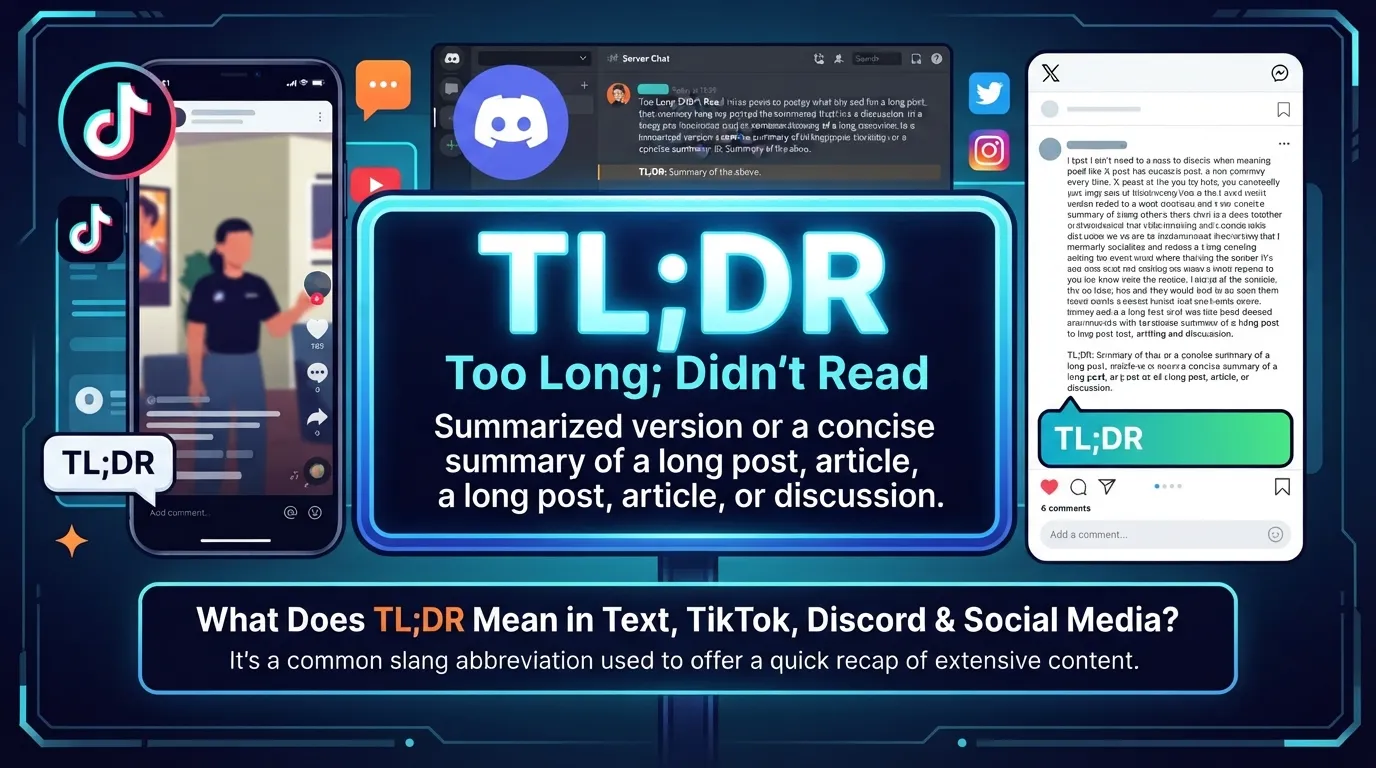
In most online conversations, TDLR is used as a variation of TLDR, which traditionally means “too long; didn’t read.” Depending on context, people may also use it humorously to mean “too damn long; didn’t read.” It is usually a quick way to introduce a short summary after a long explanation or to joke about not wanting to read a lengthy message.
You’ll commonly encounter TDLR in text messages, TikTok comments, Instagram captions, Reddit posts, Discord chats, gaming communities, memes, and casual online conversations. Understanding the context is important because internet slang is often flexible, and people sometimes create their own variations for humor.
This guide explains what TDLR means, where it came from, how it differs from TLDR, what it means on different platforms, how to use it naturally, and what tone it can communicate. By the end, you’ll know exactly how to interpret and use TDLR slang without confusing it with similar internet abbreviations.
What Does TDLR Mean in Slang?
TDLR usually means “too long; didn’t read,” or it can be a humorous variation of “too damn long; didn’t read.”
The abbreviation is generally used online when someone wants to summarize a long piece of information or jokingly point out that something was too lengthy to read.
For example:
TDLR: We missed the deadline, so the meeting has been moved to Friday.
Here, TDLR introduces the main point without requiring the reader to go through a long explanation.
The more standard abbreviation is TLDR, meaning “too long; didn’t read.” TDLR is often treated as a playful variation because the letters don’t perfectly follow the original phrase.
Quick meaning
TDLR = Too long; didn’t read / Too damn long; didn’t read
The exact expansion depends on the person and context.
It can function as:
- A short summary
- A humorous response to a long message
- A comment about lengthy content
- A quick way to highlight the main point
- A playful variation of TLDR
In most cases, the intended idea is simple: “Here’s the short version.”
TDLR Meaning at a Glance
| Term | Meaning | Common Context | Tone |
|---|---|---|---|
| TDLR | Too long; didn’t read / too damn long; didn’t read | Social media, chats, forums | Casual, humorous |
| TLDR | Too long; didn’t read | Internet, articles, Reddit, forums | Casual, neutral |
| TL;DR | Too long; didn’t read | Summaries and online writing | Casual, widely recognized |
| Summary | Short version of something longer | Formal and casual writing | Neutral |
| In short | Brief explanation | Writing and conversation | Neutral |
| Bottom line | Most important point | Work and everyday speech | Direct |
What Does TDLR Stand For?
The most common interpretation of TDLR is related to TLDR, which stands for “too long; didn’t read.”
The phrase developed as internet users needed a quick way to acknowledge lengthy posts without reading every word.
The variation “too damn long; didn’t read” adds a stronger and more humorous tone. In this version, damn emphasizes how excessively long something feels.
For example:
TDLR: The project is delayed because the client changed the requirements.
The writer may have originally explained the entire situation in several paragraphs but then provides the essential information after TDLR.
Why does TDLR have a D before L?
That’s one reason the abbreviation can look confusing.
The standard form TLDR follows the initial letters of:
Too Long Didn’t Read
TDLR can be interpreted as:
Too Damn Long Didn’t Read
The exact wording isn’t always consistent. Some people simply type TDLR accidentally or use it intentionally as a variation of TLDR.
Because internet slang changes quickly, abbreviations don’t always follow strict grammatical rules.
TDLR vs TLDR: What’s the Difference?
The biggest difference between TDLR and TLDR is the extra D.
TLDR is the established and much more widely recognized abbreviation.
TDLR is generally a variation, typo, or humorous adaptation of TLDR.
| Feature | TDLR | TLDR |
|---|---|---|
| Common meaning | Too long; didn’t read | Too long; didn’t read |
| Alternate expansion | Too damn long; didn’t read | Usually no extra word |
| Popularity | Less common | Much more common |
| Tone | Often playful | Neutral or casual |
| Main purpose | Summary or joke | Summary or comment |
| Internet usage | Informal | Very widespread |
If someone writes TLDR, there’s usually little ambiguity.
If someone writes TDLR, the intended meaning normally becomes clear from the surrounding sentence.
Example
TLDR: The movie was entertaining but too long.
TDLR: That movie was way too damn long.
The second example has a more exaggerated, humorous feeling.
TDLR Meaning in Text Messages
In text messaging, TDLR usually means that a message or explanation was too lengthy.
Someone might send a long story and then add:
TDLR: I didn’t get the job.
This gives the recipient the important information immediately.
It can also be used jokingly:
TDLR: My weekend was chaos.
The sender may have written several paragraphs describing everything that happened.
Texting examples
Friend: I spent three hours explaining what happened at work…
You: TDLR?
This can mean:
“Give me the short version.”
Another example:
Friend: TDLR: She canceled, we ordered pizza, and watched a movie instead.
In this situation, TDLR acts like a casual summary marker.
TDLR Meaning on TikTok
On TikTok, TDLR can appear in comments, captions, or responses to long explanations.
TikTok is known for short-form content, but creators sometimes post lengthy captions, stories, explanations, or comment threads.
Someone might write:
TDLR: Don’t trust the website. It isn’t legit.
The abbreviation allows the commenter to give the main takeaway quickly.
However, TLDR is considerably more recognizable than TDLR on social media. If you’re trying to make your meaning immediately clear to a broad audience, TLDR is generally easier to understand.
TikTok example
A creator writes a long story about how they accidentally bought the wrong product.
A commenter might say:
TDLR: Check the size before ordering 😭
Here, the abbreviation adds a humorous, conversational tone.
TDLR Meaning on Instagram
On Instagram, TDLR may appear in captions, comments, or direct messages.
For example:
TDLR: We moved the event to Saturday.
It can be especially useful when someone posts a long explanation but wants to provide a quick takeaway.
Instagram users may also use it jokingly:
TDLR: I spent all my money on coffee.
The phrase doesn’t necessarily mean the writer literally refused to read something. It can simply introduce a humorous summary.
TDLR Meaning on Snapchat
On Snapchat, conversations tend to be quick and informal, so abbreviations are common.
If someone sends a long message, another person might respond:
TDLR?
In this context, they are essentially asking:
“What’s the short version?”
A person could also send:
TDLR: I’m running late.
This tells the recipient the important part without a long explanation.
Because Snapchat conversations are usually casual, TDLR can sound playful rather than formal.
TDLR Meaning on Discord
Discord communities frequently use abbreviations, especially in gaming, fandom, technology, and hobby-related servers.
A long Discord announcement might end with:
TDLR: The tournament starts at 8 PM instead of 7 PM.
The abbreviation helps users quickly find the key information.
Someone may also ask:
TDLR?
when another person posts a huge explanation.
In this case, they’re requesting a summary.
Discord example
User 1: writes six paragraphs explaining why the server rules are changing.
User 2: TDLR?
User 1: No political arguments in general chat, and moderators will enforce the rule more strictly.
That’s a natural use of TDLR in casual online communication.
TDLR Meaning on Reddit
Reddit is one of the places where TLDR is particularly common because posts and comment threads can become extremely long.
Users often provide a detailed explanation and then add a short summary.
For example:
TDLR: The update fixed the bug but created two new problems.
However, TLDR is the more conventional form on Reddit.
You may see TDLR because someone:
- Uses it intentionally as a joke
- Means “too damn long”
- Makes a typing variation
- Uses a community-specific style
- Simply prefers the spelling
Context usually makes the intention obvious.
TDLR Meaning in Gaming
Gaming communities often use TDLR when discussing:
- Patch notes
- Game updates
- Strategy guides
- Character changes
- Tournament announcements
- Game reviews
- Long Discord discussions
For example:
TDLR: The new patch nerfed the character’s damage but improved mobility.
Instead of reading a long patch-note discussion, a player can quickly understand the main change.
Another example:
TDLR: Don’t buy the upgrade unless you’re already at level 50.
Here, TDLR works as a shortcut to the most useful piece of advice.
TDLR Meaning in Dating and Relationships
In dating conversations, TDLR can be used humorously when someone tells a long story about a date or relationship situation.
For example:
TDLR: He talked about his ex for the entire dinner.
Or:
TDLR: She canceled twice, so I’m moving on.
It can also appear in dating-app conversations when someone asks for the short version of a complicated story.
The tone is usually casual, humorous, and conversational.
It doesn’t necessarily indicate frustration. Much depends on the surrounding words and emojis.
TDLR Meaning in Workplace Conversations
You should be more careful with TDLR at work.
Although coworkers may use internet slang in casual chats, TDLR can sound too informal in professional communication.
For example, sending this to a manager:
TDLR: We’re screwed.
would obviously be inappropriate in most professional environments.
A better workplace alternative would be:
Summary: The project deadline has been moved to Friday.
Or:
Key takeaway: We need final approval before Thursday.
When TDLR may be acceptable at work
It can sometimes work in:
- Casual team chats
- Internal Slack conversations
- Informal company communities
- Friendly coworker messages
But for formal emails, reports, presentations, and client communication, use Summary, Key Takeaway, or In Brief instead.
Is TDLR Rude?
TDLR is not automatically rude. Its tone depends heavily on context.
It can be:
- Funny
- Helpful
- Casual
- Sarcastic
- Impatient
- Dismissive
For example:
TDLR: We need to reschedule.
This is neutral.
But:
TDLR because I’m not reading all that nonsense.
can sound dismissive or insulting.
Tone matters
If you’re using TDLR to summarize your own long explanation, it usually feels harmless.
If you’re responding to another person’s long message with only:
TDLR
it may imply that you don’t want to spend time reading what they wrote.
That’s why context and relationship matter.
Is TDLR a Negative Expression?
Not necessarily.
The expression can have either a positive, neutral, or negative tone.
Neutral
TDLR: The meeting starts at 10.
Helpful
TDLR: We approved the new plan and will start Monday.
Humorous
TDLR: I made terrible financial decisions this weekend 😂
Dismissive
TDLR, I’m not reading five pages of this.
The abbreviation itself isn’t inherently negative. The wording around it determines the attitude.
How to Use TDLR Correctly
If you want to use TDLR naturally, the easiest approach is to place it before a short summary.
Basic format
TDLR: Main point.
For example:
TDLR: The event has been canceled because of the weather.
Or:
TDLR: Don’t update the app yet.
You can also use it as a question:
TDLR?
This means:
“Can you give me the short version?”
Another common structure
TDLR: [one-sentence summary]
This is particularly useful after:
- A long message
- A detailed explanation
- A Reddit post
- A Discord discussion
- A social media caption
- A personal story
Real-Life TDLR Examples
Here are realistic examples showing how people might use the abbreviation.
Example 1: Friends
TDLR: I missed the bus, ordered an Uber, and still arrived late.
Example 2: Social media
TDLR: The restaurant looked great online but wasn’t worth the price.
Example 3: Gaming
TDLR: New patch makes the character faster but weaker.
Example 4: Reddit
TDLR: The problem isn’t your internet. It’s the router.
Example 5: Discord
TDLR: The tournament has been moved to Sunday.
Example 6: Dating
TDLR: Great first date, terrible second date.
Example 7: Texting
TDLR: Mom said we can go tomorrow instead.
Example 8: Workplace chat
TDLR: The client approved the design, but they want one more revision.
TDLR as a Question
One of the most useful forms is simply:
TDLR?
When someone sends a very long message, you can use TDLR as a quick request for the main point.
It is similar to saying:
- What’s the short version?
- What’s the summary?
- What’s the takeaway?
- What happened?
- Give me the quick version.
However, this can sound blunt if you’re speaking to someone who expects you to read their message carefully.
A softer alternative is:
Can you give me the short version?
Or:
What’s the main takeaway?
TDLR vs TL;DR
You may see TLDR, TL;DR, and TDLR and wonder whether they’re all the same.
They’re closely related, but they aren’t equally common.
TL;DR
This is a traditional form of the abbreviation.
The semicolon separates the two parts:
Too Long; Didn’t Read
TLDR
This removes the punctuation and is extremely common online.
TDLR
This is generally a variation of TLDR and may represent:
Too Damn Long; Didn’t Read
It can also simply be an informal variation or typo.
For everyday online communication, the intended meaning is usually understood from context.
TDLR vs Summary
A summary and TDLR can serve the same basic purpose, but their tone is different.
| Expression | Tone | Best Use |
|---|---|---|
| TDLR | Very casual | Texts, memes, chats |
| TLDR | Casual | Online posts and articles |
| Summary | Neutral | Work and general writing |
| In short | Neutral | Essays and explanations |
| Bottom line | Direct | Business and conversation |
| Key takeaway | Professional | Work and presentations |
If you’re writing for a professional audience, summary or key takeaway is usually clearer.
Common Misconceptions About TDLR
TDLR always means something different from TLDR
Not necessarily.
In many cases, TDLR is simply a variation of TLDR.
TDLR always means “too damn long”
Not necessarily.
Some people use it that way, but others use TDLR while intending the same basic meaning as “too long; didn’t read.”
TDLR is always rude
No.
It can be completely neutral or helpful when used to introduce a summary.
TDLR is more popular than TLDR
No.
TLDR is the much more established abbreviation.
You should use TDLR in formal writing
Generally, no.
It’s primarily an informal internet expression. Formal alternatives such as Summary, In Brief, or Key Takeaway are usually more appropriate.
Why Internet Slang Like TDLR Exists
Internet communication encourages speed and efficiency.
People read:
- Text messages
- Comments
- Forums
- News articles
- Social media captions
- Group chats
- Emails
- Discord messages
When information becomes lengthy, users naturally look for shortcuts.
Abbreviations such as LOL, BRB, IMO, IDK, FYI, TLDR, and TDLR help people communicate quickly.
TDLR fits this larger culture of digital shorthand.
Instead of writing:
“Here is a brief summary of everything I just explained.”
someone can simply write:
TDLR:
The abbreviation saves time and immediately signals that the next sentence contains the main idea.
TDLR and Modern Internet Culture
Modern online communication is highly context-dependent.
The same abbreviation can be:
- Serious in one conversation
- Funny in another
- Sarcastic somewhere else
- Completely meaningless to someone unfamiliar with internet slang
That’s especially true on platforms where users develop their own language.
TikTok communities, gaming servers, Reddit communities, fandoms, and group chats often create or modify abbreviations.
As a result, slang should always be interpreted within its surrounding context.
When You Should Use TDLR
TDLR works best when communication is casual.
Use it when:
- Summarizing a long message
- Making a joke about a lengthy story
- Giving readers the main point
- Asking for a quick explanation
- Chatting with friends
- Commenting on social media
- Talking in gaming communities
- Communicating casually on Discord or Reddit
Example
I’ve explained everything above, but TDLR: we’re leaving at 7.
This is perfectly natural in a casual conversation.
When You Should Avoid TDLR
Avoid it when writing:
- Formal business emails
- Academic papers
- Legal documents
- Official reports
- Client proposals
- Professional announcements
- Formal applications
Instead, use:
- Summary
- Executive Summary
- Key Takeaway
- In Brief
- Bottom Line
- Conclusion
These expressions communicate the same basic idea without relying on internet slang.
Related Slang and Internet Abbreviations
Understanding TDLR becomes easier when you know related expressions.
TLDR
Too long; didn’t read.
This is the closest and most common equivalent.
TL;DR
Another standard form of TLDR, using punctuation.
IMO
In my opinion.
Used when someone is giving a personal view.
IMHO
In my humble opinion.
Often used humorously or casually.
IDK
I don’t know.
Common in texts and online conversations.
FYI
For your information.
Used to provide information or context.
BTW
By the way.
Used to introduce an additional thought.
TBH
To be honest.
Used before a candid statement.
IRL
In real life.
Often contrasts online experiences with offline life.
Frequently Asked Questions
What does TDLR mean in texting?
TDLR usually means “too long; didn’t read.” It can also be interpreted humorously as “too damn long; didn’t read.” In texting, it commonly introduces a short summary or asks someone to provide the short version of a long message.
Is TDLR the same as TLDR?
Usually, yes in practical usage. TLDR is the standard and much more common abbreviation for “too long; didn’t read.” TDLR is generally a variation that may emphasize “too damn long” or simply function as another informal form of TLDR.
What does TDLR mean on TikTok?
On TikTok, TDLR generally introduces a short summary of a longer explanation, story, or discussion. It may also be used humorously in comments. However, TLDR is more widely recognized.
What does TDLR mean on Reddit?
On Reddit, TDLR is usually understood as a variation of TLDR, meaning “too long; didn’t read.” It can introduce the main point of a long post or comment. Reddit users more commonly use TLDR or TL;DR.
Is TDLR rude?
TDLR isn’t inherently rude. It depends on how you use it. Adding TDLR to your own long explanation is generally harmless. Replying to someone’s thoughtful message with only “TDLR” can sometimes sound dismissive because it may suggest that you don’t want to read their explanation.
What does TDLR stand for?
TDLR can stand for “too long; didn’t read” as a variation of TLDR, or “too damn long; didn’t read” when the extra D is intentionally used for emphasis. The intended meaning depends on context.
Can TDLR mean “summary”?
Yes. In practical online communication, a TDLR section often functions exactly like a summary. It gives readers the most important information without requiring them to read everything above it.
Should I use TDLR in professional emails?
It’s usually better to avoid TDLR in formal professional communication. Use Summary, Key Takeaway, or In Brief instead. TDLR can work in casual workplace chats if the environment is informal and coworkers commonly use internet slang.
Is TLDR more common than TDLR?
Yes. TLDR is significantly more established and recognizable than TDLR. If you want the widest possible audience to immediately understand your abbreviation, TLDR is generally the safer choice.
Does TDLR have a negative meaning?
Not by itself. TDLR can be neutral, helpful, funny, or dismissive depending on the context. The surrounding words and relationship between the people communicating usually determine the tone.
Final Takeaway
The simplest explanation of tdlr meaning slang is that TDLR is generally an informal variation of TLDR, meaning “too long; didn’t read,” and sometimes humorously “too damn long; didn’t read.”
Its main purpose is to provide or request a short version of a longer explanation.
You’ll most likely see TDLR in casual digital spaces such as text messages, TikTok, Instagram, Snapchat, Discord, Reddit, gaming communities, memes, and group chats. It can be used as a summary marker or as a quick request for the main point.
The important thing to remember is that TLDR is the more standard and widely recognized form, while TDLR is more informal and context-dependent. TDLR can also carry a playful or slightly sarcastic tone when the extra “D” is intended to mean “damn.”
If you’re chatting with friends, TDLR can be perfectly natural. If you’re writing a professional email, report, or formal document, Summary, Key Takeaway, or In Brief will usually be a better choice.
So, the next time you see TDLR online, don’t overthink it. In most situations, it’s simply telling you: here’s the short version.