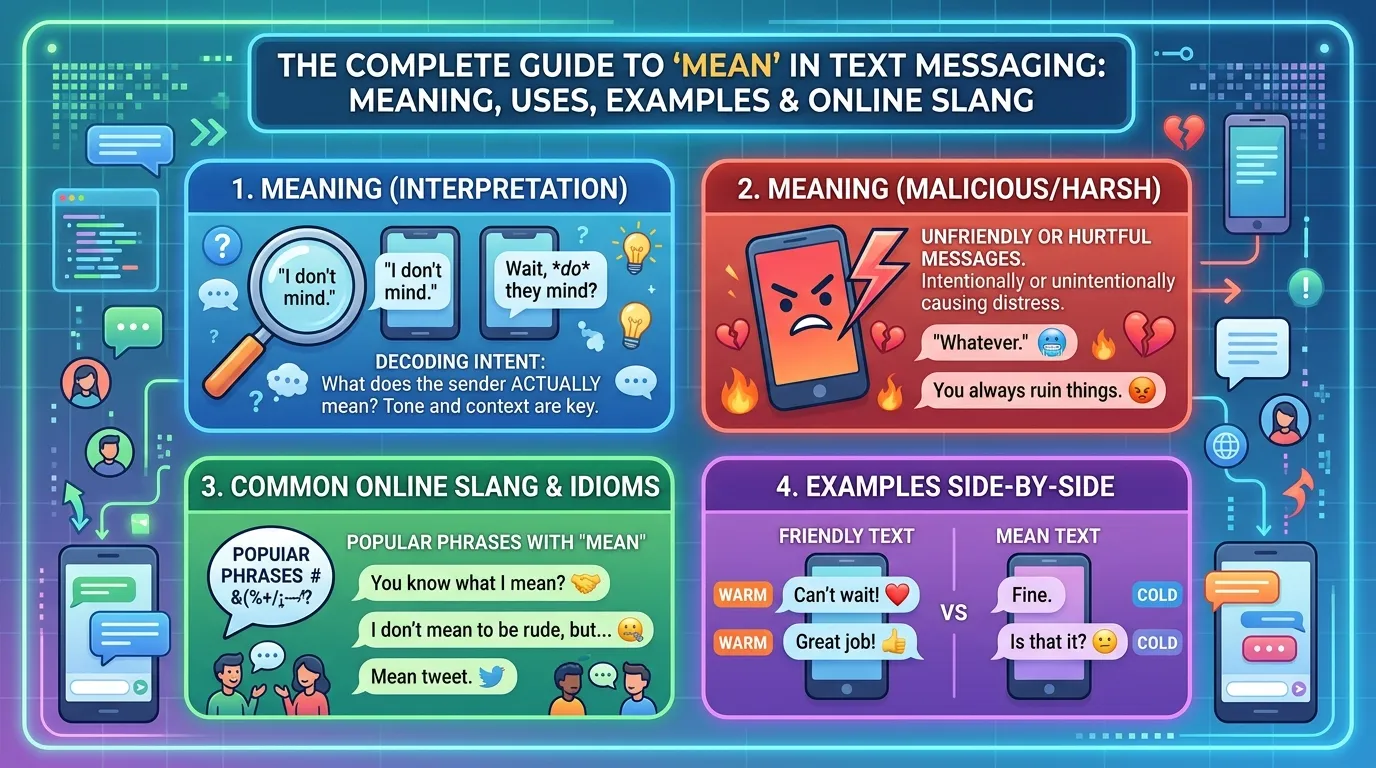
Have you ever received a message that simply said “mean” or seen someone ask, “What do you mean?” in a text conversation? The word mean is one of the most common words in the English language, yet it can have several completely different meanings depending on the context. Whether you’re texting friends, chatting on TikTok, scrolling through Instagram, messaging on Snapchat, discussing topics on Reddit, gaming on Discord, or communicating at work, understanding what mean in text really mean can help you avoid confusion.
In modern digital communication, context is everything. The same word can describe someone as unkind, explain the meaning of something, represent an average in mathematics, or simply ask for clarification in a conversation. Because texting is often short and informal, readers can easily misunderstand what someone intends.
In this complete guide, you’ll learn exactly what “mean” means in text, how it’s used across different platforms, where the word originated, its different meanings, examples of real conversations, common mistakes, comparisons with similar expressions, and much more. By the end of this article, you’ll confidently recognize every major way the word mean is used online and in everyday communication.
What Does Mean in Text Really Mean?
Quick Answer:
The word mean in text usually refers to one of these meanings:
| Meaning | Description | Example |
|---|---|---|
| To intend or signify | Explaining what something represents | “What do you mean?” |
| Unkind or rude | Describing someone’s behavior | “He was mean to me.” |
| Serious or determined | Expressing intention | “I mean business.” |
| Average (Math) | Mathematical average | “The mean score is 92.” |
The intended meaning depends entirely on the conversation.
What Does “Mean” Mean in Text Messages?
In texting, mean most commonly refers to the intended meaning behind someone’s words.
Examples:
Person A:
What did you mean by that?
Person B:
I meant it as a joke.
Another example:
Sarah:
You’re different lately.
Alex:
What do you mean?
Here, Alex is asking Sarah to explain her statement.
The Most Common Meanings of Mean
Mean = To Intend
This is the most common definition.
Examples:
- I didn’t mean to upset you.
- That’s not what I meant.
- What exactly do you mean?
This meaning is used every day in:
- Text messages
- Emails
- Face-to-face conversations
- Social media comments
Mean = Rude or Unkind
Another popular meaning describes someone’s personality.
Example:
- She’s really mean.
- Stop being mean.
- That comment was mean.
Here, mean describes unpleasant behavior.
Mean = Significant
Sometimes mean refers to importance.
Example:
- You mean a lot to me.
- Family means everything.
- That gift means so much.
In these sentences, mean expresses emotional value.
Mean = Mathematical Average
Outside texting, mean also refers to the average of numbers.
Example:
Numbers:
10, 20, 30
Mean:
20
Although this meaning rarely appears in casual chats, students often use it.
Origin and History of the Word Mean
The word mean comes from the Old English word mænan, meaning:
- to intend
- to signify
- to have in mind
Over centuries, English developed several additional meanings.
Today, the word can function as:
- Verb
- Adjective
- Noun
Few English words have evolved into as many different uses.
Why Context Matters
Context completely changes the meaning.
Consider these examples.
Example 1
You’re mean.
Meaning:
You’re rude.
Example 2
What do you mean?
Meaning:
Please explain.
Example 3
I didn’t mean it.
Meaning:
I didn’t intend it.
Example 4
The mean age is 28.
Meaning:
Average age.
How Mean Is Used on Social Media
Mean on TikTok
TikTok creators often use:
- What do you mean?
- You mean…
- I mean…
Example:
“I mean…he’s actually right.”
Here it introduces an opinion.
Mean on Instagram
Instagram comments frequently include:
- You mean everything ❤️
- You’re so mean 😂
- What do you mean??
Tone depends on context.
Mean on Snapchat
Snapchat conversations often contain:
- What’d you mean?
- I didn’t mean it.
- Don’t be mean.
Because chats disappear, misunderstandings happen quickly.
Mean on Discord
Gamers commonly say:
“I didn’t mean to throw.”
Meaning:
I didn’t intentionally lose.
Mean on Reddit
On Reddit people ask:
“What do you mean exactly?”
They seek clarification before continuing a discussion.
Mean in Dating Conversations
Dating texts frequently use the word.
Example:
“I didn’t mean to ignore you.”
Meaning:
It wasn’t intentional.
Another example:
“You mean a lot to me.”
Meaning:
You’re emotionally important.
Sometimes:
“Don’t be mean.”
Meaning:
Stop teasing or insulting.
Mean in Workplace Communication
Professional conversations also use mean.
Examples:
“What do you mean by increased productivity?”
“I didn’t mean the report was bad.”
“What do you mean by urgent?”
Professional settings usually require clarification to avoid misunderstandings.
Mean in Everyday Conversations
Examples include:
- What do you mean?
- I know what you mean.
- You mean well.
- I didn’t mean that.
- He means business.
- That means everything.
These expressions appear daily.
Common Expressions Using Mean
I Mean
Often used to explain thoughts.
Example:
“I mean, it’s not impossible.”
You Mean
Used to clarify.
Example:
“You mean tomorrow?”
What Do You Mean?
Requests explanation.
Example:
“What do you mean by expensive?”
Mean Business
Shows seriousness.
Example:
“The coach means business.”
Mean Well
Good intentions despite mistakes.
Example:
“I know she means well.”
Examples of Mean in Text Conversations
Example 1
Emily:
You’re acting strange.
Ben:
What do you mean?
Emily:
You haven’t replied much.
Example 2
Ryan:
Sorry.
I didn’t mean to hurt you.
Olivia:
Thanks for apologizing.
Example 3
Jake:
You’re mean 😂
Lily:
Only because you stole my fries.
Example 4
Teacher:
The mean score is 91%.
Student:
That’s pretty good.
Positive Uses of Mean
Although people think mean sounds negative, many uses are positive.
Examples:
- You mean so much to me.
- That means everything.
- Your support means a lot.
- It means the world.
These express appreciation.
Negative Uses of Mean
Negative meanings include:
- Being rude
- Bullying
- Cruel comments
- Insults
Examples:
- Stop being mean.
- That was mean.
- You’re so mean.
Is Mean Formal or Informal?
| Situation | Appropriate? |
|---|---|
| Texting | Yes |
| Emails | Yes |
| School | Yes |
| Workplace | Yes |
| Academic writing | Yes |
| Social media | Very common |
It works in nearly every setting.
Common Mistakes People Make
Confusing Mean with Meaning
Wrong:
“What mean?”
Correct:
“What does that mean?”
Assuming It Always Means Rude
Many learners think mean always describes personality.
Actually, it often means:
- explain
- intend
- represent
Ignoring Context
Always read surrounding sentences before deciding which definition applies.
Mean vs Similar Words
| Word | Meaning |
|---|---|
| Mean | Intend or rude |
| Explain | Give details |
| Define | State meaning |
| Represent | Symbolize |
| Imply | Suggest indirectly |
| Signify | Indicate |
Popular Slang Phrases Using Mean
Online slang includes:
- What you mean?
- You know what I mean.
- I mean…
- Mean girl
- Mean mugging
- Mean streak
Each phrase has a slightly different meaning.
Cultural Relevance
The word appears constantly in:
- Movies
- TV shows
- YouTube
- TikTok
- Podcasts
- Gaming streams
Its versatility makes it one of English’s most frequently used words.
Modern Trends
Recent internet communication has increased the popularity of phrases like:
- What do u mean?
- WYM? (What You Mean?)
- I mean…
- You mean?
Abbreviations make conversations even faster.
Tips for Using Mean Correctly
Follow these tips:
- Consider context first.
- Read the full conversation.
- Don’t assume negativity.
- Ask for clarification when unsure.
- Use complete sentences in professional communication.
- Remember multiple meanings exist.
Summary Table
| Feature | Details |
|---|---|
| Primary Meaning | To intend or signify |
| Other Meaning | Unkind or rude |
| Additional Meaning | Mathematical average |
| Part of Speech | Verb, adjective, noun |
| Tone | Neutral, positive, or negative depending on context |
| Origin | Old English |
| Common Platforms | Texting, TikTok, Instagram, Snapchat, Discord, Reddit |
| Formality | Suitable for both formal and informal communication |
| Popularity | Extremely common |
| Related Terms | Meaning, imply, signify, define, explain |
Frequently Asked Questions
What does “mean” usually mean in a text?
Most often, it refers to what someone intends or is trying to say. For example, “What do you mean?” asks someone to explain their message.
Does “mean” always describe someone as rude?
No. Although mean can describe unkind behavior, it more commonly refers to intention or meaning in everyday conversations.
What does “I didn’t mean it” mean?
It means the speaker did not intend to say or do something in the way it was understood.
What does “You mean a lot to me” mean?
It expresses deep appreciation or affection, indicating that someone is very important.
Why do people say “I mean” so often?
“I mean” is a conversational phrase people use to clarify, explain, or emphasize what they’re saying.
Is “mean” considered slang?
No. Mean is a standard English word. However, some phrases containing it, such as “mean girl” or “mean mugging,” have slang meanings.
What does “What do you mean?” imply?
It asks the other person to explain, clarify, or provide more detail about what they said.
Can “mean” have multiple meanings in one conversation?
Yes. For example, someone might say, “I didn’t mean to be mean,” where the first mean means intend and the second mean means unkind.
What is the difference between “mean” and “meaning”?
Mean is a verb, adjective, or noun depending on the sentence, while meaning is a noun referring to the definition or significance of something.
Conclusion
The phrase “mean in text really mean” highlights just how flexible the word mean is in modern communication. Depending on the context, mean can express intention, definition, importance, kindness or unkindness, or even a mathematical average. In text messages and online conversations, the most common use is to ask for or provide clarification, as in “What do you mean?” or “I didn’t mean that.”
The key to understanding this versatile word is paying attention to the surrounding conversation rather than focusing on the word alone. Whether you’re chatting with friends, posting on social media, communicating at work, or learning English, recognizing the different meanings of mean will help you interpret messages more accurately and communicate with greater confidence. By understanding its definitions, contexts, and common expressions, you’ll be better equipped to navigate both casual and professional conversations without confusion.