If you spend time on social media platforms like X (formerly Twitter), Instagram, TikTok, or online forums, you may have come across the word MOOT and wondered what it means. The term has become increasingly popular in online communities, especially among younger internet users. At the same time, moot meaning can be completely different in legal discussions, academic settings, and everyday conversations.
This makes MOOT one of those fascinating words that can have multiple meanings depending on the context. Understanding the correct definition can help you communicate more effectively, avoid confusion, and better understand internet culture.
In this comprehensive guide, we’ll explore the meaning of MOOT, its origins, how it is used on social media, its legal definition, examples, common misconceptions, related terms, and much more. Whether you’re trying to understand internet slang or looking for the traditional meaning of the word, this article has you covered.
What Does MOOT Mean?
The word MOOT has two primary meanings:
| Context | Meaning |
|---|---|
| Social Media | Mutual follower or mutual friend |
| Traditional English & Law | A topic that is debatable, irrelevant, or no longer important |
The intended meaning depends entirely on where and how the word is being used.
For example:
- “She’s my moot on Twitter.” → Mutual follower.
- “The argument became moot after the decision was made.” → No longer relevant.
Let’s explore each meaning in detail.
MOOT Meaning on Social Media
On social media, MOOT is short for mutual follower.
A moot is someone who follows you and whom you follow back. The relationship is mutual, which is why the term became popular among online communities.
Example
If Sarah follows Alex on X and Alex follows Sarah back, they are moots.
People often say:
- “Looking for new moots.”
- “My moots are amazing.”
- “Any moots interested in gaming?”
- “Thanks for the support, moots!”
In online culture, moots often interact regularly through:
- Likes
- Comments
- Replies
- Retweets
- Shares
- Direct messages
Many internet friendships start as moot relationships.
Why Is MOOT Popular on Social Media?
The rise of social media communities helped make the term popular.
Unlike random followers, moots usually have a stronger connection because both people choose to follow each other.
Benefits of having moots include:
- Building online friendships
- Growing engagement
- Finding people with similar interests
- Creating supportive communities
- Sharing content with an interested audience
Many creators and influencers actively seek new moots to expand their network.
Example Post
“Looking for anime moots who love action series and manga recommendations!”
This means the person wants mutual followers who share similar interests.
MOOT Meaning on Twitter (X)
The term became especially popular on X, where users frequently use “moot” and “moots.”
Common Twitter Examples
- “Good morning, moots!”
- “My moots always make me laugh.”
- “Any moots online right now?”
- “I need more book-loving moots.”
Over time, the term spread to:
- TikTok
- Tumblr
- Threads
- Discord communities
Today, it is widely recognized internet slang.
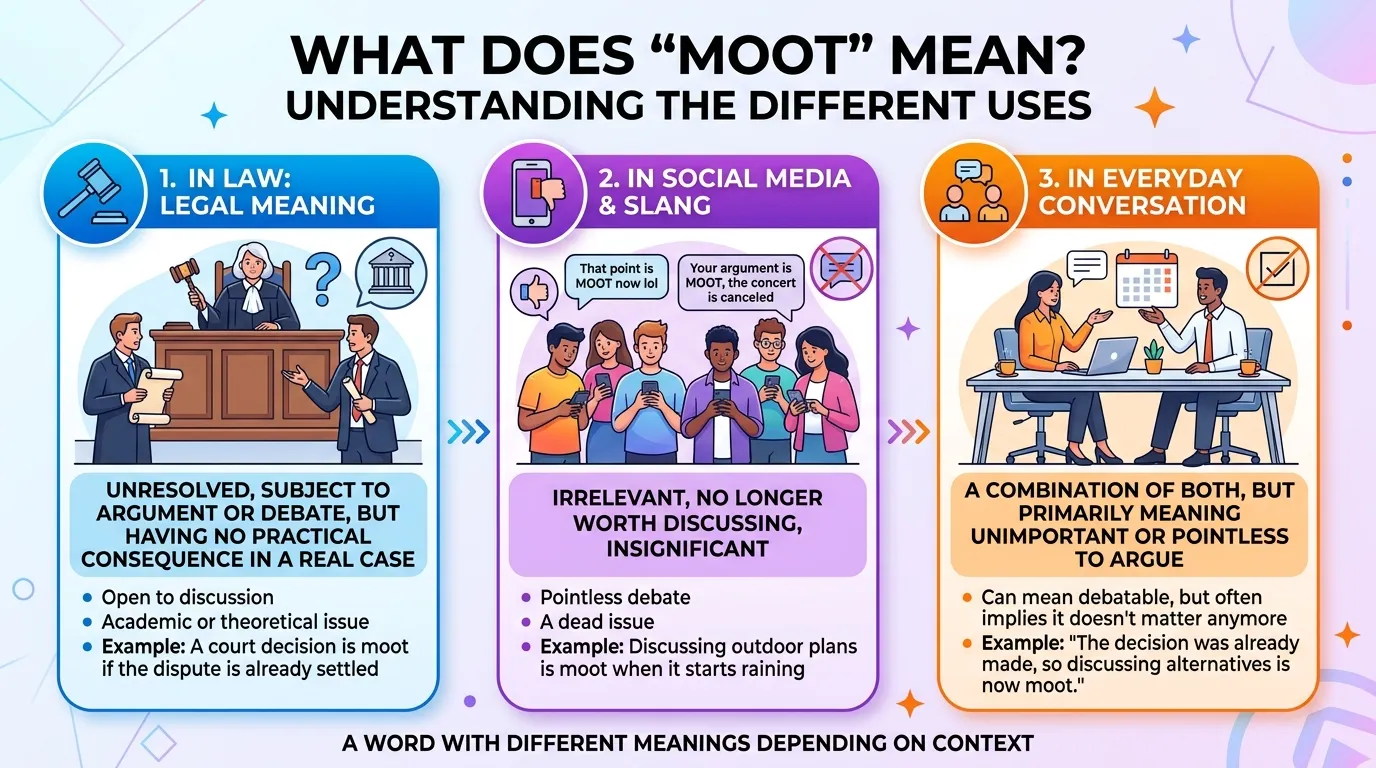
MOOT Meaning in Law
Outside social media, moot has a very different meaning.
In legal language, a moot issue is one that no longer requires a decision because circumstances have changed.
Legal Definition
A case becomes moot when a court’s ruling would no longer have practical significance.
Example
Suppose a student challenges a school’s temporary policy in court. Before the court reaches a decision, the school removes the policy.
The dispute may become moot because the issue no longer exists.
In simple terms:
A moot case is one that has lost its relevance.
What Is a Moot Court?
Many people hear the word moot through the phrase moot court.
A moot court is a simulated court proceeding used for educational purposes.
Law students participate in moot courts to practice:
- Legal research
- Public speaking
- Argument presentation
- Courtroom procedures
- Critical thinking
Benefits of Moot Court
- Builds confidence
- Improves legal writing
- Develops advocacy skills
- Prepares students for real cases
Moot court competitions are common in law schools worldwide.
MOOT Meaning in Everyday English
In traditional English, moot often refers to something that is:
- Open to debate
- Uncertain
- Hypothetical
- No longer important
Examples
- “Whether aliens exist is a moot question.”
- “The discussion became moot after the project was canceled.”
- “The issue is moot because the deadline has passed.”
The exact meaning depends on context.
The History and Origin of MOOT
The word moot has ancient roots.
It comes from Old English and originally referred to an assembly or meeting where people gathered to discuss important matters.
Historically, a moot was:
- A council meeting
- A public assembly
- A gathering for debate
Over centuries, the meaning evolved into:
- A topic for discussion
- A debatable issue
- A hypothetical question
Eventually, legal systems adopted the term, and later internet culture gave it a completely new meaning.
How MOOT Evolved Into Internet Slang
Internet users often shorten phrases into quick, memorable words.
The phrase mutual follower became:
- Mutual
- Mootual
- Moot
Over time, users simplified it further to just moot.
Social media communities embraced the term because it was:
- Short
- Easy to type
- Easy to understand
- Community focused
Today, many users know moot primarily as internet slang rather than its traditional definition.
Examples of MOOT in Different Contexts
Understanding context is the key to interpreting the word correctly.
Social Media
- “My moots recommended this movie.”
- “Looking for gaming moots.”
Meaning: Mutual followers.
Legal Context
- “The lawsuit became moot.”
Meaning: No longer relevant.
Academic Discussion
- “That remains a moot question among researchers.”
Meaning: Open to debate.
Everyday Conversation
- “The point is moot now.”
Meaning: The issue no longer matters.
Common Misunderstandings About MOOT
Many people misunderstand the term because of its multiple definitions.
Misconception 1: MOOT Always Means Mutual Follower
This is only true on social media.
Misconception 2: MOOT Means Useless
Not always.
In some contexts, it means debatable rather than pointless.
Misconception 3: Moot Court Is a Real Court
Moot courts are educational simulations.
Misconception 4: Moot Is a New Word
The word is actually centuries old and existed long before social media.
MOOT vs Mutuals
People often use “moots” and “mutuals” interchangeably.
Similarities
Both refer to:
- People who follow each other
- Reciprocal online connections
- Social media friendships
Differences
| Term | Usage |
|---|---|
| Moot | More common among younger online communities |
| Mutuals | More universally understood |
Examples:
- “My moots are active today.”
- “My mutuals are active today.”
Both sentences mean essentially the same thing.
MOOT vs Friends
A moot is not always a friend.
Moot
- Mutual follower
- Online connection
- May not know each other personally
Friend
- Stronger relationship
- Personal connection
- More interaction and trust
Many online friendships begin as moot relationships and eventually develop into genuine friendships.
When Should You Use the Word MOOT?
You can use the term when discussing social media relationships.
Appropriate Situations
- Looking for new followers
- Talking with online communities
- Referring to mutual followers
Examples:
- “Any music moots here?”
- “My moots always support my posts.”
In professional settings, however, “mutual followers” may sound more formal.
Related Internet Slang Terms
If you’re learning internet slang, these related terms may also be useful.
Mutuals
People who follow each other.
FYP
For You Page.
OOTD
Outfit of the Day.
DM
Direct Message.
Stan
A devoted fan.
IRL
In Real Life.
POV
Point of View.
Ratio
When a reply receives more engagement than the original post.
Understanding these terms can help you navigate online conversations more confidently.
How Brands and Creators Use MOOT Culture
Many creators use moot culture to build communities.
Strategies include:
- Engaging with followers
- Following back active supporters
- Creating niche communities
- Hosting discussions
- Sharing user-generated content
A strong network of moots can help increase:
- Reach
- Visibility
- Engagement
- Audience loyalty
This is one reason the term remains popular across social platforms.
Signs Someone Considers You a Moot
You may be considered a moot if someone:
- Follows you back
- Frequently likes your content
- Replies to your posts
- Tags you in discussions
- Shares your content
- Sends friendly messages
Many online communities view moots as valuable connections rather than just numbers on a follower list.
Quick Reference Table
| Meaning | Context | Example |
|---|---|---|
| Mutual follower | Social media | “My moots are great.” |
| Debatable issue | Traditional English | “It’s a moot question.” |
| No longer relevant | Legal discussions | “The case became moot.” |
| Educational court simulation | Law school | “She joined moot court.” |
Frequently Asked Questions
What does MOOT mean in texting?
In texting and social media, MOOT usually means mutual follower, referring to someone who follows you and whom you follow back.
What does “my moots” mean?
“My moots” refers to your mutual followers or mutual online connections.
Is MOOT a slang word?
Yes. In internet culture, moot is slang for a mutual follower. However, the word itself is much older and has traditional meanings in English and law.
What does moot mean in legal terms?
In law, moot means a matter that no longer requires resolution because circumstances have changed.
What is a moot court?
A moot court is a simulated court proceeding where law students practice legal arguments and courtroom skills.
Is a moot the same as a friend?
Not necessarily. A moot is simply a mutual follower. Some moots become friends, while others remain online acquaintances.
Why do people say “looking for moots”?
They are searching for mutual followers who share similar interests and may engage with their content.
Conclusion
The MOOT meaning depends entirely on context. In today’s online world, a moot usually refers to a mutual follower on social media platforms such as X, Instagram, TikTok, and Threads. In legal and traditional English contexts, however, moot refers to an issue that is debatable or no longer relevant.
Understanding these different meanings helps prevent confusion and allows you to communicate more effectively both online and offline. The next time you see someone mention their “moots,” you’ll know they’re talking about their mutual followers. And if you hear a lawyer describe a case as moot, you’ll understand that the issue has lost its practical significance.
Whether you’re exploring internet slang, studying law, or simply expanding your vocabulary, knowing the various meanings of MOOT is a valuable addition to your communication toolkit. Pay attention to context, use the term appropriately, and you’ll never be confused by this versatile word again.