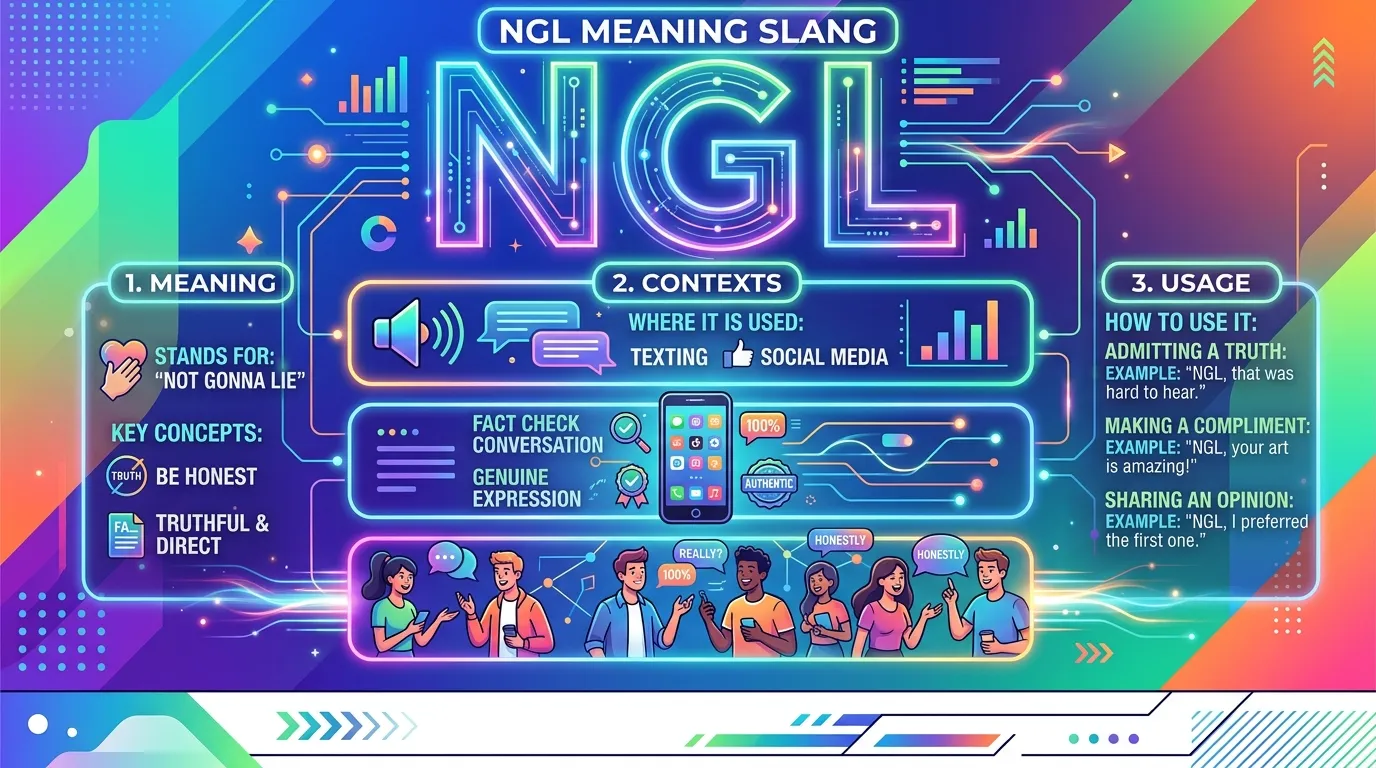
If you have seen NGL in a text, TikTok comment, Instagram caption, Snapchat message, or online conversation, you may have wondered what those three letters actually mean. The short answer is simple: NGL means “Not Gonna Lie.” It is a popular piece of internet slang people use when they want to introduce an honest opinion, confession, reaction, or personal feeling.
For example, someone might text, “NGL, that movie was amazing.” They are essentially saying, “Honestly, that movie was amazing.” Someone else might write, “NGL, I was nervous before the interview.” Here, the abbreviation signals a personal admission.
Understanding NGL meaning slang matters because online language often depends on tone and context. The same abbreviation can introduce a funny confession, a sincere compliment, a criticism, or an emotional statement. It is especially common in text messages and social media, where short, conversational expressions are part of everyday communication. Cambridge Dictionary defines NGL as an informal abbreviation for “not gonna lie” and notes its use in social media and text messages.
In this guide, you will learn what NGL means, how to use NGL in a sentence, where it came from, what NGL means on TikTok, Instagram, Snapchat, Discord, Reddit, gaming, and dating apps, and how it compares with expressions such as TBH, IMO, and honestly.
What Does NGL Mean in Slang?
NGL stands for “Not Gonna Lie.”
It is an informal internet abbreviation used to signal that the speaker is about to say something honest, personal, surprising, or candid.
Quick definition
| Fact | Answer |
|---|---|
| NGL meaning | Not Gonna Lie |
| Type | Internet slang / abbreviation |
| Main purpose | To introduce an honest statement |
| Tone | Casual, conversational, sincere, humorous, or blunt |
| Common platforms | Texting, TikTok, Instagram, Snapchat, Discord, Reddit |
| Common position | Usually at the beginning or end of a sentence |
| Formal or informal? | Informal |
| Similar expressions | TBH, honestly, to be real, IMO |
| Capitalization | Usually written as NGL or ngl |
Merriam-Webster also lists ngl as an informal abbreviation of “not gonna lie” or “not going to lie.”
Simple examples
- NGL, I really like this song.
- NGL, that test was harder than I expected.
- I was nervous, ngl.
- NGL, your new haircut looks great.
- NGL, I forgot about the meeting.
In each example, NGL tells the reader that the following statement is meant to sound genuine or candid.
What Does “Not Gonna Lie” Actually Mean?
The phrase “not gonna lie” is a conversational way of saying “to be honest,” “honestly,” or “I have to admit.”
It does not necessarily mean that the speaker was previously lying. Instead, it emphasizes that the person is about to share a genuine reaction.
For example:
NGL, I thought the restaurant would be better.
This does not mean the person has been lying about the restaurant. It simply introduces an honest opinion.
Likewise:
NGL, I was scared before the presentation.
The speaker is admitting something personal.
This is one reason NGL is so useful in casual communication. It gives a statement a more natural, conversational feeling.
NGL Meaning in Text Messages
One of the most common places you will encounter NGL is in texting.
People use it with friends, family members, classmates, partners, and other people they communicate with casually.
NGL in texting examples
Person A: Did you like the new episode?
Person B: NGL, it was better than I expected.
Here, NGL means “Honestly.”
Another example:
Person A: Are you ready for tomorrow?
Person B: NGL, I’m kind of nervous.
The abbreviation introduces a personal feeling.
It can also introduce a compliment:
NGL, you did a really good job on that presentation.
Or a mild criticism:
NGL, I think the first version was better.
This flexibility explains why NGL appears so often in casual digital conversations.
Why Do People Use NGL?
People use NGL slang for several reasons.
1. To emphasize honesty
The most obvious purpose is to tell someone that the following statement is genuine.
NGL, I really enjoyed that movie.
2. To admit something
NGL works well before an admission that may feel slightly embarrassing.
NGL, I checked the menu before going there.
3. To share an opinion
Someone may use NGL before giving a personal reaction.
NGL, I don’t think that update made the app better.
4. To make a compliment sound genuine
NGL can make praise feel spontaneous.
NGL, your artwork is incredible.
5. To soften criticism
Sometimes NGL creates a conversational cushion before a negative opinion.
NGL, I wasn’t a huge fan of the ending.
However, NGL does not automatically make criticism polite. The words that follow still matter.
Compare:
- NGL, I don’t think this works.
- NGL, this is terrible and you clearly didn’t try.
The first sounds relatively mild. The second can still sound harsh.
NGL Meaning on TikTok
On TikTok, NGL can appear in captions, comments, replies, and direct messages.
A creator might write:
NGL, this trend is actually fun.
A commenter might say:
NGL, I watched this five times.
Or:
NGL, I didn’t expect that ending.
TikTok’s fast-moving conversational style makes short expressions such as NGL particularly convenient.
The abbreviation can also be combined with other informal internet expressions:
- NGL, this is fire.
- NGL, that’s wild.
- NGL, I lowkey love this.
- NGL, this is actually so good.
The important point is that NGL does not have a special TikTok definition. Its basic meaning remains “not gonna lie.” The platform simply provides a setting where the slang is frequently used.
NGL Meaning on Instagram
On Instagram, you may see NGL in captions, comments, Stories, DMs, and replies.
Examples include:
- NGL, this view is unreal.
- NGL, I miss this place.
- NGL, your outfit looks amazing.
- That was one of the best trips ever, ngl.
It can appear at the beginning or end of a sentence.
NGL at the beginning
NGL, I love this picture.
This gives the statement an immediate “honest opinion” feeling.
NGL at the end
This picture turned out really well, ngl.
Here, NGL acts more like an afterthought or final emphasis.
Both forms are common in informal online writing.
NGL Meaning on Snapchat
Snapchat conversations are usually casual and personal, so ngl fits naturally.
For example:
NGL, I thought you were going to cancel.
Or:
That party was actually fun ngl.
Because Snapchat messages often resemble spoken conversation, abbreviations such as NGL can make messages shorter and more relaxed.
NGL Meaning on Discord
On Discord, NGL can appear in group chats, private messages, gaming communities, and casual discussions.
For example:
NGL, that boss fight was brutal.
NGL, your strategy worked perfectly.
That update is pretty good ngl.
In Discord communities, the meaning usually remains exactly the same. The surrounding conversation determines whether NGL sounds serious, funny, sarcastic, or enthusiastic.
NGL Meaning in Gaming
Gamers may use NGL when discussing gameplay, characters, updates, strategies, or their own performance.
Examples:
- NGL, that weapon is overpowered.
- NGL, I thought we were going to lose.
- That was the funniest match ever, ngl.
- NGL, I need to practice this map.
- NGL, that boss was easier than I expected.
In gaming conversations, NGL often introduces a strong personal reaction.
For example:
NGL, I don’t understand why everyone hates this character.
The speaker is emphasizing that this is their honest opinion.
NGL Meaning on Reddit
Reddit discussions often involve opinions, debates, reviews, stories, and personal experiences. That makes NGL useful when someone wants to introduce a candid reaction.
Examples:
NGL, I preferred the original version.
NGL, this subreddit helped me a lot.
That ending was disappointing, ngl.
On Reddit, the abbreviation may be used seriously or humorously depending on the community and discussion.
It is still important to remember that NGL does not make an opinion objectively true. It simply signals that the writer is presenting their genuine view.
NGL Meaning in Dating and Relationships
NGL can have a slightly more personal or emotional feeling in dating conversations.
For example:
NGL, I really enjoyed talking to you.
This can sound warm and sincere.
Another example:
NGL, I was hoping you’d text me.
Here, NGL introduces vulnerability.
It can also be used for flirting:
NGL, you looked really good tonight.
Or for expressing uncertainty:
NGL, I don’t know where this relationship is going.
In romantic conversations, context is especially important. NGL itself does not automatically mean someone is flirting, confessing love, or expressing romantic interest. The words around it determine the message.
NGL Meaning at Work
This is where you should be more careful.
NGL is informal internet slang, so it is generally better suited to casual communication than formal workplace writing. Cambridge Dictionary specifically classifies it as informal.
You might see it in a relaxed team chat:
NGL, that presentation went really well.
But in a formal email, a more professional alternative would be:
To be honest, I think the presentation went very well.
Instead of:
NGL, I don’t think this deadline is realistic.
Use:
I don’t think this deadline is realistic.
The second version is clearer and more professional.
Where to avoid NGL
Avoid NGL in:
- Formal business reports
- Academic essays
- Job applications
- Legal documents
- Formal client communication
- Professional proposals
- Official correspondence
The abbreviation is not “wrong,” but the register may be inappropriate.
NGL in Everyday Conversation
Although NGL is strongly associated with online communication, the full phrase “not gonna lie” is also common in casual spoken English.
Someone might say:
“Not gonna lie, I’m exhausted.”
When written online, that often becomes:
“NGL, I’m exhausted.”
This illustrates a broader pattern in digital communication: people often shorten familiar spoken phrases into abbreviations.
The Origin and History of NGL
The exact point when NGL was first coined is difficult to establish with certainty. The phrase “not gonna lie” existed in spoken English before its abbreviated internet form became widespread.
As texting and online chat developed, users increasingly shortened common phrases to save typing time and create a recognizable digital style.
NGL fits this broader culture of internet shorthand alongside expressions such as:
- LOL
- IDK
- BTW
- TBH
- IMO
- FYI
- BRB
Older online slang dictionaries contain examples of NGL being used as “not gonna lie” well before its current social-media popularity. For example, Urban Dictionary entries for NGL date back to the late 2000s and early 2010s. These user-generated records are useful evidence of historical online usage, although they should not be treated as authoritative linguistic sources.
Today, mainstream dictionaries recognize NGL as an informal abbreviation. Dictionary.com defines it as “not gonna lie,” particularly in internet communication when making an admission or confession.
NGL’s evolution
Its development can be understood roughly like this:
- Spoken phrase: People used “not gonna lie” in everyday conversation.
- Texting shorthand: Digital communication encouraged shorter expressions.
- Internet slang: NGL became recognizable as an abbreviation.
- Social media: Platforms such as Instagram, TikTok, Snapchat, and Reddit helped spread it.
- Mainstream recognition: Dictionaries began recording the abbreviation as established informal usage.
The exact timeline should not be treated as a single invention date because slang usually develops gradually rather than appearing at one identifiable moment.
Is NGL an Acronym or Abbreviation?
Technically, NGL is best described as an initialism or abbreviation.
The letters come from:
N = Not
G = Gonna
L = Lie
It is generally pronounced by saying the individual letters: “en-jee-el.”
You do not normally pronounce NGL as a single word.
NGL vs. TBH
One of the most common comparisons is NGL vs. TBH.
| Expression | Meaning | Typical feeling |
|---|---|---|
| NGL | Not gonna lie | Casual, candid, conversational |
| TBH | To be honest | Honest, direct, slightly more neutral |
Examples:
NGL, this pizza is amazing.
TBH, this pizza is amazing.
Both communicate honesty, but NGL often feels more casual and conversational.
When should you use NGL instead of TBH?
Use NGL when you want a relaxed internet-style tone.
Use TBH when you want to emphasize honesty in a slightly more straightforward way.
There is significant overlap between the two.
NGL vs. IMO
IMO means “in my opinion.”
It emphasizes that something is a personal viewpoint.
IMO, the first movie was better.
NGL is slightly different:
NGL, I thought the first movie was better.
The first focuses on the fact that the statement is an opinion. The second focuses more on candidness or honesty.
Quick comparison
| Slang | Full meaning | Main function |
|---|---|---|
| NGL | Not gonna lie | Signals candidness |
| TBH | To be honest | Signals honesty |
| IMO | In my opinion | Signals personal opinion |
| IMHO | In my humble opinion | Signals personal opinion, often playfully |
| Honestly | Honestly | Directly emphasizes sincerity |
NGL vs. “Honestly”
NGL and honestly can often replace each other.
For example:
NGL, I love this song.
Honestly, I love this song.
The meanings are very close.
However, NGL usually feels more like internet slang, while “honestly” works in both casual and more polished contexts.
That makes “honestly” the safer choice in professional communication.
Positive and Negative Uses of NGL
A common misunderstanding is that NGL is only used before criticism.
That is not true.
Positive use
NGL, you did an amazing job.
NGL, this is the best coffee I’ve had all week.
NGL, I’m really proud of you.
Negative use
NGL, I didn’t like the ending.
NGL, that was disappointing.
NGL, I’m not sure this idea will work.
Neutral or emotional use
NGL, I was nervous.
NGL, I didn’t expect that.
NGL, I miss those days.
So the meaning of NGL does not determine whether the statement is positive or negative. It simply introduces a candid statement.
Can NGL Sound Rude?
Yes, depending on what follows it.
NGL itself is not inherently rude.
Compare:
NGL, I think you look great.
This is clearly positive.
Now consider:
NGL, your idea makes no sense.
This is much more confrontational.
The abbreviation may make a blunt comment feel conversational, but it does not erase the emotional effect of the words that follow.
A useful rule
Think of NGL as a tone signal, not a politeness guarantee.
It tells the reader, “I’m being candid.”
It does not necessarily tell them, “I’m being gentle.”
Can NGL Be Used Sarcastically?
Yes.
Internet slang frequently depends on context, and NGL can be used humorously or sarcastically.
For example:
NGL, that went perfectly.
If the person just experienced a complete disaster, the sentence may be sarcastic.
Another example:
NGL, spending three hours fixing one tiny bug was extremely relaxing.
The speaker probably does not mean that literally.
The abbreviation remains “not gonna lie,” but the surrounding context creates the humorous meaning.
Common Mistakes When Using NGL
Mistake 1: Assuming NGL always introduces criticism
It can introduce praise, criticism, humor, vulnerability, or a simple observation.
Mistake 2: Using NGL in every sentence
Too much slang can make writing feel forced.
Compare:
NGL, this is good. NGL, I love it. NGL, you’re right. NGL, that’s chaotic.
This quickly becomes repetitive.
Use it naturally.
Mistake 3: Using it in formal writing
NGL is informal. Replace it with honestly, to be candid, or a direct statement when the situation requires professional language.
Mistake 4: Assuming NGL means “no offense”
NGL can sometimes soften a criticism, but its literal meaning is “not gonna lie.”
It is not a direct synonym for “no offense.”
Mistake 5: Thinking NGL proves someone is telling the truth
NGL is a conversational signal. Anyone can write it.
For example:
NGL, I’m definitely telling the truth.
The words themselves do not provide evidence.
How to Use NGL Naturally
If you want to use NGL correctly, keep these tips in mind:
- Use it in informal conversations.
- Place it before an honest statement.
- Use lowercase or uppercase depending on your personal style.
- Don’t add it to every message.
- Remember that context controls the tone.
- Avoid it in formal academic or professional writing.
- Use “honestly” or “to be honest” when you want a more polished alternative.
Natural examples
- NGL, I’m tired.
- That was actually fun, ngl.
- NGL, I didn’t expect you to say that.
- NGL, your idea is pretty good.
- I kind of miss school, ngl.
Real-Life NGL Conversation Examples
Example 1: Friends
Alex: Did you enjoy the concert?
Sam: NGL, it was incredible.
Meaning: Sam is honestly saying that the concert was incredible.
Example 2: School
Mia: How was the exam?
Jordan: NGL, I thought it was going to be easier.
Meaning: Jordan is admitting that the exam was harder than expected.
Example 3: Compliment
A: What do you think of my new haircut?
B: NGL, it looks really good.
Meaning: B is giving a sincere compliment.
Example 4: Dating
A: Did you have fun last night?
B: NGL, I really did.
Meaning: B is emphasizing a genuine positive feeling.
Example 5: Gaming
A: You thought we were going to win?
B: NGL, no. I thought we were finished.
Meaning: B is honestly admitting what they expected.
Is “NGL” Still Used?
Yes. NGL remains recognizable as informal internet slang, and major dictionaries continue to list it as an abbreviation for “not gonna lie.”
However, slang usage varies by age group, platform, community, and individual style. Not everyone uses the same internet abbreviations, and language changes continuously.
You should therefore focus more on understanding the context than trying to force every current slang term into your own vocabulary.
NGL Can Mean Something Else
Although “not gonna lie” is the dominant meaning in casual online conversations, NGL can have other meanings in specialized contexts.
For example, Dictionary.com lists NGL as an abbreviation for natural gas liquids in technical usage.
This means context matters.
If you see NGL in:
- A text from a friend → probably not gonna lie
- A TikTok comment → probably not gonna lie
- A Discord message → probably not gonna lie
- A Reddit post → probably not gonna lie
- An oil and gas document → potentially natural gas liquids
- A technical report → check the surrounding terminology
The safest approach is to look at the context before deciding what NGL means.
NGL Meaning: Quick Summary Table
| Category | Details |
|---|---|
| Primary meaning | Not Gonna Lie |
| Definition | A casual phrase signaling honesty or candidness |
| Language type | Internet slang / initialism |
| Typical placement | Beginning or end of a sentence |
| Tone | Casual, sincere, humorous, emotional, or blunt |
| Commonly used in | Texting and social media |
| TikTok meaning | Not Gonna Lie |
| Instagram meaning | Not Gonna Lie |
| Snapchat meaning | Not Gonna Lie |
| Discord meaning | Not Gonna Lie |
| Reddit meaning | Not Gonna Lie |
| Gaming meaning | Not Gonna Lie |
| Dating meaning | Usually a candid admission or feeling |
| Formal writing | Generally avoid |
| Similar terms | TBH, honestly, IMO |
| Capitalization | NGL or ngl |
| Pronunciation | “en-jee-el” |
Frequently Asked Questions
1. What does NGL mean in slang?
NGL means “not gonna lie.” It is informal internet slang used before or after a statement to emphasize that someone is being honest, candid, or sincere.
For example: “NGL, I really enjoyed that movie.”
2. What does NGL mean in texting?
In texting, NGL means “not gonna lie.” Someone may use it before sharing an honest opinion, confession, feeling, compliment, or criticism.
Example: “NGL, I was nervous about the interview.”
3. What does NGL mean on TikTok?
On TikTok, NGL normally means “not gonna lie.” It is commonly used in comments, captions, replies, and messages to introduce a genuine or humorous reaction.
4. What does NGL mean on Instagram?
On Instagram, NGL means “not gonna lie.” You may see it in captions, comments, Stories, and DMs.
For example: “NGL, this photo turned out amazing.”
5. Is NGL positive or negative?
NGL can be positive, negative, neutral, humorous, or emotional. Its meaning does not determine the attitude of the sentence.
“NGL, you’re amazing” is positive.
“NGL, I didn’t like the movie” is negative.
6. Is NGL the same as TBH?
They are very similar but not identical.
NGL means “not gonna lie”, while TBH means “to be honest.” Both can introduce a candid statement, although NGL often has a particularly casual internet tone.
7. Does NGL mean “no offense”?
Not exactly. NGL literally means “not gonna lie.” It can sometimes appear before criticism and therefore have a similar conversational effect to “no offense,” but the expressions have different meanings.
8. Can NGL be used in formal writing?
Generally, no. NGL is informal internet slang. In a formal email, essay, report, or professional document, use “honestly,” “to be honest,” “to be candid,” or simply state your point directly.
9. How do you pronounce NGL?
NGL is normally pronounced by saying its individual letters:
“en-jee-el.”
It is not usually pronounced as a single word.
10. What is the difference between NGL and IMO?
NGL means “not gonna lie” and emphasizes candidness. IMO means “in my opinion” and emphasizes that something is a personal viewpoint.
For example:
NGL, this movie is amazing.
IMO, this movie is the best in the series.
Both express a personal reaction, but they highlight different things.
Final Takeaway
The most important thing to remember about NGL meaning slang is simple: NGL means “Not Gonna Lie.”
People use it in informal communication when they want to introduce an honest opinion, confession, compliment, criticism, reaction, or personal feeling. You can encounter it in text messages, TikTok comments, Instagram captions, Snapchat chats, Discord servers, Reddit discussions, gaming conversations, and dating messages.
For example:
“NGL, I really like this.”
means:
“Honestly, I really like this.”
NGL can sound friendly, funny, sincere, emotional, or blunt depending on the words and situation surrounding it. It does not automatically make a statement positive or polite.
If you are learning modern English slang, the best way to understand NGL is to treat it as a casual honesty marker. Use it naturally with friends and in relaxed online conversations, but choose more formal expressions such as “honestly” or “to be honest” in professional and academic settings.
So, the next time someone messages you “NGL…”, you will know exactly what they are signaling: they are about to tell you what they genuinely think or feel.