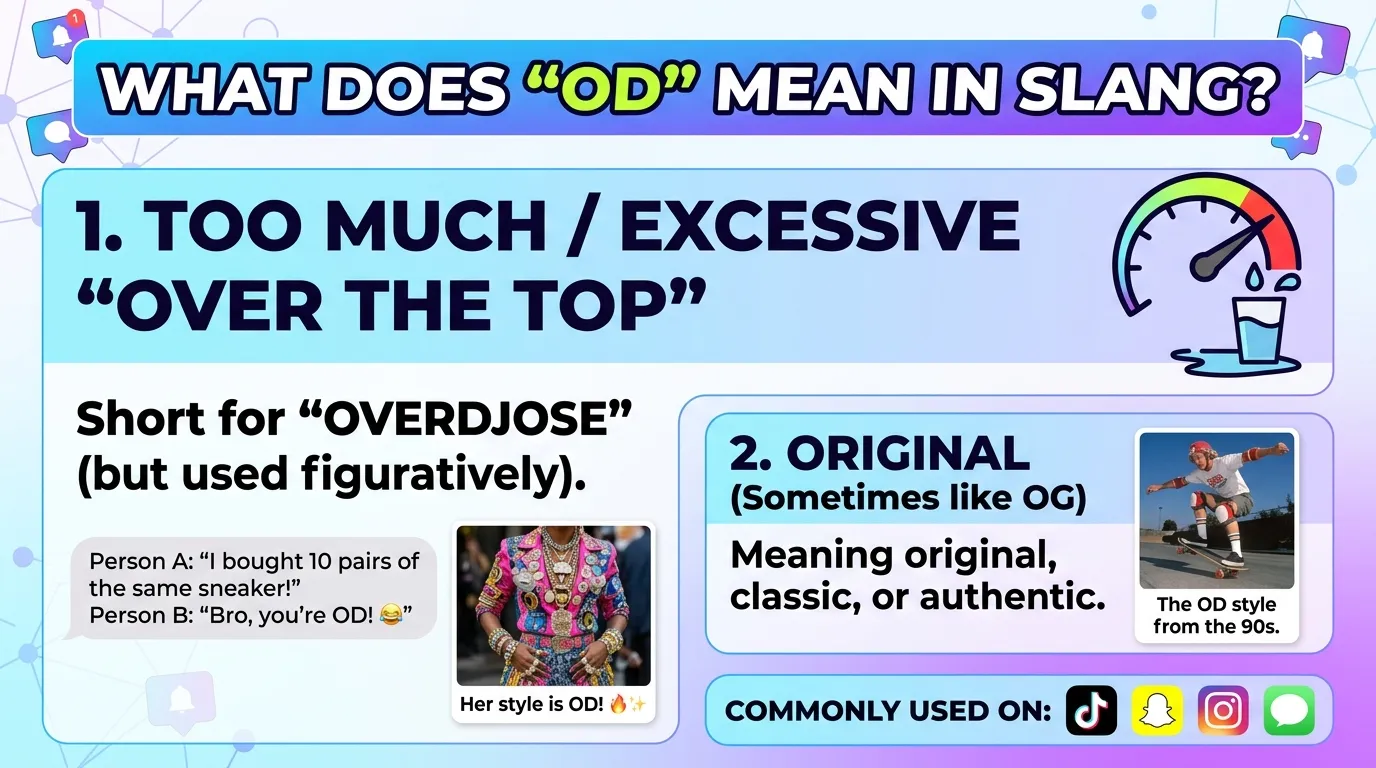
If you have seen someone type OD in a text, TikTok comment, Snapchat message, Instagram caption, or gaming chat, you may have wondered what they actually mean. OD meaning slang can be confusing because the abbreviation has several uses, and its meaning depends heavily on context. In modern online communication, OD most commonly means overdoing it, overly, or overdose, depending on the situation.
For example, someone might say, “You’re OD funny,” meaning you’re extremely funny or you’re being overly funny. Someone else might write, “I’m OD tired,” meaning I’m extremely tired. In a more serious context, however, “OD” can mean overdose, especially when discussing drugs or medication.
The abbreviation has become especially common in texting, TikTok, Instagram, Snapchat, Discord, Reddit, gaming, and casual conversations. Its use can range from playful exaggeration to serious discussion.
Understanding the context is the key. In this guide, you will learn the OD slang meaning, where it came from, how people use it today, what it means on social media, and how it differs from related expressions such as extra, doing too much, overly, and overdose.
What Does OD Mean in Slang?
OD is a slang abbreviation with different meanings depending on the context.
The most common modern slang meanings include:
- Overdoing it or doing too much
- Overly or extremely, as an intensifier
- Overdose, especially in health or drug-related conversations
- Occasionally, other meanings depending on a specific community or situation
When used casually online, OD often intensifies whatever comes after it or describes someone as doing something excessively.
For example:
“You OD funny.”
This can mean:
“You are extremely funny.”
Another example is:
“Bro is OD.”
Depending on the conversation, this could mean:
“Bro is doing way too much.”
However, if someone says:
“He OD’d.”
the meaning may be completely different. In a serious context, OD’d can mean overdosed.
Quick Answer
OD slang usually means “overdoing it,” “doing too much,” or “extremely/overly.” It can also mean “overdose” in drug or medical contexts. The surrounding conversation determines the meaning.
OD Meaning in Text Messages
In text messages, OD is usually casual slang.
People often use it to emphasize an adjective, reaction, or behavior.
For example:
- “That movie was OD good.”
- “You’re OD loud.”
- “I’m OD hungry.”
- “She’s OD talented.”
- “That was OD funny.”
In these examples, OD works like “very,” “extremely,” or “really.”
It can also describe excessive behavior:
- “You’re OD texting me.”
- “He’s OD worried.”
- “Why are you OD stressing?”
- “They’re OD arguing.”
Here, the meaning is closer to overdoing it or doing something excessively.
OD as an Intensifier
One of the easiest ways to understand casual OD slang is to replace it with very or extremely.
For example:
“That food is OD good.”
means roughly:
“That food is extremely good.”
Likewise:
“I’m OD tired.”
means:
“I’m extremely tired.”
This usage is especially common in informal conversations.
OD Meaning on TikTok
On TikTok, OD can appear in comments, captions, direct messages, and videos.
A TikTok user might comment:
“This is OD funny 😂”
They probably mean:
“This is extremely funny.”
Someone might also write:
“He’s OD obsessed.”
That means:
“He is extremely obsessed.”
Another example:
“Y’all OD with these comments.”
Here, OD means:
“You all are taking it too far.”
TikTok slang changes quickly, so the exact interpretation depends on the video and surrounding comments.
Why Context Matters on TikTok
The same abbreviation can communicate different ideas.
“This song is OD good.”
Here, OD means extremely.
“You’re OD right now.”
Here, it may mean you are doing too much.
“He OD’d.”
This could mean he overdosed, particularly if the video is discussing drugs, addiction, or health.
OD Meaning on Snapchat
On Snapchat, OD is generally used in the same casual way as it is in texting.
Friends may use it to exaggerate reactions.
Examples include:
- “You OD funny 😂”
- “That snap was OD random.”
- “I’m OD tired today.”
- “Why are you OD mad?”
- “You’re OD stressing.”
Snapchat conversations are often fast and informal, so abbreviations such as OD can save time while making a reaction sound stronger.
For instance:
Person A: “Did you see what happened?”
Person B: “Yeah, that was OD obsessed.”
Here, OD means extremely.
OD Meaning on Instagram
On Instagram, you might encounter OD in:
- Comments
- Direct messages
- Captions
- Stories
- Reels
- Memes
For example:
“This outfit is OD 🔥”
This usually means:
“This outfit is extremely good.”
A comment such as:
“Y’all OD 😂”
could mean:
“You all are doing too much.”
The tone is often playful rather than genuinely critical.
OD in Instagram Comments
Consider this exchange:
User A: “I finally bought the shoes.”
User B: “You OD flexing 😂”
The second person is joking that User A is showing off too much.
The abbreviation can therefore communicate both intensity and excessive behavior.
OD Meaning on Discord
On Discord, OD can have different meanings depending on the server.
In casual gaming or friend groups, it may mean:
- Extremely
- Too much
- Overdoing it
For example:
“That boss is OD difficult.”
This means:
“That boss is extremely difficult.”
Or:
“Bro is OD toxic.”
This means:
“Bro is being extremely toxic.”
However, Discord communities can develop their own slang. Always consider the specific server and conversation before assuming the meaning.
OD Meaning in Gaming
Gamers may use OD as an intensifier during fast-paced conversations.
Examples:
- “That player is OD good.”
- “This level is OD hard.”
- “That weapon is OD powerful.”
- “He’s OD annoying.”
- “The enemy team is OD sweaty.”
In these examples, OD means extremely or excessively.
Gaming slang often relies on abbreviations because players communicate quickly while playing.
Example Gaming Conversation
Player 1: “How did he beat that boss?”
Player 2: “His build is OD strong.”
Player 1: “No way 😂”
Here, “OD strong” means extremely strong.
OD Meaning on Reddit
On Reddit, OD can be more difficult to interpret because different communities use different terminology.
In casual discussions, someone might say:
“You’re OD overthinking this.”
That means:
“You’re overthinking this way too much.”
A Reddit user might also say:
“That explanation is OD long.”
Meaning:
“That explanation is extremely long.”
However, in communities discussing substance use, addiction, medicine, or public health, OD may refer to an overdose.
This is one reason context is especially important on Reddit.
OD Meaning in Dating and Relationships
OD can appear in dating conversations when someone describes intense behavior.
For example:
“He’s OD texting me.”
This can mean:
“He is texting me way too much.”
Another example:
“She’s OD jealous.”
This means:
“She is extremely jealous.”
A person might also say:
“You’re OD cute.”
Here, the meaning is positive:
“You’re extremely cute.”
Is OD Romantic?
Not necessarily.
OD does not have an inherently romantic meaning. The emotional tone comes from the words around it.
For example:
- “You’re OD cute” = positive
- “You’re OD annoying” = negative
- “You’re OD funny” = positive
- “You’re OD jealous” = negative
The abbreviation simply adds intensity or suggests excess.
OD Meaning in Everyday Conversation
Although OD is common online, people also use it in casual spoken conversations.
Someone might say:
“That was OD expensive.”
Meaning:
“That was extremely expensive.”
Or:
“You’re OD loud.”
Meaning:
“You’re being way too loud.”
This style of slang is informal and is more appropriate for friends and casual settings than professional communication.
The Two Most Important Meanings of OD
The two meanings that deserve the most attention are overdoing it and overdose.
| Meaning | Typical context | Example |
|---|---|---|
| Extremely / overly | Texting and social media | “That movie was OD good.” |
| Overdoing it | Casual criticism | “You’re OD right now.” |
| Overdose | Drug or medical discussion | “He suffered an OD.” |
The context usually makes the intended meaning clear.
OD as “Overdoing It”
When OD means overdoing it, it describes behavior that has gone beyond what seems necessary or reasonable.
For example:
“You OD with the decorations.”
This suggests:
“You went overboard with the decorations.”
Another example:
“He’s OD trying to impress her.”
This means:
“He is trying way too hard to impress her.”
Similar Expressions
When OD means overdoing it, similar expressions include:
- Doing too much
- Going overboard
- Taking it too far
- Being extra
- Overreacting
- Trying too hard
- Going over the top
These expressions are not always interchangeable, but they share the general idea of excess.
OD as “Extremely” or “Very”
This usage is particularly important in slang.
Consider:
“That restaurant is OD good.”
Here, OD doesn’t literally mean “overdose.” It functions as an intensifier.
Other possible replacements include:
- Very
- Really
- Extremely
- Super
- Seriously
- Incredibly
For example:
“That game was OD fun.”
could become:
“That game was extremely fun.”
The slang version sounds more casual and conversational.
OD Meaning “Overdose”
The other major meaning of OD is overdose.
This is not simply casual slang. It is commonly used as an abbreviation in discussions involving drugs, medication, substance use, addiction, and emergency situations.
Examples include:
- “He was hospitalized after an OD.”
- “The article discussed opioid ODs.”
- “They were talking about overdose prevention.”
- “She survived an OD.”
In these contexts, interpreting OD as “extremely” would obviously be incorrect.
How to Tell When OD Means Overdose
Look for words related to:
- Drugs
- Medication
- Addiction
- Substance use
- Emergency rooms
- Naloxone
- Opioids
- Recovery
- Poisoning
- Medical emergencies
If those topics surround OD, the intended meaning is likely overdose.
OD vs. Overdose
OD is simply a shortened form commonly used for overdose.
For example:
Full word: overdose
Abbreviation: OD
In informal communication, people may use either one.
However, when discussing a serious medical situation, spelling out overdose can sometimes be clearer, particularly for people who may not understand the abbreviation.
OD vs. Extra
Extra and OD can overlap, but they are not identical.
Extra usually describes someone or something as unusually dramatic, excessive, or attention seeking.
OD can mean excessive behavior, but it can also simply mean extremely.
Compare:
“She’s extra.”
This suggests she is dramatic or doing more than necessary.
“She’s OD talented.”
This means she is extremely talented.
Therefore, extra describes a type of behavior, while OD often intensifies a description.
OD vs. Doing Too Much
These expressions can be very similar.
“You’re doing too much.”
This directly criticizes someone’s behavior.
“You’re OD.”
This may communicate the same idea in a shorter, more slang-heavy way.
However, OD can also mean very or extremely, so it has a broader range of informal uses.
OD vs. Overly
In some sentences, OD can function similarly to overly.
For example:
“You’re OD sensitive.”
could mean:
“You’re overly sensitive.”
But OD is much more informal.
Overly is standard English and works in professional or academic writing.
OD is slang and is better suited to casual communication.
OD vs. AF
Another common comparison is OD versus AF.
Both can intensify a statement.
For example:
“That movie was OD good.”
and:
“That movie was good AF.”
Both suggest that the movie was extremely good.
However, AF is vulgar slang, while OD is generally less explicit.
The choice depends on the speaker, audience, and platform.
Positive and Negative Uses of OD
OD does not automatically have a positive or negative tone.
Positive Examples
- “That song is OD good.”
- “You’re OD talented.”
- “This food is OD delicious.”
- “That joke was OD funny.”
- “She’s OD creative.”
Here, OD strengthens a compliment.
Negative Examples
- “You’re OD annoying.”
- “He’s OD jealous.”
- “That game is OD difficult.”
- “Why are you OD angry?”
- “They’re OD dramatic.”
Here, OD strengthens criticism.
Neutral or Playful Uses
Sometimes OD is neither strongly positive nor negative.
“That meeting was OD long.”
The speaker is simply emphasizing how long the meeting was.
Common Mistakes When Using OD
Because OD has multiple meanings, misunderstandings can happen.
Mistake 1: Assuming It Always Means Overdose
Seeing “OD” does not automatically mean overdose.
“That pizza is OD good.”
Clearly means extremely good, not overdose.
Mistake 2: Assuming It Always Means Extremely
The opposite mistake is also possible.
“He was hospitalized after an OD.”
Here, OD almost certainly refers to an overdose.
Mistake 3: Using It in Formal Writing
OD is informal slang.
Avoid using it in:
- Academic essays
- Business reports
- Formal emails
- Job applications
- Professional documentation
Instead of:
“The project is OD difficult.”
write:
“The project is extremely difficult.”
Mistake 4: Ignoring the Sentence Structure
Look at the words surrounding OD.
OD + adjective often suggests extremely:
“OD funny”
OD + behavior may suggest overdoing something:
“OD texting”
OD + medical or drug context may mean overdose.
Real-Life Examples of OD Slang
Here are realistic examples showing how context changes the meaning.
Example 1: Compliment
Person A: “Did you like her performance?”
Person B: “Yeah, she was OD talented.”
Meaning: She was extremely talented.
Example 2: Excessive Behavior
Person A: “Why are you sending 20 messages?”
Person B: “My bad 😂”
Person A: “You’re OD texting.”
Meaning: You are texting too much.
Example 3: Humor
Person A: “Did you watch that video?”
Person B: “Yeah, it was OD funny.”
Meaning: It was extremely funny.
Example 4: Serious Context
Person A: “Why was he taken to the hospital?”
Person B: “They said it was an OD.”
Meaning: They said it involved an overdose.
Is OD a Bad Word?
OD itself is not necessarily a bad word.
When it means extremely or overdoing it, it is generally casual slang.
However, the term can refer to overdose, which is associated with a serious and potentially life-threatening situation.
Its appropriateness depends on the context.
In a professional setting, it is usually better to use standard language instead of slang.
Is OD Still Used in 2026?
Yes. OD continues to appear in informal digital communication, especially where users rely on short, expressive slang.
Its exact popularity varies by age group, platform, region, and online community. Slang changes quickly, so some expressions become more popular while others fade.
Still, OD remains recognizable in many casual contexts because it can communicate intensity with very few characters.
Modern social platforms also encourage short-form language, making abbreviations useful in:
- Comments
- Captions
- Direct messages
- Group chats
- Gaming chats
- Memes
- Short videos
How to Respond When Someone Says OD
Usually, you do not need to respond differently just because someone uses OD.
If they say:
“That was OD funny.”
you can simply reply:
“For real 😂”
If they say:
“You’re OD.”
and you are unsure what they mean, context can help.
You can also ask:
“What do you mean by OD?”
This is especially useful when the conversation could involve the word overdose.
How to Use OD Naturally
If you want to use OD in casual conversation, pay attention to the sentence.
For “Extremely”
Use it to emphasize an adjective:
- “OD good”
- “OD funny”
- “OD tired”
- “OD expensive”
- “OD difficult”
For “Doing Too Much”
Use it when describing excessive behavior:
- “You’re OD texting.”
- “He’s OD stressing.”
- “They’re OD arguing.”
- “She’s OD worrying.”
For “Overdose”
Use it only when the context clearly concerns an overdose:
- “He survived an OD.”
- “The story was about an OD.”
- “They discussed preventing ODs.”
Should You Use OD at Work?
Generally, no.
Even if your coworkers understand slang, professional communication should be clear.
Instead of:
“The deadline is OD tight.”
write:
“The deadline is extremely tight.”
Instead of:
“This report is OD long.”
write:
“This report is very long.”
Informal slang is best reserved for conversations where that style is appropriate.
OD Meaning: Key Facts at a Glance
| Category | Information |
|---|---|
| Slang term | OD |
| Common meaning | Extremely, overly, or doing too much |
| Another major meaning | Overdose |
| Common platforms | Texting, TikTok, Snapchat, Instagram, Discord, Reddit |
| Tone | Casual and informal |
| Positive use | “That song is OD good.” |
| Negative use | “You’re OD annoying.” |
| Excessive behavior | “You’re OD texting.” |
| Medical context | OD = overdose |
| Formal writing | Usually avoid |
| Main clue | Context determines meaning |
| Similar expressions | Very, extremely, extra, doing too much, overboard |
Frequently Asked Questions
What does OD mean in text slang?
In text slang, OD usually means extremely, overly, or doing too much. For example, “That movie was OD good” means the movie was extremely good. In drug or medical conversations, OD can instead mean overdose.
What does OD mean on TikTok?
On TikTok, OD commonly works as an intensifier, meaning very or extremely. Someone might comment “That is OD funny,” meaning “That is extremely funny.” It can also mean doing too much when describing someone’s behavior.
What does OD mean on Snapchat?
On Snapchat, OD is generally informal slang meaning extremely, overly, or excessively. For example, “You’re OD funny” means “You’re extremely funny,” while “You’re OD texting” can mean “You are texting too much.”
Does OD mean overdose?
Yes. OD can mean overdose, especially when the conversation involves drugs, medication, addiction, or a medical emergency. Context is essential because OD also has several casual slang meanings.
What does OD mean when someone says “you’re OD”?
When someone says “you’re OD,” they may mean “you’re doing too much,” “you’re being excessive,” or “you’re acting extremely.” The exact meaning depends on the conversation and tone.
Is OD a compliment?
It can be. For example, “You’re OD talented” means “You’re extremely talented.” But OD can also be negative, such as “You’re OD annoying.” The words around OD determine whether the statement is positive or negative.
Is OD the same as “extra”?
Not exactly. Extra usually describes someone as dramatic, excessive, or over the top. OD can describe excessive behavior, but it can also simply mean extremely or very. Therefore, OD has a wider range of casual meanings.
Is OD appropriate in professional communication?
Usually, no. OD is informal slang, so it is better to use standard words such as “extremely,” “very,” “excessively,” or “overdoing it” in professional emails, reports, academic writing, and formal documents.
What is the difference between OD and AF?
Both can intensify a statement. However, AF is vulgar slang, while OD is generally less explicit. For example, “That movie is OD good” and “That movie is good AF” can both mean the movie is extremely good, but they have different levels of informality.
Final Thoughts
The meaning of OD slang depends almost entirely on context. In casual texting and social media, OD commonly means extremely, overly, or doing too much. It can turn a simple description into a stronger reaction, as in “OD funny,” “OD good,” or “OD tired.”
At the same time, OD can mean overdose in medical, drug-related, and addiction-related conversations. That meaning is much more serious and should never be confused with casual slang.
The easiest way to understand OD is to examine the words around it. If it appears before an adjective, it often works as an intensifier. If it describes someone’s behavior, it may suggest excess. If the conversation concerns drugs or health, it may mean overdose.
So, when you see OD in a text, TikTok comment, Snapchat message, Instagram post, Discord chat, or Reddit discussion, don’t rely on the abbreviation alone. Read the entire conversation. Context will usually reveal what the person means.
For casual conversations, OD can be a quick and expressive way to say very, extremely, or too much. For formal communication, however, standard English is usually the clearer choice.