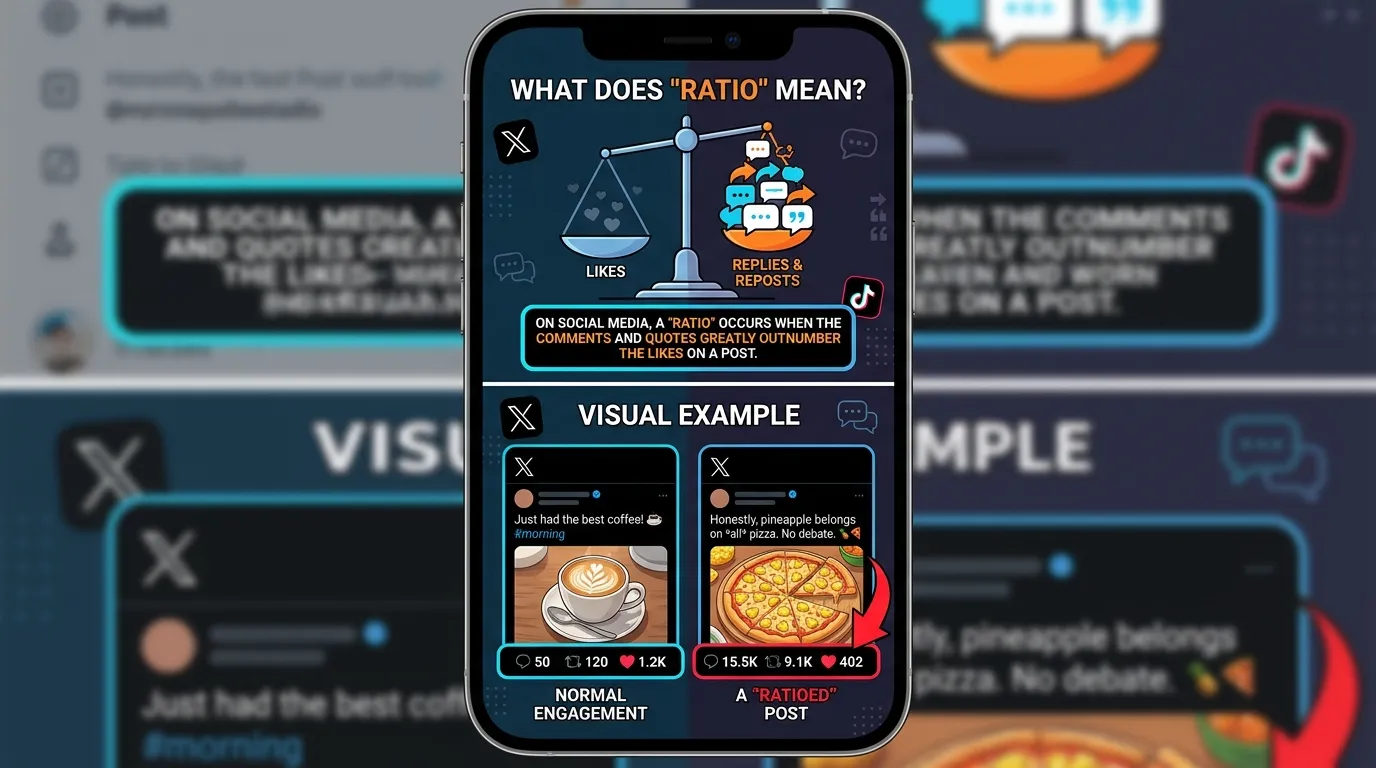
If you have ever seen someone comment “ratio” under a post and wondered what everyone was talking about, you are not alone. In modern internet language, ratio meaning slang usually refers to a social media situation where a post receives much more negative or critical engagement than positive engagement. It can also mean that a reply, comment, or quote post gets more likes or attention than the original post.
In simple terms, “ratio” means the crowd is siding against the original post or giving more attention to the response.
The slang became especially popular on Twitter, now known as X, where users began comparing replies, retweets, and likes to judge whether a post was being supported or criticized. Today, the term appears across TikTok, Instagram, Reddit, Discord, gaming communities, and other online spaces.
You might see someone write “ratio,” “you got ratioed,” “ratio + L,” or “L + ratio.” Depending on the context, it can be playful teasing, a way to celebrate winning an online argument, or a public jab at an unpopular opinion.
This complete guide explains what ratio means in slang, where it came from, how people use it, what “ratioed” means, and how the expression has evolved across the internet.
Quick Answer: What Does “Ratio” Mean in Slang?
Ratio is internet slang for a situation where a social media post receives disproportionately more replies, criticism, or negative engagement than likes or positive reactions.
It can also describe a reply that receives more likes or attention than the original post.
For example:
Person A: “This is the greatest movie ever made.”
Person B: “Absolutely not.”
Person B’s reply gets 20,000 likes while Person A’s post gets 2,000.
Someone comments: “Ratio.”
Here, “ratio” means that the response received much stronger approval than the original opinion.
The slang is usually associated with disagreement, criticism, mockery, or winning an online argument. Merriam-Webster defines the social-media verb ratio as giving considerably more negative than positive responses to a post.
Ratio meaning in one sentence
“Ratio” means that a social media response is getting significantly more support or engagement than the original post, often because people disagree with the original poster.
What Does “Ratioed” Mean?
“Ratioed” is the past-tense form of the slang verb ratio.
If someone says:
“He got ratioed.”
They generally mean that other users responded negatively to his post or that another person’s reply received much more support.
There are two closely related ways people use ratioed:
- The original post gets far more replies than likes or positive engagement.
- A reply or comment gets more likes than the post or comment it responds to.
Both meanings are documented in modern slang references.
Example
Original post: 500 likes
Critical reply: 8,000 likes
Someone might say:
“Bro got ratioed.”
The implication is that the audience preferred the reply and rejected the original opinion.
What Does “Ratio” Mean on X or Twitter?
The slang ratio is strongly associated with Twitter, now called X.
On X, a post can be considered ratioed when it attracts substantially more replies than likes or other positive engagement. This often suggests that users are responding to criticize, challenge, mock, or disagree with the post.
For example:
| Original post | Engagement |
|---|---|
| Likes | 800 |
| Reposts | 150 |
| Replies | 9,000 |
Someone might respond:
“That ratio is brutal.”
The exact numbers needed to call something a ratio are not fixed. There is no universal official mathematical threshold. The term is informal and depends on the culture of the platform and the context.
The “reply wins” version
Another common use involves comparing an original post with a reply.
Original post: 1,200 likes
Reply: 18,000 likes
Someone may simply comment:
“Ratio.”
This means:
“The reply performed much better than the original post, so the audience clearly preferred the response.”
Where Did the Slang “Ratio” Come From?
The slang comes from the ordinary mathematical word ratio, which describes a relationship between quantities.
The internet meaning developed because social media users began informally comparing engagement numbers.
The idea became especially recognizable on Twitter during the late 2010s. Merriam-Webster explains that the social media use of ratio essentially turned the noun into a verb.
The word itself is much older than social media. Ratio comes from Latin ratiō, associated with reckoning, calculation, or reasoning. Dictionary.com traces the English word to the 1630s and 1640s.
So the slang did not invent the concept of comparing numbers. Instead, internet culture gave the familiar mathematical term a new social meaning.
Why did Twitter make “ratio” popular?
Twitter was particularly suited to this slang because public engagement numbers made it easy to compare:
- Likes
- Replies
- Retweets
- Quote tweets
- Other forms of interaction
When a controversial post attracted hundreds or thousands of angry replies but relatively few likes, users could immediately see the imbalance.
Eventually, “ratio” became shorthand for “the audience is against you.”
How the Meaning of “Ratio” Evolved
The meaning of ratio slang has changed slightly over time.
Originally, users often focused on the relationship between replies and retweets. Later, likes became a more common comparison point.
Today, people may use ratio more broadly to describe an engagement imbalance or a situation where a response clearly receives more public approval than the original statement.
This evolution is normal for internet slang. Online communities often shorten complex ideas into one-word expressions.
Instead of saying:
“Your post received considerably more disagreement than support, and the reply challenging you received substantially more approval.”
Someone can simply say:
“Ratio.”
That is one reason the slang became so effective.
Ratio Meaning on TikTok
On TikTok, people may use “ratio” in comments when they expect a particular comment or reply to receive more likes than the comment above it.
For example:
Comment A: “This song is terrible.”
Reply: “You just don’t have good taste.”
Reply gets 25,000 likes.
Someone says: “Ratio.”
Here, the term focuses on the popularity of the response.
TikTok also has its own comment culture, so ratio does not always follow the exact engagement pattern associated with older Twitter usage.
The basic idea remains:
One side receives much stronger audience approval than the other.
Ratio Meaning on Instagram
On Instagram, ratio can appear in comments, replies, captions, or discussions about controversial posts.
For example:
“She said nobody likes the new album, then her comment got ratioed.”
This might mean that another person’s reply received far more likes.
Instagram users can also use “ratio” simply as a playful prediction:
“Ratio.”
The commenter is essentially challenging another user to see whether their response can receive more likes.
Instagram example
Comment: “This outfit is ugly.”
Reply: “You could have just kept scrolling.”
If the reply receives dramatically more likes than the original comment, users may call it a ratio.
Ratio Meaning on Reddit
Reddit works differently because its voting system centers around upvotes and downvotes.
As a result, ratio slang can refer to a comment or post receiving much more negative feedback than positive feedback.
For example:
“That comment got ratioed.”
may mean that it received a large number of downvotes or that a response to it received substantially more approval.
Merriam-Webster specifically notes that the social-media meaning can extend to websites where upvotes and downvotes are used.
However, Reddit’s voting culture varies significantly by subreddit, so the exact meaning depends on context.
Ratio Meaning on Discord
Discord does not have the same universal public engagement system as X or TikTok, so ratio is more conversational on the platform.
Someone might say:
“Ratio.”
after another user makes an unpopular argument.
The person may be jokingly predicting that the group will disagree.
For example:
Alex: “Pineapple absolutely does not belong on pizza.”
Sam: “Ratio.”
Here, Sam is basically saying:
“Everyone is going to disagree with you.”
In Discord communities, ratio can therefore function more like competitive banter than a literal measurement.
Ratio Meaning in Gaming
Gamers frequently use ratio as a form of trash talk.
Imagine a player posts:
“I’m easily the best player in this lobby.”
Another player responds:
“Ratio.”
If that response receives much more approval, the original player may be considered ratioed.
Gaming communities may also combine ratio with terms such as:
- L
- W
- skill issue
- washed
- cope
- owned
- get good
The meaning is usually playful, competitive, or mocking.
Gaming example
Player 1: “You only won because your team carried you.”
Player 2: “Ratio.”
The second player is essentially saying:
“The audience agrees with me, not you.”
What Does “L + Ratio” Mean?
“L + ratio” is a popular internet phrase combining two pieces of slang.
L means loss or losing.
Ratio refers to the social-media idea of receiving stronger negative engagement or being outperformed by a response.
Together:
L + ratio
roughly means:
“You lost this argument, and everyone is siding against you.”
Dictionary.com describes L + ratio as a combination of the slang L and the social-media sense of ratio.
Example
Person A: “Nobody likes this game anymore.”
Person B: “It’s literally one of the most popular games.”
Person C: “L + ratio.”
This is usually dismissive and teasing rather than a serious statement.
What Does “Ratio + L” Mean?
“Ratio + L” has essentially the same meaning as “L + ratio.”
The order may change depending on the person’s preferred style.
You might see:
- L + ratio
- Ratio + L
- L ratio
- You got ratioed
- Massive ratio
- Huge ratio
- Common ratio
- Ratio
All of these can communicate the general idea that someone has lost an online exchange or received overwhelming disagreement.
Is “Ratio” Positive or Negative?
Most of the time, ratio has a negative connotation for the person being ratioed.
Being ratioed can suggest:
- People disagree with you.
- Your opinion is unpopular.
- Another person made a stronger response.
- Your post attracted criticism.
- Your argument lost public support.
- Your attempt at humor failed.
- Your comment became the target of mockery.
However, ratio can be positive for the person doing the ratioing.
If someone responds to a controversial post with a clever argument and gets thousands of likes, their followers may celebrate the result.
Negative example
“He got completely ratioed for that awful take.”
Positive or celebratory example
“She ratioed him so hard.”
In the second example, the speaker is praising the person who supposedly won the exchange.
Is Being Ratioed Always Proof That Someone Is Wrong?
No.
This is one of the most important things to understand about ratio slang.
A ratio measures online engagement, not objective truth.
A person can be ratioed because:
- Their opinion is unpopular.
- Their post is controversial.
- Their audience disagrees with them.
- Their statement was poorly worded.
- Their post attracted trolls.
- Their followers disagree with the platform’s dominant community.
- The topic became politically or culturally heated.
- A large account amplified criticism.
- People simply found the response funnier.
Therefore, a ratio should not automatically be treated as proof that one person is factually correct.
It is better understood as a social signal.
Common Examples of “Ratio” in Texting
Because internet slang often moves into private conversations, people may use ratio in texts and DMs.
Example 1: Friendly teasing
A: “I’m definitely winning this argument.”
B: “Ratio.”
Example 2: Group chat
A: “Cats are better than dogs.”
B: “L + ratio.”
Example 3: Online debate
A: “Nobody watches that show.”
B: “Check the ratings.”
C: “Ratio.”
Example 4: Gaming
A: “You got lucky.”
B: “Ratio.”
Example 5: Dating conversation
A: “You can’t tell me that outfit works.”
B: “Ratio.”
In each case, the speaker is usually jokingly suggesting that the other person has lost the argument or would receive less support.
Ratio Meaning in Dating and Relationships
Ratio is not specifically a dating term, but it can appear in dating-related social media conversations.
For example, someone may post an opinion about relationships and receive a huge number of critical comments.
A commenter might say:
“This take is getting ratioed.”
The meaning remains the same.
In dating discussions, the term can sometimes be used when people strongly disagree with advice about:
- Relationships
- Dating apps
- First dates
- Marriage
- Breakups
- Attraction
- Dating etiquette
Because relationship topics can be highly subjective, a ratio does not necessarily mean the original opinion is objectively wrong.
Ratio Meaning in Workplace Conversations
Ratio is generally informal internet slang, so it is usually better suited to casual workplace chats than formal professional communication.
For example, coworkers who regularly joke with one another might say:
“That idea is about to get ratioed.”
But you probably would not want to write:
“L + ratio”
in a formal email to a client, manager, or executive.
Better rule
Use ratio slang when:
- The environment is informal.
- Your audience understands internet slang.
- Humor is appropriate.
- You know the people well enough for teasing.
Avoid it when:
- Writing formal business communication.
- Speaking with customers.
- Discussing sensitive workplace issues.
- Communicating with unfamiliar professional audiences.
What Does “Ratio” Mean in a Comment Section?
When someone comments simply:
“Ratio”
they may be doing one of two things.
1. Predicting a ratio
They are saying that the original post is likely to receive more criticism than support.
2. Trying to create a ratio
They may be intentionally posting a response and encouraging others to like it so that it outperforms the original.
This second use turns ratio into something of an online challenge.
Common Variations of Ratio Slang
Here are several forms you may encounter online:
| Expression | Meaning |
|---|---|
| Ratio | The audience appears to favor the response over the original |
| Ratioed | Someone received disproportionate criticism or was outperformed by a reply |
| Getting ratioed | Currently experiencing a ratio |
| Ratio’d | Informal spelling of “ratioed” |
| L + ratio | You lost and the audience disagrees with you |
| Ratio + L | Same basic meaning as L + ratio |
| Massive ratio | A particularly strong imbalance |
| Common ratio | A joking way of celebrating a ratio |
| W ratio | A ratio considered impressive or successful |
The spelling “ratio’d” is also used online as an informal alternative to “ratioed.”
Ratio vs. Ratioed: What’s the Difference?
The two terms are closely related but grammatically different.
| Term | Typical use | Example |
|---|---|---|
| Ratio | Noun, command, or reaction | “Ratio.” |
| Ratioed | Verb or adjective | “He got ratioed.” |
| Ratioing | Ongoing action | “They’re ratioing the post.” |
| Ratio’d | Informal spelling | “She got ratio’d.” |
Simple way to remember it
Ratio = the phenomenon or action.
Ratioed = someone experienced it.
Ratioing = someone is actively doing it.
Ratio vs. “Owned”
These slang terms can overlap, but they are not identical.
Owned generally means someone was decisively defeated in an argument or exchange.
Ratioed specifically emphasizes audience reaction or engagement.
For example:
“She owned him.”
focuses on the quality of the response.
“She ratioed him.”
focuses more on how the audience reacted.
A person can theoretically make a brilliant argument without being ratioed, while another person can get ratioed because the audience simply disagrees with them.
Ratio vs. “L”
L means loss.
It can describe losing a game, argument, opportunity, or social exchange.
Ratio is more specific to public online reaction.
So:
“L”
means:
“You lost.”
While:
“Ratio”
means something closer to:
“The audience is siding against you.”
And:
“L + ratio”
combines both ideas.
Ratio vs. Downvotes
These concepts are related but not identical.
Downvotes are an actual voting mechanism on certain platforms.
Ratio is slang describing an imbalance in public engagement or support.
For example, a Reddit comment with many downvotes may be described informally as ratioed, but the terms do not technically mean the same thing.
Common Mistakes When Using “Ratio”
Mistake 1: Thinking ratio always means mathematics
In normal English, ratio is a mathematical or comparative term.
In online slang, it can describe social-media engagement.
Context matters.
Mistake 2: Assuming every unpopular post is ratioed
A post can be unpopular without having the engagement pattern associated with a ratio.
Mistake 3: Treating ratio as proof
A large number of likes or replies does not automatically establish who is factually correct.
Mistake 4: Using it in formal communication
“Ratio” is internet slang in this context. It can sound immature or overly casual in professional writing.
Mistake 5: Assuming one exact formula exists
There is no universal rule saying a post becomes ratioed at a specific number or percentage.
Internet communities use the term flexibly.
How to Use “Ratio” Naturally
If you want to use the slang correctly, keep the context casual.
Natural examples
- “Bro got ratioed.”
- “That reply is getting a massive ratio.”
- “L + ratio.”
- “You might get ratioed for saying that.”
- “The original post got destroyed in the replies.”
- “That comment ratioed the original.”
- “Everyone is saying ratio.”
Less natural example
“The employee was ratioed during the quarterly business meeting.”
This sounds strange unless the speaker is deliberately joking.
Can “Ratio” Be Used as a Verb?
Yes.
Internet slang has transformed ratio from a noun into a verb.
For example:
“They ratioed his post.”
or:
“We’re going to ratio this.”
This grammatical shift is recognized in modern dictionary references.
The verb means roughly:
To generate enough opposing engagement that the original post is visibly outperformed or overwhelmed by negative responses.
Why Do People Say “Ratio”?
The word is popular because it is extremely short.
Instead of explaining an entire social-media dynamic, someone can type one word:
Ratio
That single word can communicate:
- “People disagree.”
- “Your post is unpopular.”
- “The response is better.”
- “You lost.”
- “I’m predicting your post will get criticized.”
- “I’m trying to outperform your post.”
Internet slang often succeeds when it compresses a complicated social idea into a quick expression.
The Cultural Significance of Ratio Slang
Ratio reflects a broader feature of modern internet culture: public engagement has become a form of social feedback.
Likes, replies, reposts, votes, and comments can act as visible signals of approval or disagreement.
The term ratio turns those numbers into a kind of informal scoreboard.
This is especially common during:
- Online debates
- Celebrity controversies
- Political arguments
- Gaming discussions
- Sports debates
- Entertainment conversations
- Viral posts
- Meme culture
The slang therefore represents more than simple numbers. It reflects how online communities use engagement to communicate collective reactions.
Does Ratio Still Matter in 2026?
Yes, the term remains recognizable in modern internet slang, although the exact way people use it varies by platform.
The original Twitter/X-style meaning remains important, while newer social platforms have adapted the concept to their own comment and engagement cultures.
On X, TikTok, Instagram, Reddit, and other communities, ratio can refer to different engagement patterns while preserving the same basic idea:
One side of an online exchange is receiving significantly more public approval or attention than the other.
Because social platforms change their interfaces and engagement systems over time, users should focus on the context rather than searching for one rigid formula.
Quick Facts About Ratio Slang
| Fact | Answer |
|---|---|
| Primary slang meaning | A post or response receives disproportionately stronger engagement than another |
| Most famous platform association | Twitter/X |
| Basic idea | The audience is strongly favoring one side |
| Common connotation | Negative for the person being ratioed |
| Can it be positive? | Yes, for the person whose response wins |
| Related form | Ratioed |
| Another spelling | Ratio’d |
| Popular phrase | L + ratio |
| Original word | Mathematical “ratio” |
| Typical tone | Casual, teasing, mocking, competitive |
| Formal usage | Usually inappropriate |
| Does it prove someone is wrong? | No |
| Common settings | Social media, comments, gaming, online debates |
Frequently Asked Questions
1. What does ratio mean in slang?
Ratio in slang usually means that a social media response has received significantly more support, likes, or attention than the original post. It can also mean that an original post received far more negative replies than positive engagement.
2. What does it mean when someone says “ratio”?
When someone comments “ratio,” they are usually predicting or celebrating an engagement imbalance. They may be saying that a reply will outperform the original post or that the audience already appears to favor the response.
3. What does “you got ratioed” mean?
“You got ratioed” means that your post received disproportionate criticism or that another response received much more audience approval than your original post.
It is usually teasing or mocking.
4. What does “L + ratio” mean?
“L + ratio” combines L, meaning loss, with ratio, meaning the audience is siding against you or your response has been outperformed.
It basically means:
“You lost, and everyone is against your take.”
5. Is ratio an insult?
It can be.
Calling someone “ratioed” may be intended as a joke, but it can also mock or embarrass the person involved. The tone depends heavily on the conversation and relationship between the users.
6. Does ratio mean someone is wrong?
Not necessarily.
A ratio shows how people reacted online. It does not prove that the majority opinion is factually correct.
Social media audiences can be biased, joking, coordinated, or influenced by trends.
7. Where did ratio slang originate?
The modern social-media meaning developed primarily through Twitter culture, where users compared replies, retweets, and likes to identify posts receiving unusually strong negative reactions. The slang meaning developed from the ordinary word ratio, which describes a relationship between quantities.
8. What does “ratioed” mean on TikTok?
On TikTok, ratioed can describe a situation where a reply or comment receives substantially more likes or approval than the comment or content it challenges. The concept is similar to the older social-media use of ratio, although platform-specific usage can vary.
9. Is “ratio” still slang?
Yes. Ratio remains an established form of internet slang, especially in social-media and online-community conversations. Its exact meaning can shift depending on the platform and context.
10. Can I use “ratio” in real-life conversation?
Yes, especially with friends who understand internet slang.
For example:
“You really think that movie was good? Ratio.”
But it is better to avoid the slang in formal or professional situations unless you are intentionally being humorous.
Final Takeaway
The simplest explanation of ratio meaning slang is this:
“Ratio” describes a social-media situation where one side of an online exchange receives much more support, attention, or engagement than the other, often because people disagree with the original post.
The term grew from the ordinary mathematical word ratio and became strongly associated with Twitter, now X. Over time, its use spread into TikTok, Instagram, Reddit, Discord, gaming, group chats, and everyday internet conversations.
You may see related expressions such as “ratioed,” “ratio’d,” “ratioing,” “L + ratio,” and “ratio + L.”
Remember that being ratioed does not automatically mean being wrong. It simply describes a visible imbalance in online reaction.
So, when someone types “ratio” under a post, they are usually making a short, often sarcastic statement:
“The crowd is siding against you.”
Understanding that context makes the slang much easier to recognize across modern social media.