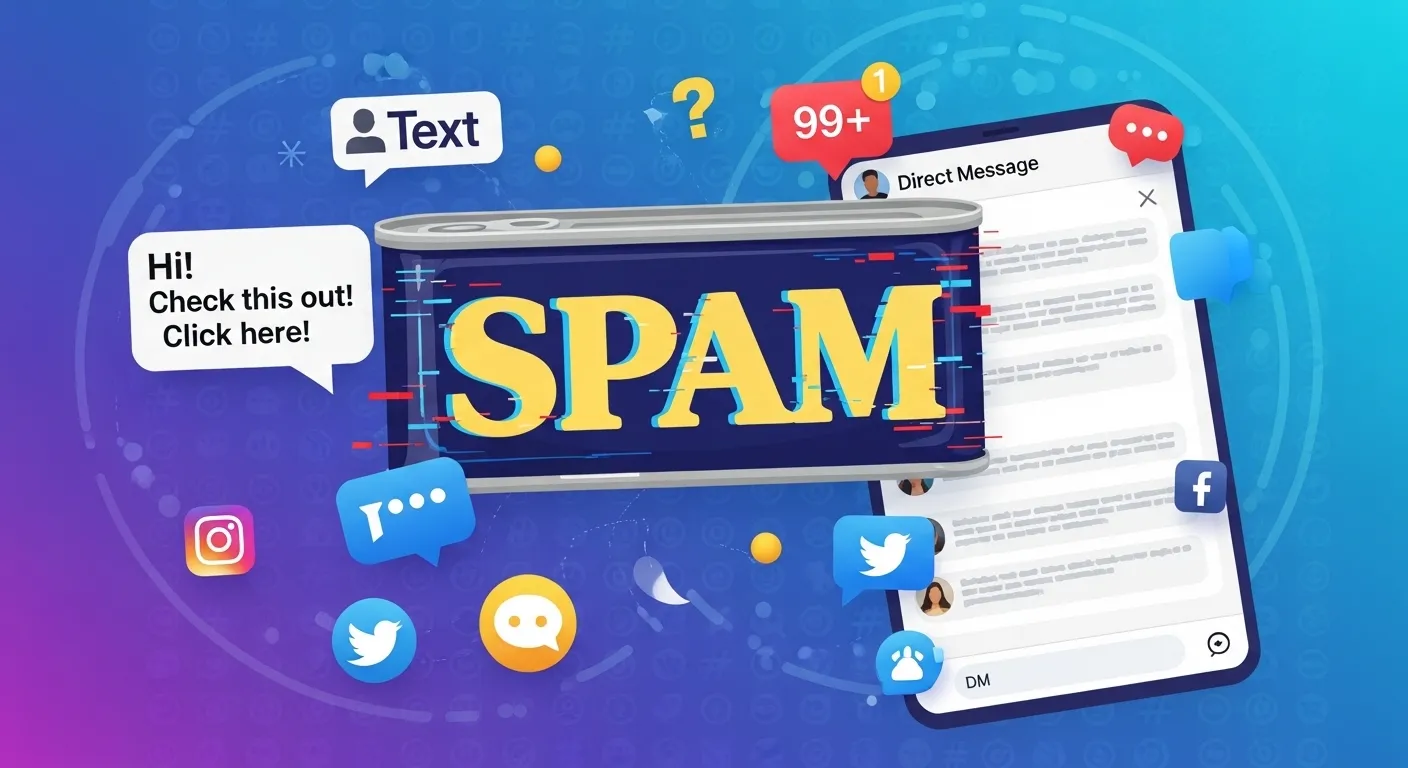
Spam meaning text slang is one of those internet terms almost everyone has seen, but not everyone interprets the same way. In casual texting, group chats, DMs, and social media, spam usually means sending too many messages, posts, or repeated content in a short time. It can be playful among friends (“Stop spamming the chat 😂”), mildly annoying (“You’re spamming my notifications”), or a serious moderation issue (“Account banned for spam”).
Understanding the slang meaning matters because the same word appears in very different contexts: texting, gaming, TikTok comments, Discord servers, email filters, and platform rules. Misreading the tone can make a joking comment sound like an accusation, or make a real moderation warning seem harmless.
Quick answer
In text slang, spam = excessive or repetitive messaging/content, usually unwanted or unnecessary. It can be joking (“You’re spamming me with memes”), descriptive (“That channel is spam”), or disciplinary (“No spam in the server”).
What does “spam” mean in text slang?
In everyday digital conversation, spam refers to a flood of messages, comments, posts, links, emojis, or other repeated content that overwhelms a conversation or feed.
| Context | What “spam” usually means |
|---|---|
| Text messages / group chats | Sending many messages rapidly, often unnecessarily. |
| Instagram / TikTok / X comments | Posting the same comment repeatedly or mass-commenting. |
| Discord / Slack / gaming chats | Flooding the channel with messages, emojis, GIFs, or repeated text. |
| Unsolicited bulk messages, advertisements, scams, or phishing. | |
| Online moderation | Behavior that clutters or disrupts communication spaces. |
The slang sense is broader than the technical email sense. A friend can “spam” you with photos from a trip without any malicious intent.
The core idea: volume + repetition + interruption
Most uses of “spam” in text slang involve three ingredients:
- Too much content — a sudden burst of messages.
- Repetition — the same or similar content repeated.
- Disruption — the content interrupts normal conversation or clutters notifications.
For example:
“Stop spamming the group chat with stickers.”
Here the complaint is not necessarily that stickers are bad—it’s that the quantity has become disruptive.
A short history of the term
The modern digital use of spam traces back to early online communities and internet culture, where repetitive, unwanted messages resembled an annoying flood of canned material. Over time, the word expanded beyond email into chat rooms, forums, games, texting, and social media.
Today, people often use it casually without thinking about the original internet-history context.
Common ways people use “spam” in texts and DMs
| Example message | Likely meaning |
|---|---|
| “Sorry for the spam 😅” | I sent a lot of messages quickly. |
| “Don’t spam me.” | Stop flooding my notifications or inbox. |
| “I’m going to spam photos from the concert.” | I’m about to send many photos; tone is playful. |
| “That account is spam.” | It posts repetitive, low-quality, scammy, or promotional content. |
| “No spam in this server.” | Channel rule: don’t flood messages or repeat content. |
Text slang vs. email spam: important distinction
| Feature | Text slang “spam” | Email spam |
|---|---|---|
| Intent | Often neutral or playful | Usually unsolicited or deceptive |
| Relationship | Often between friends/community members | Often from unknown senders |
| Typical example | 20 meme messages in a row | Mass marketing or phishing email |
| Moderation concern | Flooding or cluttering chat | Security, fraud, and inbox abuse |
Many readers assume “spam” always means scams. In slang usage, it often simply means excessive messaging.
Is “spam” always negative?
No. Tone depends on context.
| Use | Tone |
|---|---|
| “I’m about to spam vacation pics!” | Playful, self-aware |
| “Please don’t spam the channel.” | Corrective/moderation |
| “This account is spam.” | Strongly negative; implies low-quality, fake, or abusive content |
| “Sorry for the spam.” | Polite acknowledgment |
A useful rule: when someone labels an account or content “spam,” the meaning is usually negative. When someone labels their own burst of messages “spam,” it’s often lighthearted or apologetic.
Examples from real-life digital conversations
Group chat
A: “Look what I found!”
B: sends 15 screenshots
C: “Bro is spamming the chat 😭”
Meaning: B sent too many messages quickly.
Discord server
Moderator: “No emoji spam, please.”
Meaning: Don’t flood the channel with repeated emojis.
Instagram comments
“This comment section is full of spam bots.”
Meaning: Many comments are repetitive, promotional, fake, or automated.
Text DM
“Sorry for the spam—my signal was bad and the messages duplicated.”
Meaning: Multiple repeated messages were sent unintentionally.
What counts as spam on social platforms?
While platform rules vary, behavior commonly treated as spam includes:
- Posting the same comment repeatedly.
- Mass-tagging users.
- Sending unsolicited promotional links.
- Rapid-fire messages that overwhelm a channel.
- Copy-paste content across many threads.
- Bot-like repetition or automated posting.
Many platforms detect spam using signals such as repetition, frequency, link patterns, account behavior, and user reports.
Common misunderstandings
Misconception 1: “Spam always means scam.”
Reality: In text slang, it often just means too many messages. A friend can spam memes without scamming anyone.
Misconception 2: “Spam requires repeated identical text.”
Reality: A flood of different messages can still be considered spam if it overwhelms the conversation.
Misconception 3: “If friends don’t mind, it isn’t spam.”
Reality: Socially it may be acceptable among friends, but moderators or platform systems may still classify flood behavior as spam in public spaces.
Misconception 4: “One long message is always better than multiple short messages.”
Reality: Consolidating messages can reduce spammy appearance, but extremely long walls of text may create their own readability problems.
Related slang and alternatives
| Term | Meaning | Difference from “spam” |
|---|---|---|
| Flooding | Overwhelming a chat with rapid messages. | Often emphasizes volume and speed. |
| Blowing up my phone | Receiving many notifications/messages. | Focuses on the recipient’s experience. |
| Ping spam | Repeatedly mentioning/tagging users. | Specific to notifications/mentions. |
| Copypasta spam | Repeated copy-pasted text. | Specific subtype of spam. |
| Bot spam | Automated repetitive content. | Implies automation. |
How to avoid being seen as a spammer
- Combine related messages instead of sending ten separate fragments.
- Avoid repeating the same link or comment across multiple threads.
- Limit emoji/GIF bursts in public channels.
- Use threads, albums, or attachments for many photos/screenshots.
- Check community rules before posting promotions or announcements.
- Ask permission before mass-DMing or tagging many people.
A simple etiquette rule
If your messages would generate dozens of notifications for everyone in a group, pause and consolidate.
How moderators and platforms think about spam
Moderators usually care less about whether content is technically “unsolicited bulk mail” and more about whether it harms the conversation. They may remove content or mute users for:
- Repeated off-topic posting.
- Mass mentions or invites.
- Link dumping.
- Automated posting behavior.
- Disruptive message floods.
This is why someone can be warned for spam in a Discord server even if every message is unique.
Spam in gaming, Discord, and livestream chats
Gaming communities often use spam even more broadly than texting communities. Common examples:
- Repeating a phrase in Twitch or YouTube live chat.
- Copy-pasting a meme line hundreds of times.
- Sending rapid pings in Discord.
- Filling voice/text channels with soundboard or macro messages.
Moderators frequently set rate limits or slow mode specifically to reduce spam.
Spam in social media comments
On platforms like TikTok, Instagram, X, and YouTube, users may call content “spam” when it is:
- Repeated across many videos/posts.
- Generic engagement bait (“DM me for $$$”).
- Bot-generated or obviously automated.
- Mass-posted promotional material.
People also use “spam” more loosely for low-quality repetitive comments that add little to the discussion.
Quick reference: interpreting “spam” by context
| Phrase you see | Most likely interpretation |
|---|---|
| “Sorry for the spam” | “I sent too many messages.” |
| “Don’t spam the channel” | “Stop flooding or repeating content.” |
| “This account is spam” | “The account is fake, promotional, repetitive, or low-quality.” |
| “He spammed me with photos” | “He sent a large number of photos quickly.” |
| “Spam bots are everywhere” | “Automated repetitive accounts/comments are common.” |
Frequently Asked Questions
1. What does “spam” mean in a text message?
Usually it means sending too many messages, often in rapid succession. Example: “Sorry for the spam” means “Sorry for flooding your inbox.”
2. Does spam always mean scam or junk mail?
No. In text slang, spam often just means excessive messaging. Scams and junk mail are a separate, more technical use of the word.
3. Is sending many photos considered spam?
It can be, especially in group chats. Among friends, people often use “spam” playfully: “I’m going to spam vacation pics.” In public or moderated spaces, large bursts of media may be discouraged.
4. What is the difference between spam and flooding?
Flooding emphasizes the volume and speed of messages. Spam is broader and can include repetitive comments, links, promotions, bot posts, or any content that clutters communication spaces.
5. Why do moderators ban people for spam?
Because spam disrupts conversations, overwhelms channels, generates excessive notifications, and can be associated with scams, bots, or promotional abuse.
6. If I send three messages in a row, is that spam?
Not necessarily. Context matters. A few short follow-ups are usually normal; dozens of rapid-fire messages, repeated text, or unsolicited promotions are more likely to be perceived as spam.
7. What does “stop spamming me” usually mean?
It generally means stop sending so many messages, notifications, tags, or repeated content. The speaker is reacting to volume or repetition rather than necessarily accusing you of fraud.
Conclusion
Spam meaning text slang is much broader than the classic email definition. In everyday digital conversation, spam usually means excessive, repetitive, or disruptive messaging/content—whether that is a meme barrage in a group chat, a flood of emojis in Discord, or repeated comments on social media.
The safest interpretation is:
If someone says you’re spamming, they mean your messages or posts are coming too frequently, repeating too much, or cluttering the conversation.
To avoid being seen as spammy:
- Consolidate related messages.
- Don’t repeat the same content across multiple threads.
- Use albums/attachments for many photos.
- Respect community rate limits and rules.
- Avoid mass tagging or unsolicited promotions.
Understanding the tone and context—playful among friends, corrective in communities, or negative when describing accounts—will help you interpret “spam” accurately and communicate more smoothly online.