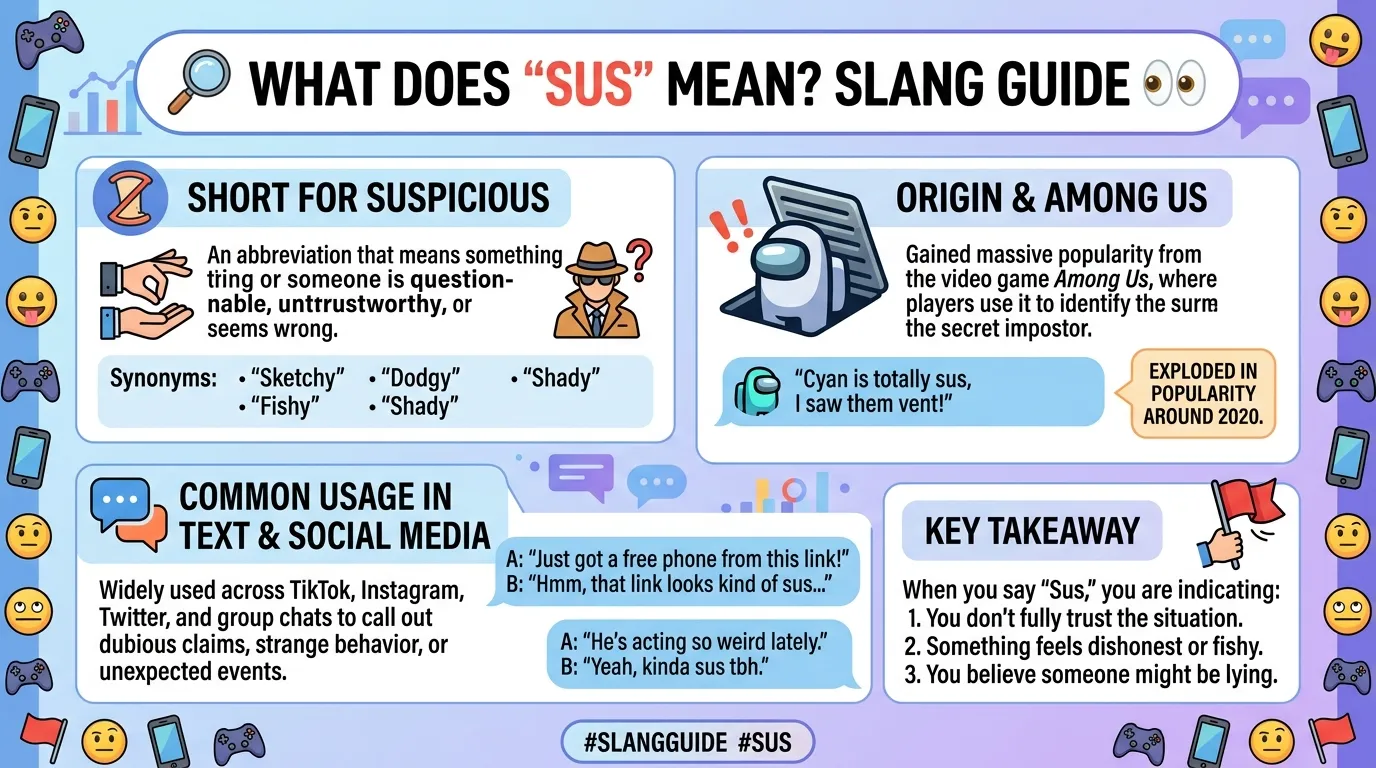
Have you ever received a text that says, “That’s kinda sus” and wondered what the person actually meant? Or maybe you’ve seen sus all over TikTok, Instagram, Snapchat, Discord, Reddit, or gaming chats and assumed it came entirely from Among Us. You’re not alone.
The sus meaning slang is usually simple: sus means “suspicious,” “suspect,” or something that seems questionable, shady, or hard to trust. For example, if your friend suddenly refuses to explain where they’ve been, you might jokingly say, “You’re acting sus.” 😏
The word became hugely popular through the online game Among Us, especially during the internet boom around 2020. However, sus is much older than the game. Dictionaries and historical slang records show that shortened forms of the word were used decades before Among Us became popular.
Today, sus slang has moved far beyond gaming. People use it to describe suspicious behavior, strange messages, questionable excuses, awkward situations, and even things that simply feel “off.”
In this guide, you’ll learn exactly what sus means, where it came from, how people use it online, what it means in texting and dating, and how to use it naturally without sounding forced.
What Does Sus Mean in Slang?
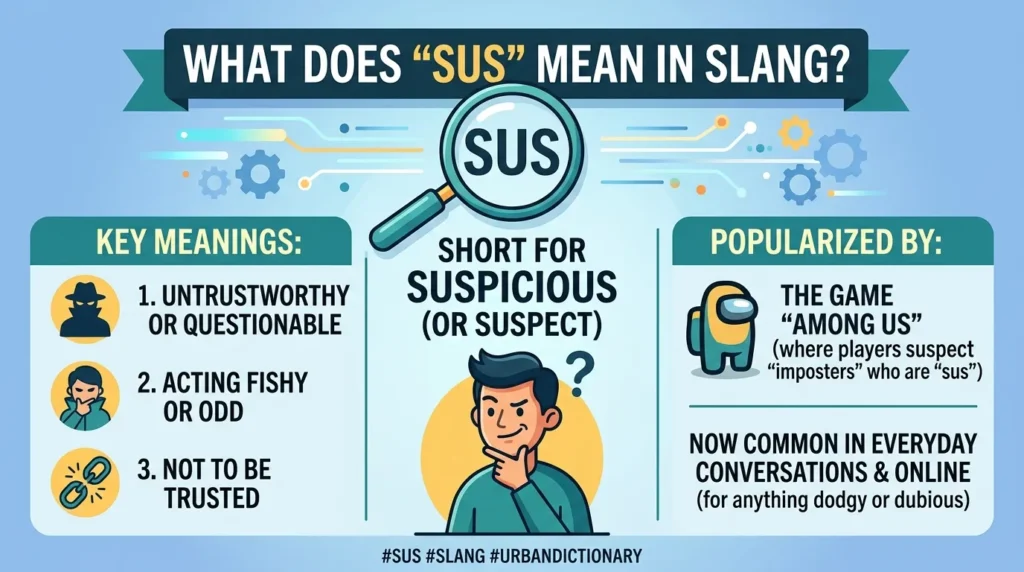
Sus is slang for “suspicious” or “suspect.” It describes a person, action, statement, situation, or object that seems questionable, dishonest, unusual, or untrustworthy.
In simple terms:
Sus = suspicious, shady, questionable, or fishy.
For example:
- “Why are you hiding your phone? That’s sus.”
- “His excuse sounds pretty sus.”
- “This website looks sus.”
- “She was acting sus all night.”
- “That deal seems sus to me.”
The word can be serious, playful, sarcastic, or humorous, depending on the context.
If someone says, “Your story is sus,” they may genuinely doubt what you said. But if a friend says, “You ate the last cookie? Sus 👀,” they may simply be joking.
Merriam-Webster defines sus as a slang synonym for suspicious or suspect and notes that the word existed long before Among Us.
Sus Meaning at a Glance
| Fact | Explanation |
|---|---|
| Word | Sus |
| Basic meaning | Suspicious or suspect |
| Pronunciation | “Suhs” |
| Type | Internet slang / informal slang |
| Common use | Texting, social media, gaming, everyday conversation |
| Popularized by | Among Us |
| Modern peak | Around 2020 |
| Tone | Usually casual, playful, skeptical, or humorous |
| Similar words | Shady, sketchy, fishy, suspicious, questionable |
| Opposite ideas | Trustworthy, believable, legit, normal |
| Common phrase | “That’s sus” / “You’re acting sus” |
What Is the Origin of Sus?
One of the biggest misconceptions about sus slang is that Among Us invented the word.
It didn’t.
The game played a major role in making sus globally recognizable, but the slang term existed before the game.
Merriam-Webster reports historical uses of sus going back to the early 20th century, including older slang meanings connected with a suspected person or suspicion. It also records adjectival uses meaning “suspicious” or “suspected” decades before Among Us.
Dictionary.com lists sus as first recorded around 1935–1940 and explains that it developed as a shortening related to suspicious.
So, the history is more interesting than the common internet story suggests.
Sus Before the Internet
People have used shortened forms of suspicious and suspect in informal speech for a long time.
The related British slang suss also developed into a verb meaning to figure something out or investigate something. Merriam-Webster dates the verb suss to the 1960s and connects it with suspect.
The modern adjective sus, however, became particularly useful because it was short, easy to say, and easy to type.
That made it perfect for casual conversations.
The Role of the “Sus Law”
There is another historical use worth knowing.
In Britain, “sus” was associated with the so-called Sus law, a nickname connected with stop-and-search powers that allowed police to act on suspicion. The term became particularly significant in discussions of policing and racial discrimination in Britain.
This historical meaning is very different from the playful internet use you see today.
It is therefore important not to assume that every historical use of sus came from gaming culture.
How Did Among Us Make Sus So Popular? 🎮
If sus already existed, why does everyone associate it with Among Us?
The answer is simple: the game gave the word the perfect environment to spread.
Among Us was released in 2018, but its popularity exploded in 2020. Players had to identify hidden impostors among a group of crewmates. Suspicion was the central mechanic of the game.
If another player behaved strangely, avoided tasks, appeared near a dead body, or gave an inconsistent explanation, someone could simply say:
“That’s sus.”
The phrase was short enough to type quickly during an emergency meeting.
The game’s 2020 explosion helped turn sus from relatively niche slang into a mainstream internet expression. Merriam-Webster specifically notes that Among Us brought the word renewed attention but did not create it.
The connection became so strong that many people learned sus meaning through Among Us rather than through ordinary slang.
Why Sus Worked So Well in Among Us
The word fit the game perfectly because:
- Players constantly looked for suspicious behavior.
- Chat messages needed to be short.
- Players had limited time to make accusations.
- “Suspicious” was too long for rapid-fire game chat.
- Saying “sus” made accusations feel more humorous.
- Memes helped the word spread outside the game.
Eventually, sus became bigger than Among Us itself.
What Does Sus Mean in Texting? 📱
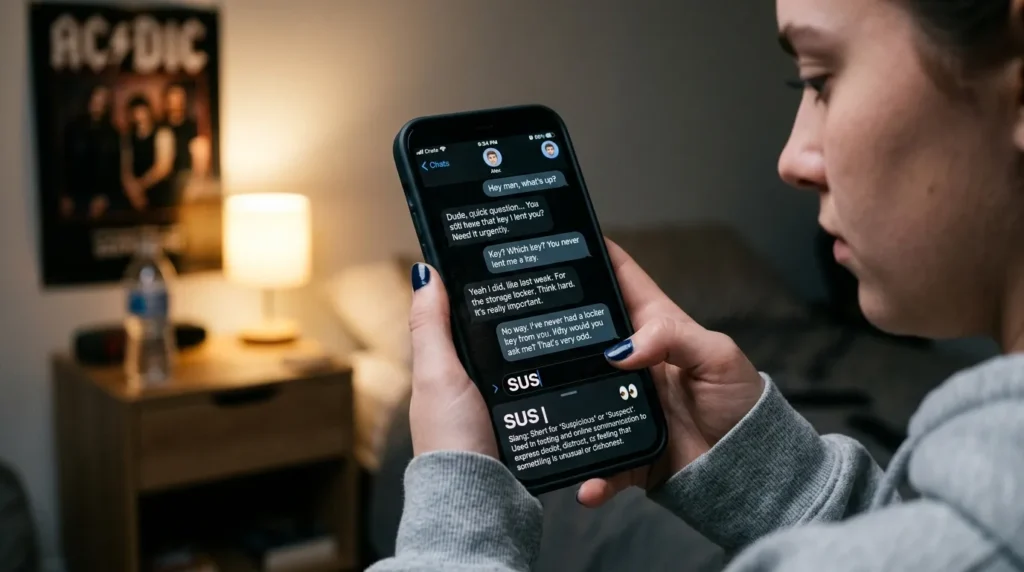
In text messages, sus usually means suspicious, questionable, or shady.
The exact meaning depends on the situation.
Example 1: Questionable Behavior
Person A: Why did you delete your message?
Person B: No reason.
Person A: Hmm… sus 👀
Here, sus means that seems suspicious.
Example 2: A Strange Excuse
Friend: I couldn’t answer because my phone suddenly stopped working.
You: But you posted on Instagram five minutes ago. Sus 😂
The speaker isn’t necessarily making a serious accusation. They’re pointing out an inconsistency.
Example 3: A Suspicious Person
“That guy is acting sus.”
This means the person is behaving in a way that makes you suspicious.
Example 4: A Suspicious Situation
“The whole situation is sus.”
Here, sus describes the situation rather than a person.
What Does Sus Mean on TikTok?
On TikTok, sus generally keeps its basic meaning: suspicious, strange, questionable, or shady.
However, TikTok often uses the word in a humorous or exaggerated way.
Someone might post a video of a person doing something completely normal but caption it:
“Bro is looking kinda sus 👀”
The joke comes from treating ordinary behavior as if it were evidence of something suspicious.
TikTok also helped spread phrases and variations related to sus, including exaggerated expressions such as sussy and meme-based references connected with Among Us.
Because TikTok favors short captions and recognizable slang, sus works especially well in comments and video captions.
What Does Sus Mean on Instagram?
On Instagram, sus can appear in:
- Comments
- DMs
- Captions
- Stories
- Memes
- Group chats
- Reactions to unusual posts
For example:
“Why did you post this at 3 a.m.? Sus.”
Or:
“That caption is sus 😂.”
Instagram users may also use sus when teasing friends.
The word doesn’t automatically mean that someone has done something wrong. Context matters.
What Does Sus Mean on Snapchat?
On Snapchat, sus is commonly used in quick chats and reactions.
Snapchat conversations are often informal, so shortened words fit naturally.
For example:
Friend: “I’m going to bed early tonight.”
You: “At 2 a.m.? Sus 😂”
Or:
“Why are you sending snaps but ignoring my messages? Kinda sus.”
The tone may be playful rather than genuinely suspicious.
What Does Sus Mean on Discord?
On Discord, sus is especially common in gaming communities, meme servers, and casual group chats.
A Discord user might say:
- “That link looks sus.”
- “Bro is sus.”
- “Your explanation is sus.”
- “Why did you leave when we joined? Sus.”
- “That new account seems sus.”
In gaming communities, the word may still carry an obvious Among Us reference.
But it has also become general internet slang.
What Does Sus Mean in Gaming? 🎮
Gaming is where many people became familiar with sus.
In Among Us, calling someone sus means you suspect that player may be the Impostor.
For example:
“Red is sus.”
This means:
“I think Red might be the Impostor.”
But gamers also use the word outside Among Us.
Imagine you’re playing an online shooter and another player suddenly appears behind your entire team without explanation.
Someone might type:
“That was sus.”
In this case, sus means the player’s behavior seemed suspicious or possibly unfair.
It can also describe:
- Strange gameplay
- Suspicious players
- Unusual movements
- Questionable strategies
- Possible cheating
- Strange accounts
- Unexplained behavior
What Does Sus Mean on Reddit?
Reddit uses sus in a wide variety of communities.
You might see it in:
- Gaming discussions
- Meme communities
- Relationship discussions
- Technology forums
- Shopping discussions
- News discussions
- Everyday conversations
For example:
“This seller has no reviews, the price is half of everyone else’s, and they want payment outside the platform. Sounds sus.”
Here, sus means potentially unsafe or untrustworthy.
Another Reddit-style example might be:
“OP’s story has a few details that don’t add up. Pretty sus.”
The word often works as a compact way of expressing doubt.
What Does Sus Mean in Dating? ❤️
In dating, sus usually means that someone’s behavior makes you suspicious.
For example:
“He says he’s single, but he won’t let anyone see his phone. That’s sus.”
Or:
“She disappears every weekend and never explains where she goes. Kinda sus.”
People may use sus when they notice:
- Contradictory stories
- Secretive behavior
- Strange communication patterns
- Sudden changes in behavior
- Suspicious social media activity
- Unclear relationship status
However, calling someone sus isn’t proof that they’re lying or cheating.
It’s simply an expression of suspicion.
That’s an important distinction.
What Does Sus Mean at Work?
You can encounter sus in workplace conversations, especially among coworkers who communicate casually through chat.
For example:
“The meeting was moved to 7 a.m. with no explanation. Sus.”
Or:
“That email asking us to download a random file looks sus.”
The second example could involve a real security concern.
Still, sus is informal slang, so it’s usually better suited to casual internal communication than formal business writing.
Instead of writing:
“This contract looks sus.”
in a formal report, you might write:
“This contract contains several unusual clauses that require review.”
That communicates the concern more professionally.
Is Sus Positive or Negative?
Most of the time, sus has a negative or skeptical meaning.
It suggests that something isn’t quite right.
However, the emotional strength can vary.
Mild and Playful
“You’re acting sus 😂.”
This could simply be friendly teasing.
Moderately Suspicious
“That explanation sounds sus.”
The speaker genuinely doubts the explanation.
Stronger Concern
“That website is extremely sus. Don’t enter your card details.”
Here, the word communicates a serious warning.
So, sus does not always mean “bad.” It means something appears suspicious or questionable.
Sus vs. Suspicious: What’s the Difference?
The biggest difference is tone and formality.
| Sus | Suspicious |
|---|---|
| Slang | Standard English |
| Very informal | Neutral/formal |
| Common online | Common everywhere |
| Short and casual | Full word |
| Often humorous | Can be serious |
| Common in texting | Appropriate in professional writing |
Compare:
“That guy is sus.”
with:
“That guy is suspicious.”
Both communicate roughly the same idea, but the first sounds much more casual.
Sus vs. Shady
Shady and sus are closely related, but they aren’t always identical.
Sus means something seems suspicious or questionable.
Shady often suggests dishonest, unethical, or intentionally secretive behavior.
Examples:
- “That explanation is sus.”
- “That business deal seems shady.”
A strange explanation might be sus without necessarily being shady.
Sus vs. Sketchy
Sketchy usually describes something that feels unsafe, unreliable, or questionable.
For example:
“That neighborhood looks sketchy.”
You could say:
“That neighborhood seems sus,”
but sketchy may communicate a stronger sense of danger or unreliability.
Sus vs. Fishy
Fishy is another close synonym.
If something doesn’t seem believable, you might say:
“Something about his story feels fishy.”
Or:
“Something about his story feels sus.”
Both work in casual conversation.
The difference is mostly style. Sus sounds more modern and internet-oriented.
Common Sus Phrases and What They Mean
Here are some popular expressions you may encounter online.
“That’s sus”
Something seems suspicious.
Example:
“Why did he suddenly leave? That’s sus.”
“You’re sus”
The speaker thinks you’re behaving suspiciously.
Example:
“You knew about the surprise party? You’re sus.”
“Pretty sus”
Something seems quite suspicious.
Example:
“He suddenly became rich overnight. Pretty sus.”
“Kinda sus”
Something seems slightly suspicious.
Example:
“She hasn’t replied all day but keeps viewing my stories. Kinda sus.”
“Very sus”
The speaker thinks something is obviously suspicious.
Example:
“That fake giveaway asking for your password is very sus.”
“Sussy”
A playful variation of sus.
It often appears in memes and joking internet language.
“Sus behavior”
Behavior that seems suspicious.
Example:
“Deleting the messages was definitely sus behavior.”
Real-Life Conversation Examples
Example 1: Friends
Alex: Where were you last night?
Sam: Just out.
Alex: With who?
Sam: Nobody.
Alex: Hmm… sus. 😂
Here, sus is playful.
Example 2: Dating
Mia: He says he’s not talking to anyone else.
Sara: But he hides his phone?
Mia: Yeah.
Sara: That’s pretty sus.
Here, sus expresses genuine doubt.
Example 3: Online Shopping
Customer: This phone is listed for $50.
Friend: Brand new?
Customer: Yeah.
Friend: That’s sus. Check the seller first.
Here, sus signals caution.
Example 4: Gaming
Player 1: Blue followed me around the entire map.
Player 2: Blue is sus.
Player 3: Agreed. Vote Blue.
Here, the word has its classic Among Us meaning.
Example 5: Workplace Chat
Coworker: The boss scheduled a surprise meeting for everyone tomorrow.
You: At 6 a.m.? Sus. 😭
This is casual workplace slang, not formal business language.
Why Do People Say Sus Instead of Suspicious?
There are several reasons.
1. It’s Short
Typing sus takes three letters.
Typing suspicious takes eleven.
That matters in fast-moving digital conversations.
2. It Sounds Casual
Sus feels less serious than suspicious.
That makes it useful when teasing friends.
3. It’s Memorable
The word became strongly associated with internet culture and Among Us.
4. It Can Be Humorous
Saying:
“Bro is sus 👀”
often feels funnier than:
“Bro’s behavior is suspicious.”
5. It Works in Many Contexts
You can describe a person, message, website, excuse, situation, product, decision, or behavior as sus.
Common Mistakes When Using Sus
Although sus is easy to understand, people sometimes misuse it.
Mistake 1: Treating Sus as a Formal Word
Avoid using sus in formal academic or professional writing unless you’re specifically discussing slang.
Use suspicious instead.
Mistake 2: Assuming Sus Always Means Lying
Someone can be sus without actually doing anything wrong.
The word expresses suspicion, not proof.
Mistake 3: Thinking Among Us Invented It
Among Us massively popularized sus, but historical uses predate the game.
Mistake 4: Using It in Every Sentence
Like any slang term, overusing sus can make your communication sound forced.
Use it when the situation naturally calls for it.
Mistake 5: Ignoring Context
“That’s sus” could mean:
- “That’s suspicious.”
- “That’s weird.”
- “I don’t believe you.”
- “That’s shady.”
- “I’m joking about this.”
- “That reminds me of Among Us.”
You need to read the surrounding conversation.
Is Sus Still Popular?
Yes, sus remains recognizable internet slang, although its cultural association with Among Us was strongest during the game’s massive 2020 popularity surge.
The word has outgrown its original gaming context.
Today, people can use sus without talking about Among Us at all.
That is a common pattern in internet language. A term begins in one community, spreads through memes and social platforms, and eventually becomes part of broader informal communication.
Among Us gave sus enormous visibility, but the word’s older history shows that internet culture didn’t create it from nothing.
Sus and Internet Culture
The popularity of sus shows how quickly digital communities can influence everyday language.
A short word can move through:
Gaming → Memes → TikTok → Instagram → Discord → Texting → Everyday Speech
This isn’t unusual.
The internet constantly rewards language that is:
- Short
- Memorable
- Easy to type
- Easy to understand
- Funny
- Flexible
- Highly shareable
Sus checks nearly every box.
Related Slang Terms
If you’re learning internet slang, you’ll probably encounter several words related to sus.
Shady
Something that seems dishonest or questionable.
Sketchy
Something that seems unsafe, unreliable, or suspicious.
Fishy
Something that doesn’t seem believable.
Weird
Something unusual or strange.
Legit
The opposite idea: genuine, trustworthy, or real.
Sussy
A playful variation of sus.
Suss
A related word, especially in British English, that can mean to investigate or figure something out. Merriam-Webster lists suss as a verb meaning to figure out or investigate, usually in the phrase “suss out.”
How to Use Sus Naturally
If you want to use sus slang without sounding awkward, keep it simple.
Good examples include:
- “That sounds sus.”
- “You’re acting sus.”
- “This website looks sus.”
- “Kinda sus, not gonna lie.”
- “That’s pretty sus 👀.”
- “Something about this feels sus.”
- “That excuse is sus.”
- “Bro is sus 😂.”
You don’t need to force a gaming reference into every use.
The modern meaning is broad enough to work in normal casual conversations.
Is Sus Appropriate for Everyone?
Sus is informal slang, so it depends on your audience.
It’s generally fine in:
- Text messages
- Casual chats
- Gaming
- Social media
- Memes
- Discord
- Informal group conversations
Use more caution in:
- Job applications
- Academic papers
- Formal emails
- Business reports
- Legal documents
- Professional presentations
For formal communication, choose words such as:
suspicious, questionable, concerning, unusual, doubtful, or potentially unreliable.
FAQ
What does sus mean in slang?
Sus means suspicious, suspect, questionable, or shady. People use it when someone’s behavior or a situation seems strange or untrustworthy. The term is especially common in texting, social media, gaming, and memes.
Is sus short for suspicious?
Yes. In modern slang, sus is commonly understood as a shortened form of suspicious. It can also relate to suspect and older slang uses. Dictionary.com identifies sus as a shortening related to suspicious and dates the word to the 1930s–40s.
Does sus mean bad?
Not necessarily. Sus means suspicious, not automatically bad. Someone might call a friend’s behavior “sus” as a joke, even when nothing wrong has happened.
Did Among Us invent the word sus?
No. Among Us popularized the word dramatically, especially in 2020, but historical evidence shows that sus existed decades before the game.
What does sus mean in texting?
In texting, sus usually means “that seems suspicious” or “I don’t fully believe that.” It can be serious or playful depending on the conversation.
What does sus mean on TikTok?
On TikTok, sus means suspicious, questionable, or strange. Users often use it jokingly in comments, captions, memes, and reaction videos.
What does sus mean in Among Us?
In Among Us, sus means a player appears suspicious and may be the Impostor. For example, saying “Blue is sus” means you suspect Blue.
What is the opposite of sus?
Depending on the situation, possible opposites include legit, trustworthy, believable, genuine, normal, safe, or credible.
Is sus a bad word?
No. Sus is not inherently a swear word or offensive term. It’s casual slang. However, calling someone sus can sound accusatory if the context is serious.
What does “pretty sus” mean?
Pretty sus means quite suspicious or questionable. The phrase became especially recognizable through internet culture and Among Us memes.
Final Takeaway
The simplest answer to sus meaning slang is:
Sus means suspicious, suspect, questionable, or shady.
It’s a short, informal word people use when something doesn’t seem quite right.
Although Among Us played a huge role in making sus famous around 2020, the word itself is much older. Historical dictionary evidence shows that sus and related forms existed long before the game.
Today, you’ll find sus in texting, TikTok comments, Instagram captions, Snapchat chats, Discord servers, Reddit discussions, gaming communities, dating conversations, memes, and casual everyday speech.
The key is context.
If a friend says, “You’re sus 😂,” they’re probably teasing you. If someone says, “That website is sus,” they may be warning you that it looks unreliable. And if someone says “Red is sus” during Among Us, they’re probably accusing Red of being the Impostor.
So the next time you see “sus” in a message, don’t overthink it. In most modern conversations, it simply means:
“Something about this seems suspicious.” 👀