In today’s fast-moving digital world, people want information quickly. Whether you’re scrolling through social media, replying to messages, reading emails, or browsing online forums, you’ve probably seen the abbreviation “TLDR” appear everywhere. But what exactly does it mean, and why has it become such a popular internet slang term?
The TLDR meaning in text is one of the most searched texting abbreviations because it reflects how modern communication works: fast, short, and efficient. From TikTok comments to Reddit discussions, workplace chats, gaming communities, and even professional emails, TLDR has become a universal shorthand for summarizing information.
Understanding the meaning of TLDR in texting, social media, and online conversations can help you communicate more naturally and avoid confusion. It’s especially important for students, professionals, bloggers, and anyone active online. Many people use it casually, while others misunderstand it as rude or dismissive. Knowing the correct context makes a big difference.
In this complete guide, you’ll learn:
- The exact TLDR meaning in text
- Where the term came from
- How people use it on social media and messaging apps
- Examples of TLDR in conversations
- Whether it’s rude or polite
- Similar slang terms and alternatives
- Common mistakes people make
- FAQs and modern texting trends
By the end, you’ll fully understand why TLDR became one of the internet’s most recognizable abbreviations.
What Does TLDR Mean in Text?
TLDR stands for:
“Too Long; Didn’t Read.”
It is used when:
- A message, article, post, or explanation is extremely long
- Someone wants a quick summary
- A reader skips lengthy details
- A writer provides a short version of a long explanation
The phrase can be used in two main ways:
| Usage Type | Meaning |
|---|---|
| As a reaction | “Your message was too long, so I didn’t read it.” |
| As a summary label | “Here’s the short version.” |
Today, the second meaning is much more common online.
Simple Definition of TLDR
Here’s the easiest way to understand it:
- TLDR = Brief summary of something long
For example:
Long message:
“We spent three hours discussing project deadlines, budget issues, marketing plans, and staffing concerns…”
TLDR:
“Project delayed by two weeks due to budget problems.”
That short summary is the “TLDR.”
The History and Origin of TLDR
The term began appearing in early internet forums during the late 1990s and early 2000s. It became especially popular on:
- Online discussion boards
- Internet forums
- Blogs
- Gaming communities
Originally, people used “Too Long; Didn’t Read” sarcastically to criticize long posts. Over time, internet culture changed the meaning into something more useful and friendly.
Now many writers intentionally add a TLDR section at the beginning or end of content to help readers quickly understand the main point.
This change reflects modern online behavior:
- Short attention spans
- Fast scrolling habits
- Mobile-first reading
- Information overload
TLDR Meaning on Social Media
The meaning stays mostly the same across platforms, but the tone can change depending on where it’s used.
TLDR on TikTok
On TikTok, creators often use TLDR in captions or comments to summarize a long storytime video.
Example:
“TLDR: My ex texted me after 3 years.”
It helps viewers decide whether they want to watch the entire video.
TLDR on Reddit
Reddit helped popularize the term. Many Reddit posts include a summary at the bottom.
Example:
TLDR: Neighbor stole my package and got caught on camera.
This allows users to understand the story quickly without reading thousands of words.
TLDR on Instagram
Instagram users often place TLDR summaries in long captions.
Example:
“TLDR: We moved to another city and love it.”
TLDR on X (Twitter)
Because character limits encourage brevity, users sometimes add TLDR when summarizing threads.
Example:
“TLDR: New update improves battery life.”
TLDR Meaning in Text Messages
In texting, TLDR usually means:
- “Please summarize”
- “Here’s the short version”
- “I skipped the long explanation”
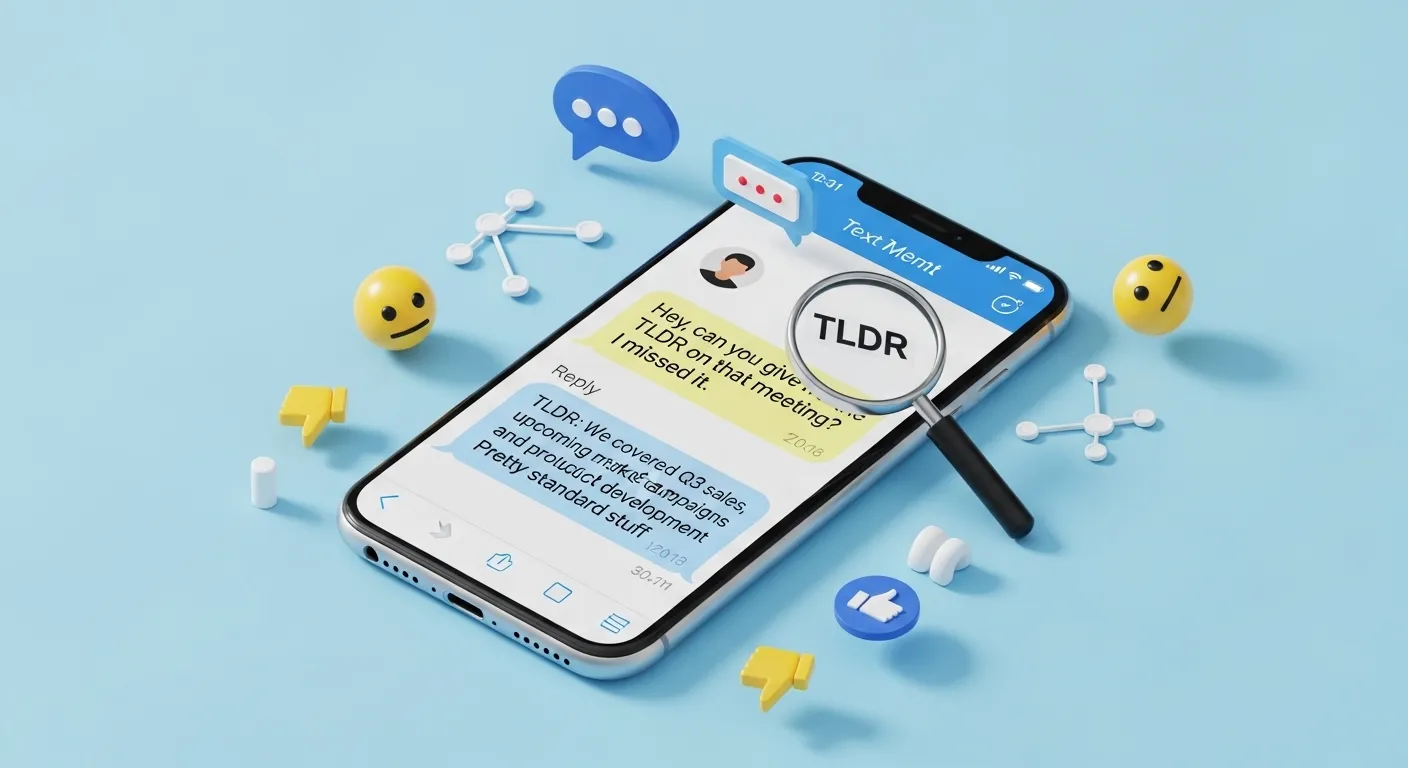
Example Conversation
Friend:
“I wrote a 15-paragraph explanation about what happened at work today…”
You:
“TLDR?”
Meaning:
“Can you give me the short version?”
How to Use TLDR Correctly
Using TLDR is simple once you understand the tone and context.
1. Use TLDR Before a Summary
This is the most common and polite use.
Example:
TLDR: The event was canceled because of rain.
2. Use It in Long Emails or Posts
Professional writers often include TLDR sections for busy readers.
Example:
TLDR: Sales increased by 18% this quarter.
3. Use It Casually With Friends
Friends often use it jokingly in conversations.
Example:
“TLDR: I embarrassed myself at the party.”
Is TLDR Rude?
This depends on how you use it.
When TLDR Can Sound Rude
If you say:
“TLDR.”
by itself after someone sends a heartfelt or detailed message, it may sound dismissive or disrespectful.
It can imply:
- “I don’t care enough to read this.”
- “You talk too much.”
When TLDR Is Totally Fine
It is generally acceptable when:
- Summarizing information
- Asking for a quick recap politely
- Used humorously among friends
- Added by the writer themselves
Polite Example:
“TLDR: The meeting went well, but we need more budget approval.”
Examples of TLDR in Everyday Conversations
Example 1: School
Student:
“I studied all night, forgot my calculator, panicked during the exam, and still somehow passed.”
Friend:
“TLDR?”
Student:
“Forgot calculator but passed anyway.”
Example 2: Workplace
Manager:
“TLDR: Project launch moved to Friday.”
Example 3: Relationships
Friend:
“TLDR: We broke up but stayed friends.”
Example 4: Gaming
“TLDR: New patch nerfed all sniper rifles.”
Why TLDR Became So Popular
There are several reasons this abbreviation exploded online.
1. People Read Quickly
Modern internet users skim content instead of reading every word.
2. Social Media Encourages Speed
Apps like TikTok and Instagram reward fast content consumption.
3. Information Overload
People receive:
- Emails
- Notifications
- Messages
- News updates
- Posts
TLDR helps simplify everything.
4. Mobile Users Prefer Short Content
Reading long paragraphs on phones can feel exhausting.
Different Ways People Write TLDR
You may see variations like:
| Version | Meaning |
|---|---|
| TLDR | Standard version |
| tl;dr | Original punctuation style |
| tldr | Lowercase casual version |
| TL;DR | Common internet formatting |
All mean the same thing.
TLDR vs Summary: What’s the Difference?
Many people think they’re identical, but there’s a subtle difference.
| TLDR | Summary |
|---|---|
| Informal internet slang | Formal writing term |
| Common online | Used academically/professionally |
| Casual tone | Neutral tone |
| Often very short | Can be detailed |
A TLDR is usually much shorter than a traditional summary.
Common Misunderstandings About TLDR
Misconception 1: TLDR Is Always Rude
Not true. Most people use it helpfully, not offensively.
Misconception 2: Only Teenagers Use TLDR
Actually, professionals, marketers, students, and journalists use it too.
Misconception 3: TLDR Means Lazy Reading
Sometimes readers genuinely need a quick overview because they are busy.
Related Slang Terms Similar to TLDR
Here are some internet abbreviations related to TLDR.
| Slang | Meaning |
|---|---|
| IMO | In My Opinion |
| BTW | By The Way |
| FYI | For Your Information |
| IDK | I Don’t Know |
| BRB | Be Right Back |
| SMH | Shaking My Head |
| ICYMI | In Case You Missed It |
These terms are commonly used alongside TLDR in online conversations.
When You Should Use TLDR
TLDR works best in these situations:
Good Situations
- Long emails
- Blog posts
- Reddit posts
- Work updates
- Group chats
- Study notes
- Tutorials
Situations to Avoid
- Serious emotional messages
- Sensitive conversations
- Formal academic papers
- Professional legal writing
Tone matters a lot.
TLDR in Professional Communication
Interestingly, TLDR has entered workplace culture.
Many professionals now include:
- Executive summaries
- Key takeaways
- Quick overviews
Some even label them “TLDR” in internal chats.
Example:
TLDR: Client approved the campaign. Launch starts Monday.
This saves time for busy teams.
How Content Creators Use TLDR
Bloggers, YouTubers, and influencers use TLDR to improve engagement.
Benefits:
- Helps readers stay interested
- Improves readability
- Makes content more accessible
- Encourages shares
- Supports SEO by clarifying topic intent
Many articles now place TLDR sections near the top for impatient readers.
Funniest TLDR Examples Online
Internet users often create humorous TLDR summaries.
Examples:
- “TLDR: I trusted a raccoon and lost.”
- “TLDR: Never microwave eggs.”
- “TLDR: Cat won the argument.”
These funny summaries became a meme format online.
Generational Use of TLDR
Different age groups use it differently.
| Generation | Usage Style |
|---|---|
| Gen Z | Casual, meme-heavy |
| Millennials | Common in texting and work |
| Gen X | More professional usage |
| Boomers | Less common but growing |
TLDR in Gaming Culture
Gamers frequently use TLDR to explain:
- Patch notes
- Game updates
- Strategy guides
- Match summaries
Example:
“TLDR: Shotguns are overpowered again.”
Best Alternatives to TLDR
If you want something more professional or polite, try:
- In short
- Briefly
- Quick summary
- Main point
- Long story short
- Key takeaway
- Bottom line
Example:
“Long story short, we missed the flight.”
How to Write a Good TLDR
A strong TLDR should:
✅ Be short
✅ Include only key information
✅ Avoid unnecessary details
✅ Stay clear and easy to understand
Bad TLDR Example
“TLDR: Lots of complicated stuff happened.”
Too vague.
Good TLDR Example
“TLDR: We lost power during the storm but everyone was safe.”
Clear and useful.
TLDR and Modern Attention Spans
The rise of TLDR reflects broader internet trends:
- Short-form video content
- Fast-scrolling behavior
- Instant communication
- Bite-sized information
Platforms like TikTok and YouTube Shorts have reinforced the demand for quick summaries.
Frequently Asked Questions (FAQs)
What does TLDR stand for in texting?
TLDR stands for “Too Long; Didn’t Read.” It usually refers to a short summary of a longer message or article.
Is TLDR rude to say?
Not always. It depends on tone and context. Using it politely as a summary is completely normal, but using it dismissively may sound rude.
What is the difference between TLDR and a summary?
A TLDR is typically shorter, more casual, and internet-focused, while a summary can be more formal and detailed.
Why do people use TLDR online?
People use TLDR because online readers prefer quick, easy-to-understand information without reading long explanations.
Can TLDR be used professionally?
Yes. Many workplaces now use TLDR sections in emails, reports, and team chats to save time.
Is TLDR still popular in 2026?
Absolutely. TLDR remains widely used across texting apps, social media, blogs, forums, and workplace communication.
Where should I place a TLDR in writing?
Most writers place it:
- At the beginning for quick previews
- Or at the end as a final recap
Both styles are common.
Final Thoughts
The TLDR meaning in text goes far beyond a simple abbreviation. It represents how digital communication has evolved in an age of endless information and short attention spans.
What started as internet slang became a powerful communication tool used by:
- Students
- Professionals
- Content creators
- Gamers
- Social media users
- Businesses
Today, TLDR helps people:
- Understand information faster
- Save time
- Improve readability
- Communicate more efficiently
The key is using it appropriately. In casual settings, it can be funny and practical. In professional situations, it can improve clarity and productivity. But in emotional or sensitive conversations, it’s important to stay thoughtful about tone.
Quick TLDR of This Article 😉
- TLDR means “Too Long; Didn’t Read.”
- It’s commonly used for summaries online.
- The term is popular across texting, TikTok, Reddit, and workplace chats.
- TLDR is not always rude—it depends on context.
- It reflects the modern internet’s preference for fast, concise communication.
As online communication keeps evolving, abbreviations like TLDR will likely remain an important part of internet culture for years to come.