Have you ever come across the term ATP and wondered what it actually means? The answer depends on the context. ATP meaning can refer to a vital molecule in biology, a world-famous tennis organization, technology terms, business abbreviations, or even legal and financial phrases.
Understanding ATP meaning is important because this abbreviation appears in science textbooks, sports news, medical discussions, workplaces, and everyday conversations. Whether you’re a student, athlete, healthcare professional, or simply curious, knowing the different meanings of ATP can help you avoid confusion.
In this guide, we’ll explore the most common meanings of ATP, explain where each one is used, provide real-life examples, clear up common misconceptions, and answer frequently asked questions.
What Does ATP Mean?
ATP is an abbreviation with multiple meanings depending on the situation.
Here are the most common definitions:
| ATP Meaning | Field |
|---|---|
| Adenosine Triphosphate | Biology & Medicine |
| Association of Tennis Professionals | Sports |
| Available to Promise | Business & Supply Chain |
| Acceptance Test Procedure | Engineering & Manufacturing |
| Advanced Technology Program | Technology |
| At This Point | Internet Slang & Messaging |
Among these, Adenosine Triphosphate is by far the most recognized meaning worldwide.
ATP Meaning in Biology
In biology, ATP stands for Adenosine Triphosphate.
It is often called the energy currency of the cell because nearly every living organism depends on ATP to power essential biological processes.
Without ATP, cells would not have the energy needed to perform their daily functions.
ATP Definition
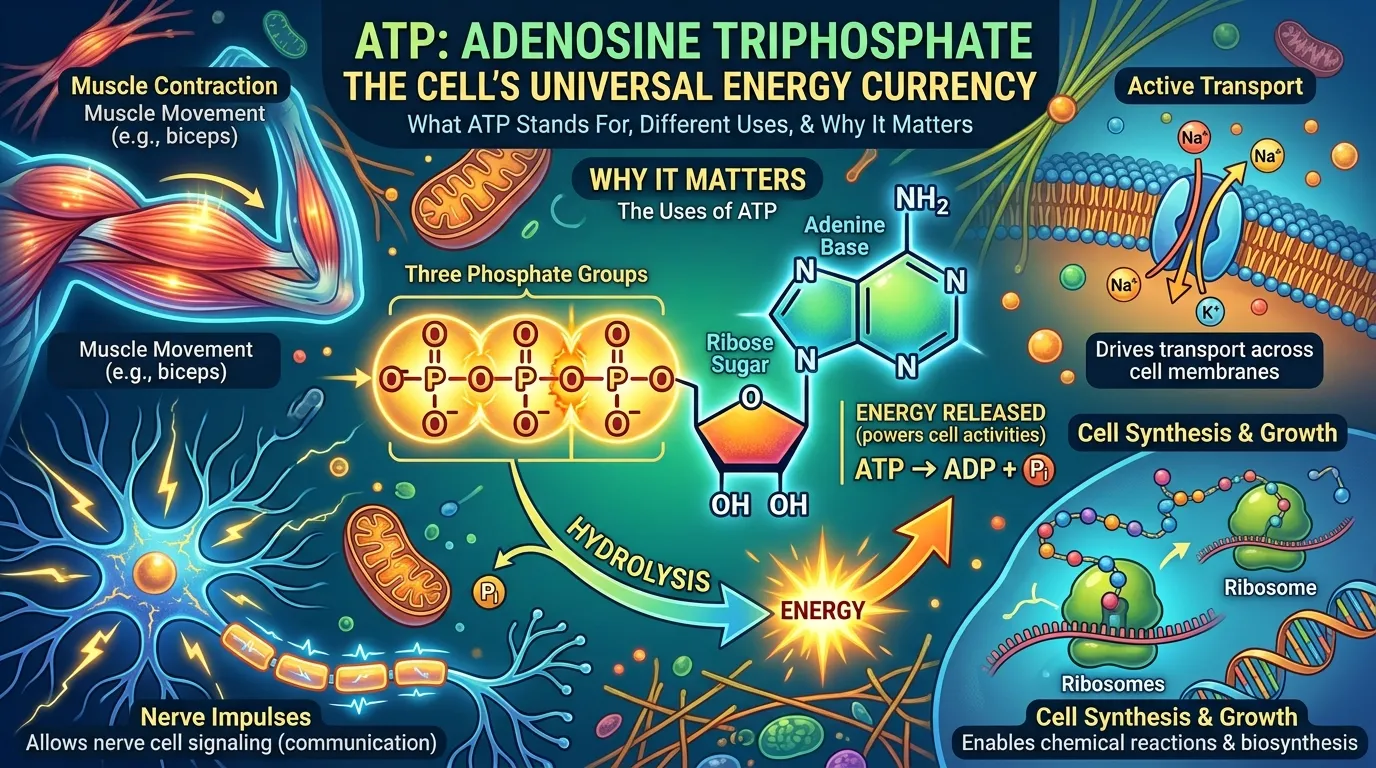
ATP is a molecule made up of:
- Adenine (a nitrogen-containing base)
- Ribose (a sugar)
- Three phosphate groups
The three phosphate groups store chemical energy.
When one phosphate group breaks away, ATP becomes ADP (Adenosine Diphosphate) and releases energy that cells can use immediately.
Simple equation:
ATP → ADP + Energy
Why Is ATP Called the Energy Currency?
Think of ATP as money in your wallet.
Instead of carrying large amounts of stored energy, your body converts food into ATP, which cells spend whenever they need energy.
ATP powers:
- Muscle movement
- Brain activity
- Heartbeats
- Cell repair
- Protein production
- Digestion
- Breathing
- Active transport across cell membranes
Every second, your body is constantly making and using ATP.
How Is ATP Produced?
Your body creates ATP from nutrients found in food.
The primary sources include:
- Carbohydrates
- Fats
- Proteins
Cells convert these nutrients into ATP through a process called cellular respiration.
The three major stages include:
Glycolysis
- Occurs in the cytoplasm
- Breaks glucose into smaller molecules
- Produces a small amount of ATP
Krebs Cycle
- Takes place inside mitochondria
- Generates molecules used in later steps
Electron Transport Chain
- Produces most of the body’s ATP
- Requires oxygen
- Happens in mitochondria
The mitochondria are often called the powerhouses of the cell because they generate most ATP.
What Does ATP Do in the Human Body?
ATP has countless jobs.
Some of its most important functions include:
Muscle Contraction
Every movement you make—from blinking to running—requires ATP.
Without ATP, muscles cannot contract or relax properly.
Brain Function
The brain uses enormous amounts of ATP.
ATP supports:
- Memory
- Thinking
- Learning
- Communication between nerve cells
Heart Function
The heart beats continuously throughout life.
ATP supplies the energy required for each heartbeat.
Cell Growth
Cells divide, repair damage, and build new tissues using ATP.
Protein Synthesis
Every protein your body creates requires ATP.
These proteins include:
- Hormones
- Enzymes
- Antibodies
- Structural proteins
Transport Across Cell Membranes
Cells actively move nutrients and minerals in and out using ATP-powered pumps.
ATP and Exercise
ATP plays a huge role during physical activity.
Different exercise types rely on different ATP production systems.
| Exercise Type | ATP System |
|---|---|
| Sprinting | ATP-PC System |
| Weightlifting | ATP-PC System |
| Running | Glycolytic System |
| Long-distance cycling | Aerobic System |
| Swimming | Aerobic System |
Athletes constantly train to improve ATP production efficiency.
ATP-PC Energy System
The ATP-PC (Phosphocreatine) system supplies immediate energy.
It provides power for:
- Heavy lifting
- Jumping
- Sprinting
- Explosive sports
Characteristics:
- Lasts about 10 seconds
- Extremely fast
- Uses stored phosphocreatine
ATP Meaning in Cellular Respiration
Cellular respiration is the process of converting food into ATP.
Overall formula:
Glucose + Oxygen → Carbon Dioxide + Water + ATP
Without oxygen, cells produce much less ATP.
This explains why intense exercise quickly causes fatigue.
ATP Meaning in Medicine
Medical professionals often mention ATP when discussing:
- Cellular metabolism
- Muscle disorders
- Mitochondrial diseases
- Energy production
- Exercise physiology
Low ATP production may contribute to fatigue and certain metabolic disorders.
Researchers continue studying ATP’s role in many diseases.
ATP Meaning in Sports
Outside biology, ATP commonly refers to the Association of Tennis Professionals.
This organization governs men’s professional tennis.
The ATP:
- Organizes tournaments
- Maintains world rankings
- Oversees ATP Tour events
- Promotes professional tennis worldwide
Popular tournaments include:
- ATP Finals
- ATP Masters 1000
- ATP 500
- ATP 250
Fans often hear commentators discuss ATP rankings during major competitions.
ATP Rankings Explained
ATP rankings determine a player’s position in professional men’s tennis.
Players earn points by competing in tournaments.
Higher rankings lead to:
- Better tournament seeding
- Entry into elite competitions
- Greater sponsorship opportunities
The rankings update every week.
ATP Meaning in Business
In business, ATP often means Available to Promise.
This refers to inventory that companies can promise customers.
Businesses use ATP to:
- Track inventory
- Estimate delivery dates
- Improve customer service
- Reduce order delays
Example:
A company has:
- 500 products in stock
- 200 already sold
Its ATP inventory equals 300 products.
ATP Meaning in Manufacturing
Manufacturing companies often use ATP to mean Acceptance Test Procedure.
This is a formal testing process used before delivering equipment.
An ATP verifies:
- Product performance
- Safety
- Compliance
- Quality standards
Industries using Acceptance Test Procedures include:
- Aerospace
- Electronics
- Construction
- Manufacturing
- Energy
ATP Meaning in Technology
Technology professionals may use ATP to refer to:
- Advanced Technology Program
- Automated Test Procedures
- Advanced Threat Protection (in some software contexts)
The exact meaning depends on the organization or industry.
ATP Meaning in Texting
Online, ATP sometimes means At This Point.
Example:
ATP I’m just going to stay home.
Meaning:
“At this point, I’m just going to stay home.”
This slang appears on:
- TikTok
- Snapchat
- X (formerly Twitter)
- Text messages
ATP vs ADP
People often confuse ATP with ADP.
Here’s the difference.
| ATP | ADP |
|---|---|
| Three phosphate groups | Two phosphate groups |
| Stores more energy | Stores less energy |
| Main energy carrier | Recharged back into ATP |
| Powers cells | Intermediate molecule |
ATP continually changes into ADP and back again.
ATP vs AMP
Another related molecule is AMP.
| Molecule | Phosphate Groups |
|---|---|
| ATP | Three |
| ADP | Two |
| AMP | One |
These molecules constantly cycle during energy metabolism.
Interesting Facts About ATP
Here are some fascinating facts:
- Every cell in your body uses ATP.
- Humans recycle their body weight in ATP nearly every day.
- ATP cannot be stored in large quantities.
- Cells constantly produce new ATP.
- Mitochondria generate most ATP.
- Plants also produce ATP.
- Animals, fungi, and bacteria all rely on ATP.
Common Misunderstandings About ATP
Many people misunderstand what ATP is.
ATP Is Not Food
Food contains nutrients.
Cells convert those nutrients into ATP.
ATP Is Not Stored Like Fat
Unlike body fat, ATP is made and used almost instantly.
More ATP Doesn’t Mean More Strength
Fitness depends on many factors including:
- Muscle mass
- Endurance
- Nutrition
- Training
- Recovery
ATP is only one part of the equation.
ATP Has Different Meanings
Always consider the context.
Reading about biology?
ATP means Adenosine Triphosphate.
Watching tennis?
ATP means Association of Tennis Professionals.
Working in supply chain?
ATP probably means Available to Promise.
Real-Life Examples of ATP
Example 1
You sprint to catch a bus.
Your muscles rapidly consume ATP.
Example 2
You study for an exam.
Your brain uses ATP for nerve signaling and memory.
Example 3
A tennis commentator says:
“The player climbed into the ATP Top 10.”
This refers to professional tennis rankings.
Example 4
An online store confirms your order using ATP inventory.
It means the products are available to ship.
Related Terms
When researching ATP, you may also encounter:
- Cellular respiration
- Mitochondria
- Metabolism
- Glucose
- ADP
- AMP
- Phosphocreatine
- ATP synthase
- Bioenergetics
- Energy metabolism
- ATP Tour
- Tennis rankings
- Inventory management
- Supply chain management
Learning these related concepts provides a deeper understanding of ATP in different contexts.
Why ATP Is So Important
ATP is one of the most essential molecules in biology.
Without it:
- Muscles couldn’t move.
- The heart couldn’t beat.
- The brain couldn’t function.
- Cells couldn’t grow.
- Life as we know it wouldn’t exist.
Beyond biology, ATP is also an important abbreviation in sports, business, engineering, and technology.
Understanding the context ensures you interpret the term correctly.
Frequently Asked Questions (FAQs)
What is the full meaning of ATP?
The most common full form is Adenosine Triphosphate, the primary energy-carrying molecule in living cells. However, ATP can also stand for Association of Tennis Professionals, Available to Promise, or Acceptance Test Procedure, depending on the context.
Why is ATP called the energy currency of the cell?
ATP stores and transfers energy that cells use for essential activities such as muscle contraction, protein synthesis, nerve signaling, and cell repair.
Where is ATP produced?
Most ATP is produced inside the mitochondria through cellular respiration. A smaller amount is generated in the cytoplasm during glycolysis.
What does ATP mean in tennis?
In tennis, ATP stands for the Association of Tennis Professionals, the organization responsible for managing the men’s professional tennis tour and player rankings.
What does ATP mean in texting?
In texting and social media, ATP often means At This Point. It is commonly used to express a current opinion or decision.
What is the difference between ATP and ADP?
ATP has three phosphate groups and contains more stored energy. When one phosphate group is removed, ATP becomes ADP, releasing energy that cells use for biological processes.
Can the human body store ATP?
No. The body stores only small amounts of ATP. Cells continuously produce and recycle ATP to meet the body’s constant energy demands.
Conclusion
ATP meaning varies depending on the context, but its most recognized definition is Adenosine Triphosphate, the molecule that powers nearly every activity in living cells. From fueling muscle movement and brain function to supporting heartbeats and cell growth, ATP is essential for life. At the same time, ATP also represents the Association of Tennis Professionals, Available to Promise, Acceptance Test Procedure, and other specialized terms used in different industries.
When you encounter the abbreviation ATP, always consider the surrounding context. Whether you’re studying biology, following professional tennis, managing inventory, or reading online slang, understanding the correct ATP meaning will help you interpret information accurately. Learning these different uses not only expands your knowledge but also makes communication clearer in academic, professional, and everyday settings.