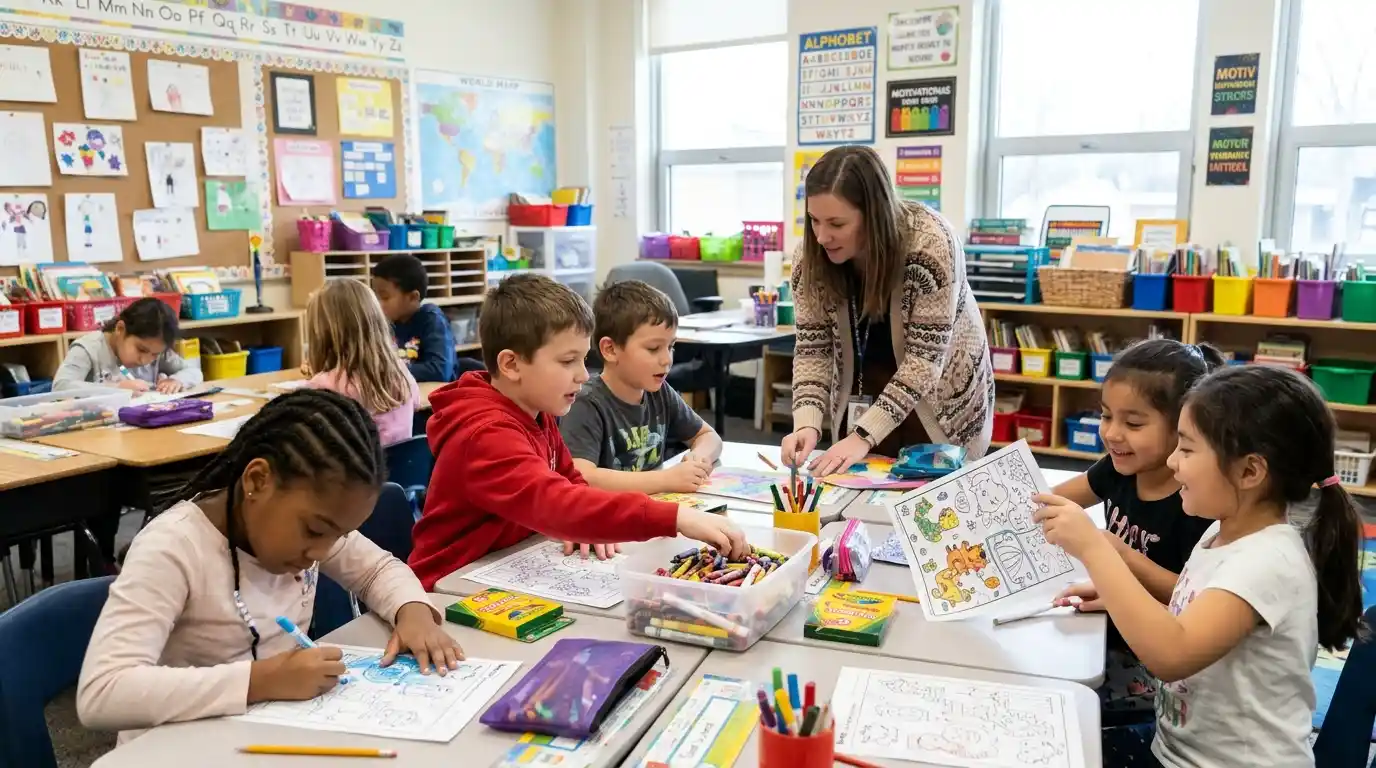
A stack of coloring sheets is one of the cheapest, lowest-prep tools in any classroom, and one of the most misunderstood. Used carelessly, it’s busy work. Used on purpose, it can be warm-up practice, a self-checking math review, a calm reset after recess, or a vocabulary lesson students actually look forward to.
This guide is for US teachers who want to use classroom coloring activities with intent. It covers why coloring earns a spot in the school day, what works at each grade level from pre-K through middle school, how to tie coloring pages to math, science, history and literacy, seasonal ideas for the year ahead, and the practical side: management routines, supplies and printing.
Why Coloring Belongs in the Classroom
Teachers, therapists and education publishers come back to the same few benefits again and again. None of them require coloring to be the main lesson. They come from using it as a short, focused activity.
Fine motor skills and handwriting readiness
Gripping a crayon, controlling pressure and filling a shape all work the small muscles of the fingers, hand and wrist. Speech-language pathologist Kevin Stuckey’s Handy Handouts on the benefits of coloring links this directly to pencil grasp and handwriting. Kindergarten teacher-authors make a similar point: many children arrive at school with less hand strength than teachers expect, and regular coloring builds the endurance that writing later demands.
Focus, patience and hand-eye coordination
Staying inside a boundary means the eyes and hand have to work together. Coloring asks students to slow down and finish a task. Scholastic’s parent guide describes coloring and drawing as activities that “train the brain to focus,” with very little prep needed.
Social-emotional learning (SEL) and calm
Coloring is often used as a calm-down or transition activity. Some classroom blogs cite research with college students on coloring and anxiety. For young children, the more practical takeaway is simple: a quiet, predictable task with a finished product gives a sense of accomplishment and a low-pressure way to settle down. You can make the SEL link explicit with feelings pages (“color the face that matches how you feel”) or a calm-corner coloring basket.
Creativity and self-expression
With art time squeezed in many schedules, a free-choice coloring page is a small creative outlet. Resist grading neatness. Pick a color scheme, try a pattern, or let a student explain why the elephant is purple.
Color recognition and vocabulary
For the youngest learners, crayons are the first color wheel. Naming colors, sorting by color and mixing primary colors into secondary ones are foundational early-learning skills.
Coloring Activities by Grade Level
Pre-K and preschool (ages 3–5)
- Big, bold outlines. Choose simple shapes with thick lines: an apple, a sun, a pumpkin. Detailed scenes frustrate small hands.
- Color recognition games. “Color the circle red, the square blue.” Then ask students to name each color back to you.
- Chunky tools. Jumbo or triangular crayons support an emerging grip better than skinny pencils.
- Short sessions. Five to ten minutes is plenty. Stop before frustration starts.
Kindergarten
- Color by letter and color by sight word. Each space holds a letter or word mapped to a color, so students practice recognition while revealing a picture.
- Count-and-color. “Color 4 apples.” Have students touch each object once as they count.
- Fill-the-space practice. Teach coloring in one direction and covering the whole shape, a small skill that carries over to writing control.
Grades 1–2
- Color by number with addition and subtraction. Facts within 10 or 20, with answers mapped to a color key.
- Phonics coloring. Color short-vowel words one color and long-vowel words another.
- Label-and-color diagrams. A simple plant (roots, stem, leaves, flower) colored and labeled, then explained aloud to a partner.
Grades 3–5
- Multiplication and division color by code. A wrong answer produces a wrong color, so the page checks itself.
- Parts-of-speech coloring. Nouns blue, verbs green, adjectives orange.
- Map coloring. States, regions, or the thirteen colonies, with a legend students build themselves.
- Reading-response pages. Students color a scene from a chapter and write a caption explaining it.
Middle school (grades 6–8)
Coloring isn’t only for little kids. Middle and high school science teachers use color-by-number worksheets for review, differentiation and sub plans. The difference is in the content and the purpose:
- Detailed mandalas and zentangle-style patterns as a quiet brain break before or after tests.
- Concept coloring. Cell organelles, layers of the Earth, the water cycle, or a periodic-table trend, each color-coded with a key.
- Integer, fraction and equation color by number for skill review.
- Sketchnote-style notes. Students add color-coding to their own notes to group related ideas.
Subject Tie-Ins: Educational Coloring Pages That Teach
The best educational coloring pages have a clear learning goal. Plan a follow-up question for each one. A 30-second explanation tells you more than a finished picture.
Math: color by number and color by code
Color by number (also called color by code or mystery pictures) is the most popular classroom format, and for good reason. Students solve a problem, match the answer to a color, and a hidden picture appears. Ideas by skill:
- Number recognition and counting (pre-K–K)
- Addition and subtraction facts (K–2)
- Place value and rounding (2–4)
- Multiplication and division facts (3–5)
- Fractions, decimals and equivalent values (4–6)
- Integers and one-step equations (6–8)
- Shapes and geometry vocabulary (any grade)
One caution from teaching guides: use color by number to practice a skill students have already learned, not to introduce a new concept.
Science
- Life science: plant parts, animal habitats, life cycles (butterfly, frog, pumpkin), the human skeleton.
- Earth science: layers of the Earth, the rock cycle, weather symbols, moon phases.
- Ecology: food chains and food webs, with producers, consumers and decomposers each in their own color.
- Physical science: states of matter, simple circuits, the color spectrum.
Social studies and history
- US maps for regions, state capitals or the original colonies.
- American symbols: the flag, the bald eagle, the Statue of Liberty and the Liberty Bell, with a fact sentence under each.
- Timelines. Students color-code events by era or theme.
- Famous Americans. Color a portrait page, then write three facts.
Literacy and ELA
- Color by sight word or by vowel sound for early readers.
- Story-sequence coloring: beginning, middle and end panels.
- Vocabulary partner talk: students color one detail, then use a target word in a sentence to describe it.
- Color dictation (great for English learners): you describe (“Color the dog’s hat yellow”), and students listen and color.
Art and color theory
Primary and secondary colors, warm versus cool palettes, complementary colors, and shading with colored pencils all make good mini-lessons.
Seasonal and Holiday Coloring Ideas for the School Year
Seasonal pages keep things fresh and connect to what students are excited about. Here’s a month-by-month starter list for US classrooms:
| Month | Coloring ideas |
|---|---|
| August–September | Back-to-school, “all about me” pages, apples, Labor Day, Constitution Day |
| October | Fall leaves, pumpkins, non-scary Halloween pages, Fire Prevention Week |
| November | Veterans Day, Thanksgiving, gratitude turkeys, harvest themes |
| December | Winter, snowflakes, gingerbread, winter holidays around the world |
| January | New Year goals, Martin Luther King Jr. Day, snowmen, penguins |
| February | Black History Month, Valentine’s Day, 100th Day of School, Presidents’ Day |
| March | St. Patrick’s Day, Women’s History Month, spring, Read Across America |
| April | Earth Day, rain and rainbows, plant life cycles |
| May | Teacher Appreciation Week, Mother’s Day, Memorial Day, end-of-year memory pages |
| June | Summer, Father’s Day, Flag Day |
For holiday pages, Zohan Colors’ free printable holiday and seasonal coloring pages cover Halloween, fall, Veterans Day and more. They include classroom-friendly activity sheets like color by addition, color by letter and placemats, all available as Letter or A4 PDFs.
Keep inclusivity in mind: offer a neutral seasonal option (leaves, snowflakes, flowers) alongside holiday-specific pages so every student has something to color.
Classroom Management Tips for Coloring Time
Coloring goes smoothly when it runs on routines.
- State the purpose. “Today’s page is our multiplication review” sets a different tone from “free coloring.”
- Set a timer. A visual timer keeps a 10-minute activity from stretching into 30.
- Use a supply caddy per table. Shared bins cut down on wandering and crayon disputes.
- Keep an early-finisher folder. Store a stack of coloring sheets for students who finish other work early. It’s quiet, independent, and keeps them busy without new prep from you.
- Have a calm corner basket with mandalas and simple pages for students who need a reset.
- Pair coloring with talk. Ask one question per page (“Which part of the plant takes in water?”) and walk the room.
- Prep sub plans. A color-by-code review page plus an answer key is about as sub-friendly as it gets.
- Display, don’t grade, neatness. Celebrate effort and choices. Grade the content (correct answers or labels) when there is some.
- Clean-up routine. Crayons back by color, pages in the finished tray, and a two-minute timer for the whole thing.
- Support every learner. Offer larger outlines, thicker tools, or fewer spaces for students with fine motor needs, and more complex pages for students who want a challenge.
Supplies and Printing Tips
Choosing coloring tools
- Crayons: best for pre-K–2. Durable, cheap, easy to grip.
- Colored pencils: better for detail and shading in grades 3 and up.
- Washable markers: bold color, but they can bleed through thin paper.
- Twistable crayons or gel sticks: no sharpening, which saves class time.
Printing coloring pages for a class set
- Paper size: US printers use Letter (8.5 × 11 in). If a file is A4, choose “Fit to page” in the print dialog so nothing gets cut off.
- Grayscale and draft mode: line art doesn’t need color ink, and draft mode saves toner on class sets.
- Heavier paper for markers: 24 lb paper or cardstock reduces bleed-through.
- Double-sided printing: put a coloring page on the back of a worksheet as a reward.
- Laminate and reuse: laminated pages or sheet protectors with dry-erase crayons work well for centers.
- Print a few extras for new students, spoiled copies and early finishers.
If you need a quick class set, Colorabble’s free printable coloring pages in Letter and A4 PDF are ready to print without reformatting.
Frequently Asked Questions
What are the benefits of coloring in the classroom?
Coloring supports fine motor control, pencil grip, hand-eye coordination, focus, color recognition and creativity. It also works as a calm transition. When it’s tied to content like math facts, vocabulary or diagrams, it doubles as low-stakes practice.
Is coloring just busy work?
It doesn’t have to be. Give each page a purpose, keep it short, and finish with a question or quick share. That turns it into practice or review instead of filler.
How do you use color by number in the classroom?
Use it for skills students already know: warm-ups, centers, homework, early-finisher work, sub plans, or test review. Because answers map to colors, mistakes show up right away, so students can self-check.
What age is coloring good for?
Every age. Preschoolers work on color names and grip, elementary students practice skills through color-by-code, and middle schoolers use detailed pages for review or a calm brain break.
Where can teachers find free printable coloring pages?
Many sites offer free printable coloring sheets for teachers by theme, holiday and skill. Look for print-ready PDFs in Letter size, clean line art, and pages labeled by age or difficulty.
How long should a classroom coloring activity last?
For young children, 5–15 minutes is usually enough. Older students can spend 15–20 minutes on a detailed review page. Use a timer and stop before attention fades.
Can coloring help students with anxiety or big feelings?
Many teachers keep coloring in a calm-down corner because it’s predictable and quiet. It isn’t a replacement for counseling support, but it can be a helpful self-regulation tool within your SEL routines.
Final Thoughts
Coloring is one of the few classroom activities that is cheap, low-prep, works for every age, and that almost every student enjoys. The trick is purpose: match the page to the grade, tie it to what you’re teaching, keep it short, and talk about it afterward. Build a small library of seasonal pages, color-by-number practice and calm-corner designs, and you’ll always have a meaningful activity ready to go.