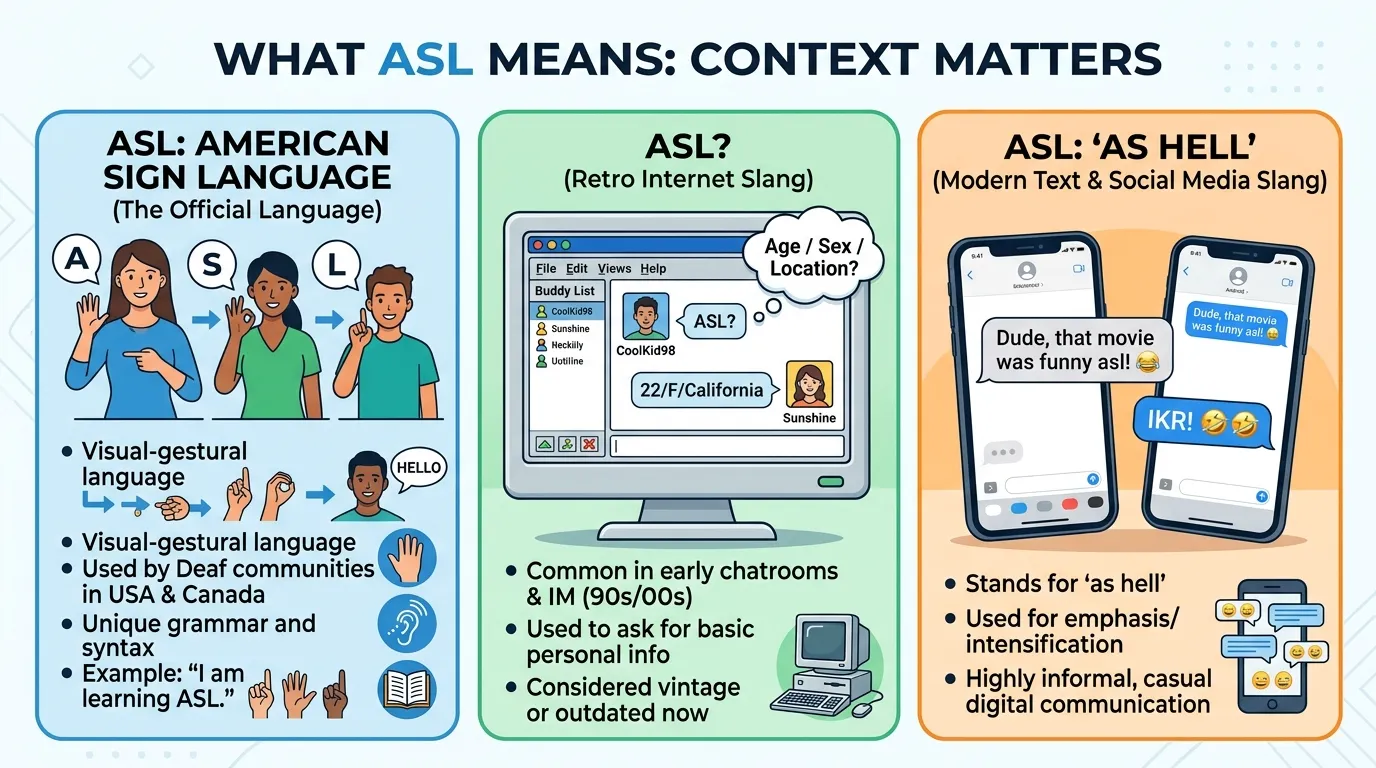
ASL meaning is one of the most searched internet abbreviations because it has more than one definition. Depending on the context, ASL can refer to Age, Sex, Location in online chats or American Sign Language, the visual language used by millions of Deaf and hard-of-hearing people. Understanding the correct ASL meaning in text, social media, gaming, and real-life conversations can help you avoid confusion and communicate more effectively.
In today’s digital world, abbreviations appear everywhere—from TikTok and Snapchat to texting, Discord, and gaming communities. Some acronyms have multiple meanings, making context incredibly important. This guide explains every major meaning of ASL, where it’s used, its history, examples, common misconceptions, and frequently asked questions.
Whether you came across ASL in a text message, social media comment, or discussion about sign language, this article will help you understand exactly what it means.
What Does ASL Mean?
The abbreviation ASL has two primary meanings:
| ASL Meaning | Used In | Definition |
|---|---|---|
| Age, Sex, Location | Texting, chat rooms, online messaging | A question asking someone’s basic information |
| American Sign Language | Education, accessibility, Deaf community | A complete visual language using hand signs, facial expressions, and body movements |
The intended meaning depends entirely on the conversation.
For example:
- Person 1: Hi!
- Person 2: ASL?
Here, ASL means Age, Sex, Location.
Another example:
- I’m learning ASL this semester.
In this sentence, ASL means American Sign Language.
ASL Meaning in Text
One of the oldest internet abbreviations is ASL, which originally stood for:
- A = Age
- S = Sex
- L = Location
People used it to quickly ask someone for basic personal information during online conversations.
Example:
Person A: Hey!
Person B: ASL?
Person A: 22/F/California
This means:
- Age: 22
- Sex: Female
- Location: California
Today, younger users may replace “Sex” with Gender, but the abbreviation remains the same.
The History of ASL in Online Chat
The phrase became extremely popular during the late 1990s and early 2000s through platforms like:
- AOL Instant Messenger (AIM)
- Yahoo Messenger
- MSN Messenger
- IRC Chat
- Omegle
- Early internet chat rooms
Before social media profiles became common, users didn’t know anything about each other.
Instead of asking three separate questions, they simply typed:
ASL?
This became one of the internet’s earliest viral abbreviations.
ASL Meaning on Snapchat
On Snapchat, ASL usually still means:
Age, Sex, Location
Someone may ask:
- ASL?
- What’s your ASL?
However, many younger users no longer use this abbreviation frequently because profile information is often already visible.
Sometimes users jokingly say:
- Bro still asks ASL in 2026 😂
This references the old internet culture.
ASL Meaning on TikTok
On TikTok, ASL can mean two completely different things.
Meaning 1: American Sign Language
Many creators post videos teaching:
- ASL alphabet
- ASL phrases
- ASL songs
- Sign language lessons
Example:
Learning ASL every day!
Meaning 2: Age, Sex, Location
Occasionally, nostalgic internet users reference old chat culture.
Example:
Only millennials remember asking ASL.
ASL Meaning on Instagram
Instagram users commonly use ASL when discussing:
- Sign language education
- Deaf awareness
- Accessibility
- Inclusive communication
Less commonly, people use it jokingly to reference old chat rooms.
ASL Meaning on Discord
Discord gaming communities sometimes use ASL as shorthand for:
Age, Sex, Location
Example:
Before joining voice chat:
ASL?
Many servers instead ask only:
- Age
- Country
- Time zone
Because of privacy concerns, sharing personal information with strangers is discouraged.
ASL Meaning in Gaming
Gamers occasionally use ASL when meeting new teammates.
Example:
Player 1:
ASL?
Player 2:
19/M/Canada
However, modern gaming communities often avoid asking for personal details and instead focus on usernames and gameplay.
What Is American Sign Language (ASL)?
The second—and equally important—meaning of ASL is American Sign Language.
American Sign Language is a complete natural language used primarily by Deaf and hard-of-hearing people in:
- United States
- Parts of Canada
It communicates through:
- Hand shapes
- Hand movements
- Facial expressions
- Body language
- Visual grammar
ASL is not simply English shown with hand signs.
It has its own:
- Grammar
- Sentence structure
- Vocabulary
- Linguistic rules
Why American Sign Language Is Important
Millions of people rely on ASL every day.
Benefits include:
- Better communication
- Greater accessibility
- Inclusion
- Education
- Employment opportunities
- Community building
Learning even basic ASL signs can help bridge communication gaps and show respect for Deaf culture.
Common ASL Signs Beginners Learn
Many beginners start with simple words like:
- Hello
- Thank you
- Please
- Yes
- No
- Sorry
- Help
- Family
- Friend
- Love
These signs make everyday interactions easier.
ASL Alphabet
American Sign Language uses a one-handed manual alphabet.
Each English letter has its own handshape.
People use fingerspelling for:
- Names
- Places
- Brands
- Words without established signs
Learning the alphabet is usually the first step for ASL students.
Is American Sign Language Universal?
No.
Many people mistakenly believe sign language is universal.
In reality, every country often has its own sign language.
Examples include:
- American Sign Language (ASL)
- British Sign Language (BSL)
- Australian Sign Language (Auslan)
- French Sign Language (LSF)
- Japanese Sign Language (JSL)
These languages are different, just like spoken languages.
Common Misunderstandings About ASL
Here are some myths people often believe.
ASL Always Means American Sign Language
False.
It may also mean Age, Sex, Location.
Always consider the context.
ASL Is the Same Everywhere
Incorrect.
Every country has different sign languages.
ASL Is Just English with Hand Signs
Not true.
American Sign Language has unique grammar and sentence structure.
Everyone Uses ASL in Text Messages
Not anymore.
While older internet users recognize it instantly, younger generations often use newer abbreviations.
Examples of ASL in Different Contexts
Example 1: Text Message
Friend:
ASL?
Meaning:
Age, Sex, Location
Example 2: College
I’m taking ASL next semester.
Meaning:
American Sign Language class.
Example 3: TikTok
Today’s ASL lesson teaches family signs.
Meaning:
American Sign Language.
Example 4: Gaming
ASL before we join VC?
Meaning:
Age, Sex, Location.
Example 5: Job Posting
ASL interpreter wanted.
Meaning:
American Sign Language interpreter.
Similar Internet Abbreviations
If you’re learning internet slang, you may also encounter these abbreviations.
| Abbreviation | Meaning |
|---|---|
| LOL | Laugh Out Loud |
| BRB | Be Right Back |
| IMO | In My Opinion |
| TBH | To Be Honest |
| SMH | Shaking My Head |
| IDK | I Don’t Know |
| IYKYK | If You Know, You Know |
| WYLL | What You Look Like |
| WTV | Whatever |
| TTYL | Talk To You Later |
Understanding these abbreviations makes online conversations much easier.
When Should You Use ASL?
Use ASL only when the context makes the meaning obvious.
For example:
Appropriate Uses
- Discussing sign language
- Educational content
- Referring to American Sign Language classes
- Mentioning accessibility
- Referring to old internet chat culture
Avoid Using It
- When the audience may misunderstand
- In professional communication without clarification
- When discussing sensitive personal information with strangers
Privacy Tips When Someone Asks ASL
If someone online asks:
ASL?
Remember these safety tips:
- Never share personal information with strangers.
- Protect your identity.
- Avoid revealing your exact location.
- Use privacy settings on social media.
- Trust your instincts if a conversation feels uncomfortable.
Online safety should always come first.
Why Context Matters
The biggest reason people become confused is that ASL has multiple meanings.
For example:
“I love learning ASL.”
Clearly refers to American Sign Language.
“ASL?”
Clearly asks for Age, Sex, Location.
Reading the surrounding conversation almost always reveals the correct meaning.
Related Terms You Should Know
If you’re researching ASL, you might also encounter:
- Deaf culture
- Fingerspelling
- Sign language interpreter
- Captioning
- Accessibility
- Visual language
- Internet slang
- Chat abbreviations
- Online acronyms
- Text messaging abbreviations
These related concepts help provide a fuller understanding of the topic.
Frequently Asked Questions
What does ASL mean in texting?
In texting, ASL usually stands for Age, Sex, Location. It was widely used in early online chat rooms to ask someone for basic personal information.
What does ASL mean on TikTok?
On TikTok, ASL most commonly refers to American Sign Language, especially in educational and accessibility-related content. Occasionally, it is also used to reference the older meaning of Age, Sex, Location.
Is American Sign Language the same as English?
No. American Sign Language is a separate language with its own grammar, sentence structure, and vocabulary. It is not simply English expressed through hand signs.
Is ASL still popular in online chats?
The abbreviation is less common than it was during the early internet era. While some people still use it, modern apps often display profile information, reducing the need to ask for age, gender, and location.
Is ASL used worldwide?
No. American Sign Language is primarily used in the United States and parts of Canada. Many countries have their own unique sign languages.
Should I reply when someone asks ASL?
Only if you feel comfortable and the conversation is safe. Avoid sharing personal information with strangers online, especially your exact location or other identifying details.
How can I start learning American Sign Language?
You can begin by learning the ASL alphabet, common greetings, and everyday signs through classes, online courses, educational apps, and videos created by qualified ASL instructors and members of the Deaf community.
Conclusion
The ASL meaning depends entirely on the situation. In online chats and older messaging platforms, it traditionally stands for Age, Sex, Location, serving as a quick way to introduce yourself. In education, accessibility, and conversations about the Deaf community, ASL refers to American Sign Language, a rich and fully developed visual language with its own grammar and culture.
Whenever you see ASL, pay attention to the context before assuming its meaning. If you’re discussing communication and inclusion, it’s likely referring to American Sign Language. If you’re in a casual online chat, it may mean Age, Sex, Location. Understanding both definitions helps you communicate more confidently, avoid misunderstandings, and appreciate the importance of one of the world’s most recognized abbreviations.