Have you ever seen someone say “Don’t bogart it” or “Why are you bogarting the remote?” and wondered what they meant? The word bogart can look like a person’s name, but in informal English, it can also work as a slang verb. Its meaning usually has little to do with the person being named and much more to do with keeping, taking, or controlling something instead of sharing it.
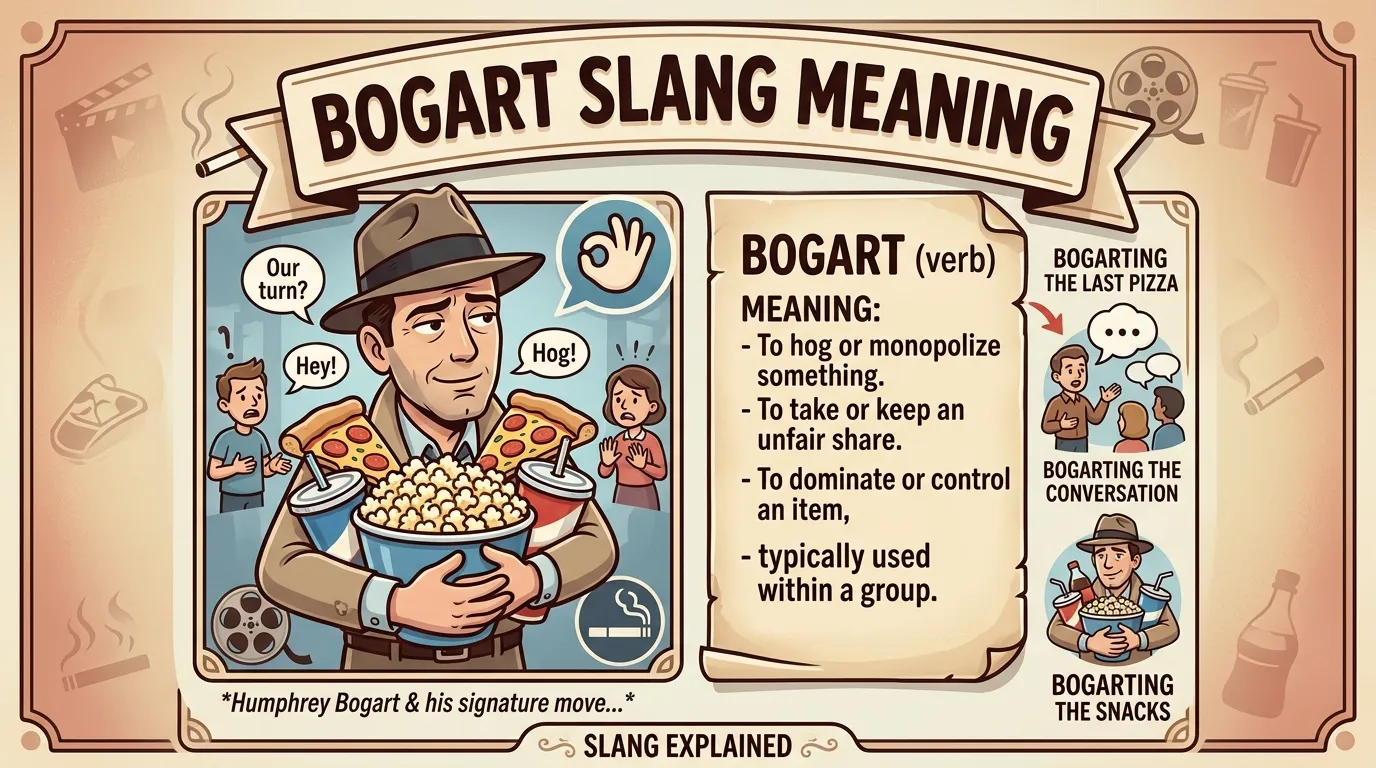
The bogart slang meaning is generally to selfishly keep something, monopolize it, or use more than your fair share. For example, if someone keeps a snack without offering any to others, a friend might jokingly say, “Stop bogarting the chips!”
The term is especially interesting because its history is connected to American pop culture and Humphrey Bogart, the famous Hollywood actor. Over time, his name developed into an informal expression that became associated with holding onto something rather than passing it around.
Today, you may encounter bogart meaning in text, on social media, in memes, gaming chats, casual conversations, or older slang expressions. However, its popularity varies by age, region, and context.
In this guide, we’ll explain exactly what bogart means in slang, where the term came from, how people use it today, what it means in texting, and how it compares with similar expressions such as hog, hoard, monopolize, and keep.
What Does Bogart Mean in Slang?
Bogart as slang means to keep something for yourself, use something selfishly, or monopolize something instead of sharing it with others.
In simple terms:
To bogart something = to selfishly keep or monopolize it.
For example:
- “Don’t bogart the popcorn. Pass it around.”
- “He’s bogarting the TV again.”
- “Quit bogarting the charger and let me use it.”
- “She bogarted all the good seats.”
The expression is usually informal and can be either playful or critical, depending on how someone says it.
Quick Example
Imagine four friends are sharing a bowl of snacks. One person grabs the bowl and keeps it beside them without passing it around.
Someone might say:
“Hey, don’t bogart the snacks!”
They’re basically saying:
“Stop keeping all the snacks to yourself and share them.”
That’s the core bogart slang meaning.
Bogart Meaning at a Glance
| Fact | Explanation |
|---|---|
| Slang word | Bogart |
| Basic meaning | To keep, take, or monopolize something selfishly |
| Part of speech | Usually a verb |
| Common phrase | “Don’t bogart it” |
| Tone | Informal, humorous, teasing, or critical |
| Origin | Associated with actor Humphrey Bogart |
| Common context | Sharing, possessions, resources, food, entertainment |
| Older slang use | Especially associated with smoking and sharing |
| Modern use | Casual speech, texting, social media, memes |
| Similar words | Hog, hoard, monopolize, keep, grab |
Where Did the Slang Word Bogart Come From?
One of the most interesting things about bogart slang is that it developed from a famous person’s surname.
Humphrey Bogart was one of Hollywood’s best-known actors. He became an iconic figure through classic films and his distinctive tough-guy screen image.
At some point, his surname began to be used as a verb in American slang.
The exact path of the expression isn’t completely straightforward, but the term became strongly associated with the idea of holding onto something rather than passing it along.
A popular explanation connects the expression to the way Bogart was often portrayed holding a cigarette in his mouth for a long time. In the culture of the 1960s, especially among young people and smokers, “bogart” came to be associated with holding a cigarette or other shared item instead of passing it to the next person.
This helped produce expressions such as:
“Don’t bogart the joint.”
The meaning was essentially:
“Don’t keep it to yourself. Pass it around.”
From there, the slang meaning expanded beyond smoking.
People could bogart food, drinks, seats, equipment, the television, attention, or almost anything else that was being shared.
From a Name to a Verb
This is an example of a broader language process called eponymous word formation, where a person’s name becomes associated with a word or action.
English has many examples of names influencing vocabulary. In the case of bogart, a famous surname became an informal verb.
That transformation is part of what makes slang so fascinating: ordinary names can develop new meanings through pop culture and everyday behavior.
What Does “Don’t Bogart It” Mean?
“Don’t bogart it” means:
“Don’t keep it for yourself. Share it or pass it to someone else.”
This is probably one of the most recognizable expressions involving the word.
For example:
Friend 1: “Are you going to pass the controller?”
Friend 2: “In a second.”
Friend 1: “You’ve had it for an hour. Don’t bogart it!”
Here, bogart means to keep control of something for too long.
The expression doesn’t necessarily imply serious selfishness. Friends often use it as a joke.
Other Examples
- “Don’t bogart the pizza.”
- “Don’t bogart the Wi-Fi.”
- “Don’t bogart the remote.”
- “Don’t bogart the good chair.”
- “Don’t bogart all the cookies.”
- “Don’t bogart the microphone.”
In each case, the speaker wants someone to stop monopolizing something.
What Does Bogart Mean in Text Messages?
The bogart meaning in text is usually the same as its traditional slang meaning: to keep something to yourself or monopolize it.
However, because texting is casual, people may use the word humorously.
Texting Examples
Person A:
“Bro, you still have my headphones?”
Person B:
“Yeah 😂”
Person A:
“Stop bogarting them!”
Another example:
A: “Are you watching the new episode?”
B: “Yep.”
A: “Don’t bogart the TV. I want to watch too.”
The word can also be used metaphorically.
For example:
“You’re bogarting all the conversation 😂”
This means the person is talking too much and not giving anyone else a chance to speak.
So in texting, bogart can refer to more than physical objects. It can describe someone monopolizing:
- A conversation
- Attention
- A group activity
- A shared resource
- A social opportunity
- A game
- A device
- Food or drinks
Bogart Meaning on TikTok, Instagram, and Snapchat
On platforms such as TikTok, Instagram, and Snapchat, bogart may appear in captions, comments, memes, or casual conversations.
Its meaning depends heavily on context.
For example, someone might post a picture of a friend holding an entire pizza and write:
“Bro really bogarted the whole pizza 😭”
That means the friend kept most or all of the pizza instead of sharing it.
Another caption might say:
“Stop bogarting the aux!”
Here, the speaker means:
“Stop controlling the music and let other people choose songs.”
Social Media Uses
You might see the word used for someone who:
- Keeps all the snacks
- Controls the music
- Takes all the attention
- Uses a shared item too long
- Refuses to share
- Takes the best spot
- Dominates a conversation
- Controls a game
Because slang evolves quickly online, younger users may understand the meaning from context even if they don’t regularly use the word themselves.
Bogart Meaning on Discord and in Gaming
In gaming and Discord conversations, bogart can describe someone who monopolizes an item, role, resource, or opportunity.
Imagine a multiplayer game where one player keeps taking all the useful equipment.
Another player might say:
“Stop bogarting all the health packs.”
They’re telling that player to stop taking everything and leave some resources for the team.
Gaming Examples
- “You’re bogarting all the loot.”
- “Don’t bogart the good weapons.”
- “He’s bogarting the only healing item.”
- “Stop bogarting the mic.”
- “You’re bogarting the controller.”
On Discord, the word can also describe someone dominating a voice channel:
“Dude, you’re bogarting the mic.”
That means:
“You’re talking constantly and not letting anyone else speak.”
Does Bogart Mean “Hog”?
Yes, bogart can be similar to hog when both mean taking or keeping more than your fair share.
For example:
“He’s hogging the remote.”
and
“He’s bogarting the remote.”
can communicate a very similar idea.
However, hog is much more common in modern everyday English.
Bogart vs. Hog
| Word | Meaning | Tone |
|---|---|---|
| Bogart | Keep or monopolize something selfishly | Informal, slang |
| Hog | Take more than your fair share | Informal, very common |
| Hoard | Store or collect something and refuse to give it up | Often more serious |
| Monopolize | Control or dominate something | More formal |
| Keep | Retain something | Neutral |
| Grab | Take something | Neutral/informal |
If you want a word everyone understands, hog is usually the safer choice.
If you’re intentionally using older or playful American slang, bogart can add personality.
Bogart vs. Hoard: What’s the Difference?
Bogart and hoard overlap, but they aren’t identical.
To hoard something usually means to collect and keep a large amount of it, often because you don’t want to give it away.
For example:
“He hoards bottled water.”
To bogart something usually suggests monopolizing or selfishly holding onto something that should be shared or passed around.
For example:
“He’s bogarting the remote.”
The difference becomes clearer when you imagine a group of people.
If someone has 50 chocolate bars hidden in their room, they might be hoarding chocolate.
If someone grabs the only chocolate bar at a party and refuses to share it, they might be bogarting it.
How Is Bogart Used in Everyday Conversation?
Although bogart isn’t as common as words like hog or keep, it can still appear in casual American English.
Here are some realistic situations.
At Home
“Who’s bogarting the remote?”
Someone has kept the TV remote and won’t let anyone else choose what to watch.
At a Party
“Don’t bogart the chips!”
Someone is eating directly from the shared bowl without passing it around.
In the Car
“Stop bogarting the aux cord.”
Someone has controlled the music for too long.
At Work
“John’s bogarting the conference room again.”
John is using a shared room and preventing others from using it.
During a Game
“You’re bogarting all the good cards.”
Someone is taking too many desirable cards or resources.
During a Conversation
“You’re bogarting the conversation.”
Someone is doing most of the talking and not allowing others to participate.
Is Bogart a Negative Word?
Bogart can have a negative meaning because it often suggests selfishness.
However, the emotional tone depends on the situation.
Playful Use
Friends may say:
“Quit bogarting the fries 😂.”
This probably isn’t a serious accusation. It’s teasing.
Mildly Critical Use
Someone might say:
“He’s always bogarting the meeting room.”
This sounds more annoyed.
Stronger Use
If someone repeatedly takes shared resources without considering others, calling them a bogart or saying they’re bogarting everything can sound openly critical.
So, the word itself isn’t necessarily offensive, but it can certainly be used as a complaint.
Can Bogart Be Used as a Noun?
Yes, although the verb form is more common in expressions such as “bogarting something.”
In some informal uses, a bogart can refer to a person who selfishly keeps or monopolizes something.
For example:
“Don’t be a bogart.”
This means:
“Don’t be selfish. Share.”
Another example:
“He’s such a bogart.”
The speaker is calling someone selfish because that person keeps things for themselves.
The noun use is informal and may sound more old-fashioned than the verb.
Common Forms of the Word Bogart
You may see several grammatical forms.
Bogart
“Don’t bogart the snacks.”
Basic verb form.
Bogarting
“Why are you bogarting the controller?”
Present participle or gerund.
Bogarted
“He bogarted the best seat.”
Past tense.
Bogart
“Don’t be a bogart.”
Informal noun use.
The meaning stays connected to selfish possession or monopolization.
Common Phrases With Bogart
Several expressions make the meaning especially easy to understand.
“Don’t bogart it.”
Share it or pass it around.
“Stop bogarting it.”
Stop keeping or controlling it.
“He’s bogarting everything.”
He’s taking or keeping too much for himself.
“Don’t be a bogart.”
Don’t act selfishly.
“She’s bogarting the conversation.”
She’s dominating the conversation.
“He’s bogarting the remote.”
He’s keeping control of the remote.
These phrases are generally casual and shouldn’t be treated as formal business language.
Bogart in Dating and Relationships
You may occasionally see bogart used jokingly in dating or relationship conversations.
For example:
“You’re bogarting all the blankets again.”
This means someone is taking most of the blankets.
Another example:
“Don’t bogart all my attention.”
This could be playful flirting, meaning someone wants another person to give them more attention.
The term can also describe shared activities:
- Bogarting the TV
- Bogarting the snacks
- Bogarting the bed
- Bogarting the conversation
- Bogarting the passenger seat
In romantic relationships, the word usually works best when the tone is clearly playful.
Can You Use Bogart at Work?
You can, but you should understand that bogart is slang.
In a relaxed workplace where coworkers joke with each other, you might hear:
“Don’t bogart the meeting room all afternoon.”
But in a formal email, professional report, or communication with a client, it’s better to use a clearer expression.
Instead of:
“You’re bogarting the equipment.”
Use:
“You’re using the equipment longer than expected.”
Or:
“Could you please let the rest of the team use the equipment?”
Better Professional Alternatives
Use:
- Monopolize
- Keep
- Hold onto
- Use excessively
- Take more than your share
- Prevent others from using
- Control
These expressions are more appropriate for formal communication.
Is Bogart Still Used Today?
Yes, but its popularity is context-dependent.
Bogart is not among the most frequently used slang words in everyday modern American texting. Younger speakers may recognize it without using it regularly.
You’ll be more likely to encounter it in:
- Older American slang
- Movies and television
- Casual conversations
- Humorous comments
- Internet discussions
- Memes
- References to smoking culture
- Expressions such as “don’t bogart it”
Language changes constantly. Some slang words become extremely popular and then disappear, while others survive for decades because they’re memorable or connected to pop culture.
Bogart has lasted partly because its meaning is easy to understand once you see it in context.
Common Misconceptions About Bogart
Misconception 1: Bogart Always Refers to Humphrey Bogart
Not necessarily.
In slang, bogart can function as a verb or noun without referring directly to the actor.
“Stop bogarting the remote” isn’t a comment about Humphrey Bogart.
It’s about someone monopolizing the remote.
Misconception 2: Bogart Only Relates to Smoking
The expression has strong historical associations with smoking and sharing, but its meaning expanded over time.
Today, someone can bogart almost any shared resource.
Misconception 3: Bogart Means Steal
Not exactly.
Stealing means taking something that belongs to someone else without permission.
Bogarting usually means keeping or monopolizing something, especially when it is expected to be shared.
Someone can bogart a shared resource without actually stealing it.
Misconception 4: Bogart Is Formal English
It isn’t.
Bogart is informal slang, so use it mainly in casual speech and relaxed writing.
How to Know What Bogart Means From Context
If you’re unsure what someone means by bogart, look at the object or activity involved.
If They Mention Food
It probably means:
“You’re keeping too much food for yourself.”
If They Mention a Device
It probably means:
“You’re using it for too long.”
If They Mention a Conversation
It probably means:
“You’re doing all the talking.”
If They Mention Music
It probably means:
“You’re controlling the music instead of letting others choose.”
If They Mention Smoking
The historical meaning may be especially relevant:
“Don’t keep it to yourself; pass it around.”
Context is the key.
Bogart vs. Other Slang Expressions
Understanding similar expressions can help you recognize the exact tone.
| Expression | Meaning | Example |
|---|---|---|
| Bogart | Keep or monopolize something | “Don’t bogart the remote.” |
| Hog | Take more than your fair share | “Stop hogging the snacks.” |
| Hoard | Collect and keep a large supply | “She hoards books.” |
| Monopolize | Dominate or control | “He monopolized the discussion.” |
| Clutch | Hold tightly or keep possession | “He’s clutching the controller.” |
| Keep | Retain something | “She kept the last piece.” |
| Camp | Stay in one advantageous spot, especially in gaming | “He’s camping the objective.” |
Bogart is most similar to hog when the subject is a shared item.
When Should You Avoid Using Bogart?
Although the word is generally harmless, it’s still slang and may not be understood by everyone.
Avoid relying on it when:
- Writing a formal report
- Communicating with clients
- Writing academic papers
- Explaining instructions
- Communicating with people unfamiliar with American slang
- You need extremely clear language
Instead, say exactly what you mean.
For example:
Instead of:
“Stop bogarting the equipment.”
Say:
“Please let others use the equipment.”
This avoids confusion.
How to Use Bogart Correctly
If you want to use bogart naturally, follow a few simple rules.
Use It With Shared Things
It works especially well when several people are expected to share something.
Examples:
- “Don’t bogart the snacks.”
- “Stop bogarting the controller.”
- “He’s bogarting the remote.”
Keep the Setting Casual
The word fits informal conversations better than formal writing.
Pay Attention to Tone
With friends, bogart can sound funny.
With strangers, it might sound unusual or old-fashioned.
Don’t Assume Everyone Knows It
If you’re speaking to someone who isn’t familiar with American slang, use hog, keep, or monopolize instead.
Real-Life Conversation Examples
Example 1: Food
Alex: “Where did all the cookies go?”
Sam: “They’re right here.”
Alex: “You’re eating all of them!”
Sam: “Okay, okay. I’m sharing.”
Alex: “Stop bogarting the cookies!”
Here, bogarting means keeping too many cookies for yourself.
Example 2: Gaming
Mike: “Can I get the controller?”
Jake: “One more game.”
Mike: “You’ve played six games!”
Jake: “Fine.”
Mike: “Stop bogarting it!”
Here, bogarting means keeping control of the controller for too long.
Example 3: Conversation
Lisa: “You haven’t let anyone else talk for ten minutes.”
Chris: “Really?”
Lisa: “Yep. You’re bogarting the conversation.”
Here, the word means dominating the conversation.
Example 4: Music
A: “Can I play a song?”
B: “After this one.”
A: “You said that five songs ago.”
B: “Fine, your turn.”
A: “Stop bogarting the aux!”
Here, bogarting the aux means controlling the music for too long.
Why Slang Like Bogart Changes Over Time
Words don’t always keep their original meanings.
Slang often develops through:
- Pop culture
- Music
- Movies
- Television
- Youth culture
- Social groups
- Regional speech
- Internet communities
- Memes
- Everyday jokes
Bogart is a strong example of how a famous person’s name can become a verb.
The original cultural association helped create the slang, but speakers later applied the word to many other situations.
That’s why someone can bogart a cigarette, a remote, a conversation, a seat, a video game controller, or even attention.
The common idea is always similar:
One person is holding onto something that others reasonably expect to have access to.
Frequently Asked Questions
What does bogart mean in slang?
Bogart means to selfishly keep, hold, use, or monopolize something instead of sharing it. For example, “Don’t bogart the snacks” means “Don’t keep all the snacks for yourself.”
What does “don’t bogart it” mean?
“Don’t bogart it” means don’t keep something to yourself; share it or pass it around. The phrase is especially associated with older American slang and sharing culture.
Is bogart a bad word?
No. Bogart isn’t generally considered a swear word or profanity. However, it is informal slang and can imply that someone is being selfish.
Is bogarting the same as hogging?
They’re very similar. Both can mean taking or keeping more than your fair share. However, hogging is much more common in modern everyday English, while bogarting has a more distinctly slangy and sometimes old-fashioned feel.
Why is the word bogart connected to Humphrey Bogart?
The slang term developed from the surname of actor Humphrey Bogart. It became associated with the image of holding onto something, particularly a cigarette, rather than passing it along. The word later developed a broader meaning of selfishly keeping or monopolizing things.
What does bogart mean on social media?
On social media, bogart generally means to keep or monopolize something. Someone might say “He’s bogarting the comments” to jokingly suggest that a person is dominating the discussion.
What does bogart mean in texting?
In texting, bogart usually means to keep something for yourself or use something for too long. For example, “Stop bogarting my charger” means “Stop keeping my charger and let me use it.”
Can you bogart a conversation?
Yes. “Bogarting a conversation” means dominating the conversation by talking too much or preventing other people from getting a chance to speak.
Is bogart still commonly used?
The word is still recognized, particularly in American English, but it isn’t among the most common modern slang terms. It may sound more familiar to people who know older American slang or popular-culture expressions.
What is another word for bogart?
Depending on the situation, alternatives include hog, monopolize, hoard, keep, dominate, hold onto, or take more than your share. “Hog” is probably the closest simple everyday alternative.
Final Takeaway
The bogart slang meaning is simple once you know the context: to bogart something means to selfishly keep, control, or monopolize it instead of sharing it with others.
The expression became part of American slang through the surname of Hollywood actor Humphrey Bogart and developed strong associations with holding onto a shared cigarette rather than passing it around. Over time, the meaning expanded far beyond that original cultural context.
Today, you might hear:
- “Don’t bogart it.”
- “Stop bogarting the remote.”
- “He’s bogarting the snacks.”
- “You’re bogarting the conversation.”
- “Don’t be a bogart.”
The central idea remains the same: someone is keeping too much of something for themselves.
If you see bogart in a text, TikTok comment, Instagram caption, Discord chat, gaming conversation, or everyday American speech, don’t automatically assume it’s referring to Humphrey Bogart. Look at what the person is talking about. If they’re discussing a shared object, resource, conversation, or activity, bogart probably means hogging, keeping, or monopolizing it.
It’s an informal word, so it works best in relaxed conversations and humorous situations. When clarity matters, especially in professional or formal writing, choose a more familiar word such as hog, monopolize, or keep.
In short, remember this easy definition:
Bogart = to selfishly keep or monopolize something instead of sharing it.
Once you know that, phrases like “Don’t bogart it” become much easier to understand.