Have you ever received a message that simply says “ditto” and wondered what the person really meant? You’re not alone. The word ditto is short, casual, and easy to use, but its meaning can change slightly depending on the conversation. In most cases, ditto means “same,” “me too,” “I agree,” or “I feel the same way.” It’s a quick way to show that you have the same opinion, feeling, or experience as someone else.
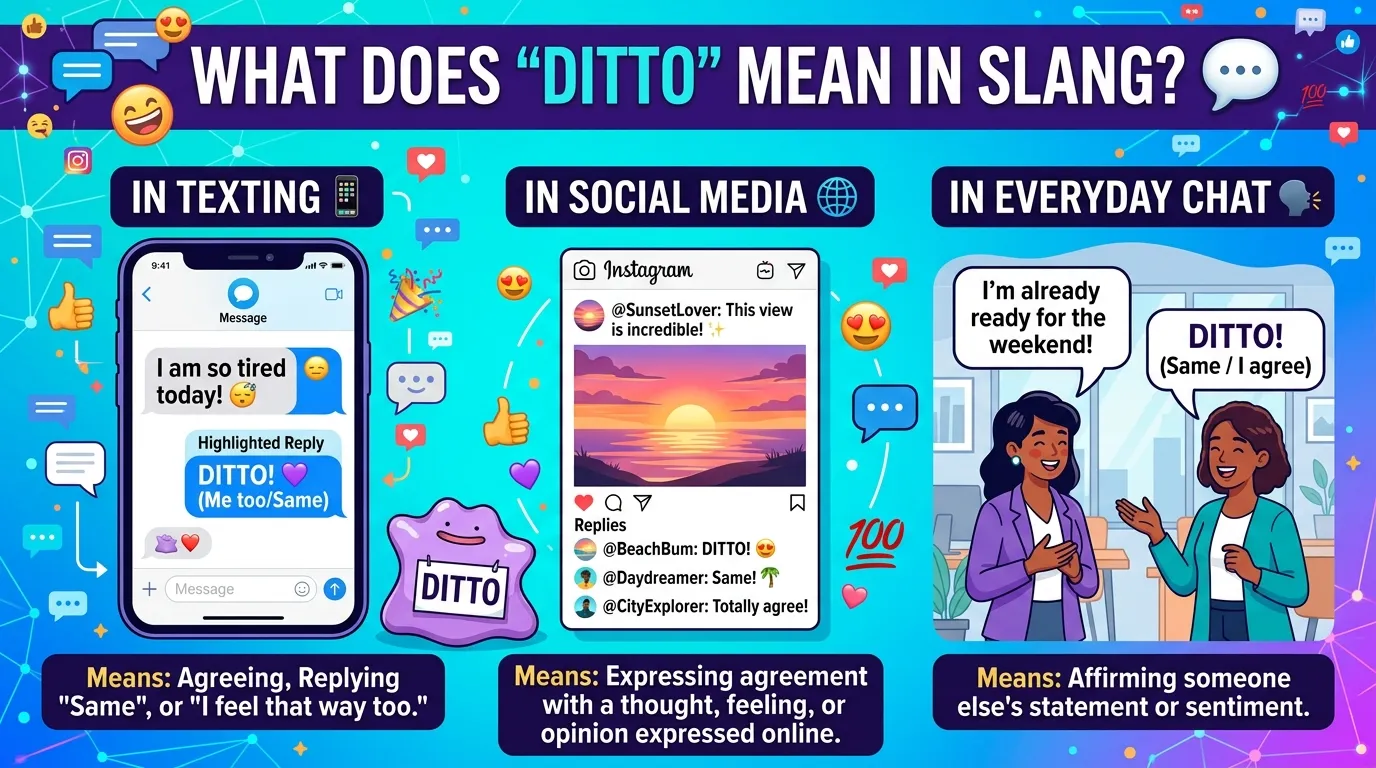
You may see ditto meaning slang searches connected to texting, social media, dating, friendships, and everyday conversations. Someone might say “I’m exhausted” and get “Ditto” as a reply. A friend may say “That was the best movie ever!” and you can simply answer “Ditto!” Instead of repeating the entire statement, you use one word to show agreement.
The word is especially useful in digital communication because people often want to respond quickly. Whether you see ditto in a text message, Snapchat, Instagram comment, TikTok conversation, Discord chat, Reddit thread, or casual conversation, the basic idea remains the same.
But where did this unusual word come from? Is ditto slang, an abbreviation, or a normal English word? And does “ditto” mean the same thing as “same,” “me too,” or “I agree”? Let’s break it all down in simple terms.
What Does Ditto Mean in Slang?
Ditto means “same,” “me too,” or “I agree” when used casually.
It tells another person that you have the same feeling, opinion, experience, or response they just expressed.
For example:
Person 1: I’m so tired today.
Person 2: Ditto.
Here, “ditto” means:
“I’m tired too.”
Another example:
Person 1: This restaurant is amazing!
Person 2: Ditto!
That means:
“I agree. I think it’s amazing too.”
Although people sometimes describe it as slang because of its informal use, ditto is actually a standard English word. It has been used for a long time and isn’t limited to internet slang.
Simple Meaning of Ditto
Depending on context, ditto can mean:
- Same
- Me too
- I agree
- Likewise
- I feel the same
- I think the same thing
- My answer is the same
- That applies to me too
The easiest way to remember it is:
Ditto = Same here.
Is Ditto Actually Slang?
Not exactly.
Ditto is an informal English expression, but it isn’t purely slang. The word has a long history in English and can appear in both casual and more traditional contexts.
Today, people often use it casually because it saves time. Instead of repeating an entire sentence, you can say “ditto.”
For example:
Long response:
“I completely agree with what you just said.”
Short response:
“Ditto.”
That makes it especially convenient for texting and social media.
However, the tone depends on the situation. In a friendly conversation, “ditto” can sound playful and relaxed. In a serious conversation, it might sound too brief if the other person expects a detailed response.
Ditto Meaning in Text
In texting, ditto usually means “same,” “me too,” or “I agree.”
It’s often used as a one-word response.
Example 1: Feelings
A: I miss summer already.
B: Ditto 😭
Meaning:
“I miss summer too.”
Example 2: Opinion
A: That new song is incredible.
B: Ditto! 🔥
Meaning:
“I agree. I think it’s incredible too.”
Example 3: Experience
A: I haven’t slept properly all week.
B: Ditto.
Meaning:
“Neither have I.”
Example 4: Agreement
A: We should definitely go there again.
B: Ditto!
Meaning:
“I completely agree.”
Because texting favors short replies, ditto can communicate agreement without making the conversation feel repetitive.
What Does Ditto Mean on Social Media?
On social media, ditto generally means “I feel the same” or “I agree with you.”
You might see it in comments, direct messages, captions, or replies.
For example:
“I could eat pizza every day.”
Someone might comment:
“Ditto 🍕”
They’re saying:
“Same. I could eat pizza every day too.”
Another example:
“This is the best vacation I’ve ever had.”
Reply:
“Ditto! ❤️”
This means:
“I feel exactly the same.”
Ditto on Instagram
On Instagram, people may use “ditto” when responding to:
- A friend’s opinion
- A funny post
- A relatable caption
- A recommendation
- A personal statement
- A comment they strongly agree with
For example:
“Coffee is basically my personality.”
Reply:
“Ditto ☕😂”
The response is short but shows strong identification with the statement.
Ditto Meaning on TikTok
On TikTok, ditto can be used as a quick way to say “same” or “literally me.”
Imagine a TikTok says:
“When you say you’re going to sleep early but it’s 2 a.m. and you’re still scrolling.”
Someone might comment:
“Ditto 😭”
They mean:
“I do exactly the same thing.”
It can also show agreement with an opinion:
“This is the funniest video on my FYP.”
Reply:
“Ditto 😂”
The tone is usually casual, friendly, humorous, or relatable.
Ditto Meaning on Snapchat
On Snapchat, people often communicate with short messages, so “ditto” fits naturally.
For example:
Friend: I’m ready for the weekend!
You: Ditto 🙌
Meaning:
“I’m ready too.”
Or:
Friend: I seriously need a vacation.
You: Ditto 😩
Meaning:
“I need one too.”
Because Snapchat conversations tend to be informal, “ditto” usually feels relaxed rather than formal.
Ditto Meaning on Discord
In Discord chats, ditto means the same thing: same, agreed, or me too.
It can appear in gaming communities, friend groups, study servers, hobby communities, and general chats.
For example:
User 1: This boss fight is impossible.
User 2: Ditto 💀
The second user means:
“I agree. I’m having the same problem.”
Another example:
User 1: We need more players for tonight.
User 2: Ditto.
Here, it may mean:
“I also need more players.”
Ditto Meaning on Reddit
Reddit users may use “ditto” to express agreement with another comment.
For example:
“This is exactly how I feel about the situation.”
A reply might simply say:
“Ditto.”
In this context, it means:
“I have the exact same opinion.”
It can also be used humorously:
“I came here for the comments.”
Reply:
“Ditto.”
The response means:
“Same. I also came here for the comments.”
Ditto Meaning in Gaming
In gaming conversations, ditto often means “same,” “I agree,” or “I have the same experience.”
For example:
Player 1: I keep losing because my teammates don’t communicate.
Player 2: Ditto.
Meaning:
“That happens to me too.”
Another example:
Player 1: This weapon is completely overpowered.
Player 2: Ditto.
Meaning:
“I agree that it’s overpowered.”
Gamers may also use it as a fast response when they don’t need to explain their position.
Ditto Meaning in Dating and Relationships ❤️
In dating conversations, “ditto” can have a slightly warmer or more personal meaning.
If someone says:
“I really enjoy talking to you.”
And you respond:
“Ditto ❤️”
You’re essentially saying:
“I really enjoy talking to you too.”
If someone says:
“I miss you.”
And you answer:
“Ditto 🥺”
It means:
“I miss you too.”
Is “Ditto” Romantic?
It can be, depending on the context.
The word itself isn’t romantic. The message around it determines the feeling.
Compare:
“I love spending time with you.”
“Ditto ❤️”
This can feel sweet and affectionate.
But:
“I need coffee.”
“Ditto.”
is obviously not romantic.
So if someone sends you “ditto” after a personal or affectionate message, they’re usually expressing the same emotion without repeating your exact words.
Ditto Meaning in Workplace Conversations
“Ditto” can also appear at work, especially in relaxed teams.
For example:
Coworker: I think we should move the meeting to Friday.
You: Ditto.
This means:
“I agree.”
However, be careful with professional communication.
In a formal email, writing only “Ditto” may seem too casual or vague. A clearer response would be:
“I agree with your suggestion.”
or:
“I feel the same way.”
So ditto is more appropriate for casual workplace chats than formal business communication.
The Origin and History of Ditto
The history of ditto is one reason the word is interesting.
The word comes from Italian, where detto means “said” or “aforementioned.” It eventually became associated with repeating something already stated.
In English, “ditto” became useful for indicating that something should be repeated or that the same thing applies.
Over time, its meaning expanded into everyday conversation.
Instead of using it only to indicate repetition in writing, people began using “ditto” as a spoken response.
That eventually gave us the modern conversational meaning:
“The same applies to me.”
Today, digital communication has made this use even more common because short responses are convenient.
Why Do People Say Ditto Instead of Same?
Both words can mean nearly the same thing, but they have slightly different personalities.
“Same” feels very modern and casual.
“Ditto” can sound playful, witty, old-fashioned, or humorous.
Compare:
“I’m exhausted.”
“Same.”
versus:
“I’m exhausted.”
“Ditto.”
Both mean:
“I’m exhausted too.”
But “ditto” has a slightly more distinctive personality.
Ditto vs. Same
| Expression | Meaning | Tone |
|---|---|---|
| Ditto | Same / me too | Casual, playful |
| Same | I feel the same | Very casual |
| Me too | I also feel this | Casual, clear |
| Likewise | The same applies to me | Polite, slightly formal |
| I agree | I share your opinion | Clear, direct |
| Exactly | I completely agree | Casual, emphatic |
Same is probably more common in modern texting, while ditto has a more playful or classic feel.
Ditto vs. Me Too
“Ditto” and “me too” are often interchangeable.
For example:
“I love this movie.”
“Me too.”
You could also say:
“I love this movie.”
“Ditto.”
Both responses communicate agreement.
The difference is mostly style.
Me too is extremely clear.
Ditto is shorter and can sound more playful.
Ditto vs. Likewise
“Likewise” is another close alternative.
For example:
“Nice to meet you.”
“Likewise.”
Here, “likewise” means:
“Nice to meet you too.”
“Ditto” could technically express the same idea in casual conversation, but “likewise” sounds more natural in polite social exchanges.
Quick comparison
- Ditto: casual and playful
- Same: very casual and modern
- Me too: natural and straightforward
- Likewise: polite and slightly formal
- Exactly: strong agreement
- I agree: direct and clear
Common Ways to Use Ditto
You can use “ditto” after statements about:
Feelings
“I’m so stressed.”
“Ditto.”
Opinions
“That movie was amazing.”
“Ditto.”
Experiences
“I couldn’t sleep last night.”
“Ditto.”
Preferences
“I love chocolate.”
“Ditto.”
Plans
“I want to go to the beach this weekend.”
“Ditto!”
Complaints
“This weather is terrible.”
“Ditto 😩”
The key is simple: the other person’s statement must also apply to you.
Real-Life Conversation Examples
Here are several natural examples of “ditto” in everyday communication.
Example 1: Friends
Alex: I need a vacation.
Sam: Ditto.
Alex: Somewhere warm.
Sam: Absolutely.
Here, “ditto” means “I need a vacation too.”
Example 2: Texting
Mia: I’m obsessed with this song.
Lily: Ditto 🎧
Meaning:
“I’m obsessed with it too.”
Example 3: Dating
Person A: I really like spending time with you. ❤️
Person B: Ditto ❤️
Meaning:
“I really like spending time with you too.”
Example 4: Work
Employee A: I think we need another day to finish this project.
Employee B: Ditto.
Meaning:
“I agree.”
Example 5: Gaming
Player A: That level is brutal.
Player B: Ditto 💀
Meaning:
“I agree. I’m struggling with it too.”
Can Ditto Sound Rude?
Usually, no. But it can sound dismissive in some situations.
Imagine someone sends you a long, emotional message:
“I’ve been having a really difficult week, and I don’t know what to do.”
If you simply reply:
“Ditto.”
They might feel that you’re not taking their feelings seriously.
The problem isn’t the word itself. The problem is lack of context or emotional support.
In a light conversation, “ditto” works perfectly.
In a serious conversation, you may want to say more.
For example:
“Ditto. I’ve been struggling too, but I’m here if you want to talk.”
That feels much more supportive.
Is Ditto Positive or Negative?
Ditto is neutral by itself.
Its emotional tone depends on what you’re agreeing with.
Positive:
“You did an amazing job!”
“Ditto!”
Negative:
“I hate being stuck in traffic.”
“Ditto.”
Romantic:
“I miss you.”
“Ditto ❤️”
Funny:
“I came here for the snacks.”
“Ditto 😂”
So don’t assume “ditto” is positive or negative. The surrounding conversation gives it its emotional meaning.
Common Misconceptions About Ditto
Misconception 1: Ditto Is Only Internet Slang
Not true.
“Ditto” existed long before social media, texting, and smartphones.
It is an established English word that is now commonly used in informal digital communication.
Misconception 2: Ditto Always Means “I Agree”
Not necessarily.
It can mean “same” without expressing an opinion.
For example:
“I didn’t sleep last night.”
“Ditto.”
This means:
“I didn’t sleep either.”
That’s similarity of experience rather than agreement with an opinion.
Misconception 3: Ditto Is Always Casual
It’s most common in casual communication, but it can appear in many types of writing and speech.
Still, if you’re writing a formal report or business email, a clearer phrase is usually better.
Misconception 4: Ditto Means “Exactly”
Sometimes it does communicate a similar idea, but the meanings aren’t identical.
“Exactly” strongly confirms someone’s statement.
“Ditto” usually says:
“The same applies to me.”
How to Respond When Someone Says Ditto
Your response depends on the conversation.
If someone says:
“I love this place.”
“Ditto.”
You can simply continue the conversation:
“We should come back next weekend!”
If they respond “ditto” to a romantic statement, you can be warmer:
“Aww, I’m glad you feel the same. ❤️”
If the topic is serious:
“Same here. Want to talk about it?”
You don’t always need to acknowledge the word itself. Treat it as confirmation that the other person feels or thinks the same way.
When Should You Use Ditto?
Use “ditto” when:
- You want a short response.
- You genuinely share the same feeling.
- You agree with someone’s opinion.
- You have had the same experience.
- The conversation is casual.
- You want a playful tone.
- Repeating the entire statement would be unnecessary.
Avoid using it when:
- The topic is highly emotional.
- The person expects a detailed answer.
- You’re writing a formal business message.
- Your meaning could be misunderstood.
- You need to explain why you agree.
Summary Table: Ditto Meaning Slang at a Glance
| Key Fact | Explanation |
|---|---|
| Main meaning | Same, me too, or I agree |
| Type | English word used informally |
| Origin | Derived from Italian |
| Common use | Texting, conversations, social media |
| Tone | Casual, playful, concise |
| Can be romantic? | Yes, depending on context |
| Can be humorous? | Yes |
| Can be negative? | Yes, when agreeing with a negative statement |
| Formal use | Possible, but often less suitable |
| Similar terms | Same, me too, likewise, exactly |
| Modern popularity | Common and easily understood |
| Basic translation | “The same applies to me” |
Frequently Asked Questions
What does ditto mean in texting?
In texting, ditto means “same,” “me too,” or “I agree.” It tells the other person that their statement also applies to you. For example, if someone says, “I’m tired,” and you reply “Ditto,” you’re saying, “I’m tired too.”
What does ditto mean from a girl?
If a girl replies “ditto,” it usually means she feels the same way about whatever you just said. The exact meaning depends on the message. If you say, “I miss you,” and she says “ditto,” she means “I miss you too.” If you say, “That movie was great,” she likely means “I agree.”
What does ditto mean from a guy?
A guy saying “ditto” usually means “same,” “me too,” or “I agree.” It doesn’t have a special male-specific meaning. The context determines whether the response is friendly, humorous, romantic, or simply practical.
Is ditto a slang word?
Ditto is better described as an informal English word rather than pure slang. It has a long history and existed before modern internet communication. People often use it casually today because it provides a quick way to express agreement or similarity.
Does ditto mean I love you too?
It can, if it directly follows “I love you.” For example:
“I love you.”
“Ditto ❤️”
In that context, “ditto” can mean “I love you too.” However, if someone says “ditto” after another statement, it simply means the same thing as that statement.
Is ditto a good response to I miss you?
Yes. If someone says “I miss you” and you genuinely feel the same, “Ditto” can mean “I miss you too.” Adding an emoji or a few extra words can make the response feel warmer, especially in a romantic conversation.
What is another word for ditto?
Common alternatives include same, me too, likewise, I agree, exactly, same here, and I feel the same. “Same” is especially common in modern texting, while “ditto” can sound a little more playful.
Does ditto mean exactly the same?
Usually, yes in the sense that the same statement applies to you. But “ditto” doesn’t always mean that two things are identical. It generally means you share the same opinion, feeling, experience, or response.
Can you use ditto in a formal email?
You can, but it isn’t usually the best choice. In formal communication, phrases such as “I agree,” “I feel the same way,” or “I have the same view” are clearer and more professional.
Why do people say ditto?
People say “ditto” because it’s a quick and convenient way to express agreement or similarity without repeating what someone else already said. It’s especially useful in texting and casual conversations where short replies are common.
Final Thoughts
So, what does ditto mean slang?
The simplest answer is:
Ditto means “same,” “me too,” “likewise,” or “I agree.”
When someone says “ditto,” they’re usually telling you that your statement also applies to them. They might share your opinion, feeling, experience, preference, or reaction.
You can find ditto in text messages, Instagram comments, TikTok discussions, Snapchat chats, Discord servers, Reddit threads, gaming conversations, dating messages, workplace chats, and everyday speech. Its meaning stays fairly consistent, although its tone can change with the situation.
The word isn’t strictly internet slang. It has a much older history and became part of everyday English long before social media existed. Modern communication simply gave people even more opportunities to use it.
If you remember only one thing, remember this:
“Ditto” = “The same goes for me.”
So if your friend says, “I need coffee,” you can say “Ditto ☕.” If your partner says, “I miss you,” you can say “Ditto ❤️.” And if someone says, “That was an amazing movie,” you can simply reply, “Ditto!”
It’s short, natural, and surprisingly versatile—which is exactly why this little word continues to work so well in modern communication.