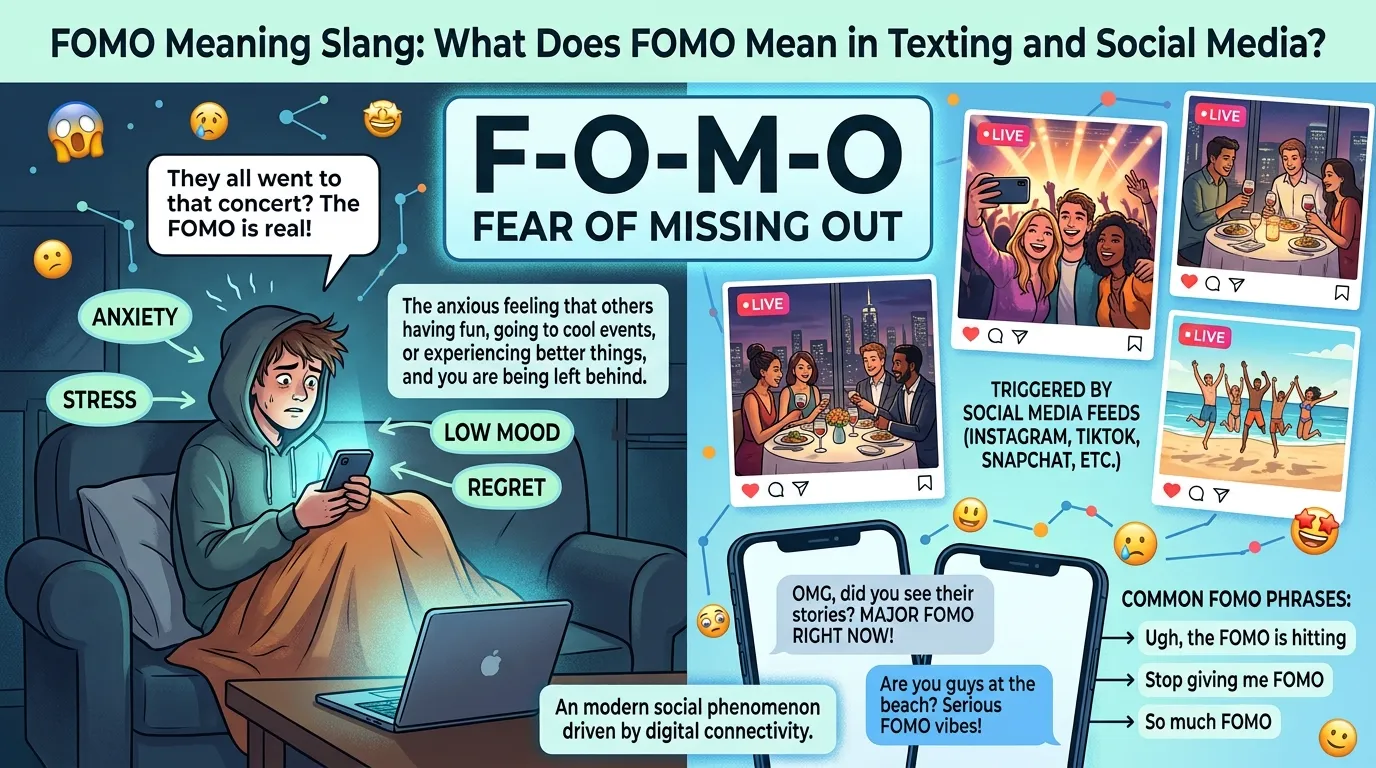
FOMO is slang for Fear of Missing Out. It describes the feeling that other people are enjoying something exciting, important, or valuable without you, which can make you feel anxious, left out, curious, or pressured to join.
In everyday texting and social media, someone might say I have FOMO, major FOMO, or FOMO is real when they regret missing an event or feel tempted to participate because everyone else seems to be doing it.
For example:
I skipped the concert, but now I’m seeing everyone’s posts. I have serious FOMO.
The FOMO meaning slang has become especially common online because social media makes it easy to see what other people are doing in real time. A single Instagram Story, TikTok video, Snapchat post, or group-chat message can make someone wonder what they are missing.
FOMO is not limited to parties or entertainment. People can experience social FOMO, dating FOMO, travel FOMO, career FOMO, gaming FOMO, and even shopping FOMO.
Understanding FOMO helps explain why people sometimes make choices based on what others are doing rather than what they actually want. It also helps you understand common phrases such as fear of missing out, FOMO is real, I have FOMO, FOMO kicking in, and don’t let FOMO get you.
FOMO Meaning at a Glance
| Term | Meaning |
|---|---|
| FOMO | Fear of Missing Out |
| Type | Internet slang / acronym |
| Main feeling | Anxiety or concern about missing something |
| Common platforms | TikTok, Instagram, Snapchat, Reddit, Discord, texting |
| Tone | Usually casual and conversational |
| Can be positive? | Yes, it can motivate participation or exploration |
| Common opposite | JOMO, or Joy of Missing Out |
| Related terms | YOLO, peer pressure, social comparison, JOMO |
| Example | I didn’t go, and now I have FOMO. |
What Does FOMO Stand For?
FOMO stands for Fear of Missing Out.
The phrase describes an emotional reaction to the possibility that other people are experiencing something enjoyable, meaningful, useful, or exciting while you are not.
FOMO can happen when you:
- See friends hanging out without you
- Watch people attend a concert you skipped
- Notice coworkers discussing an event you missed
- See a limited-time product selling out
- Hear about a party after it happened
- Watch gamers unlock something you do not have
- See people traveling while you are staying home
- Notice everyone talking about a new trend
- Feel like everyone has information you do not have
The important part is the perceived possibility of missing something.
You do not necessarily need to actually miss something important. Simply believing that you might be missing out can create FOMO.
What Is the Origin of FOMO?
The idea behind FOMO is much older than social media, but the modern slang term became popular in the early 2000s.
The acronym is commonly associated with Patrick McGinnis, who used the term while he was a student at Harvard Business School around 2004. The expression appeared in a satirical piece discussing social pressures and decision-making among students.
However, the psychological idea behind FOMO existed long before the acronym.
Humans naturally compare their lives with other people’s lives. People have always wondered whether another party was better, another opportunity was more valuable, or another group was having more fun.
Social media changed the scale of this experience.
Before smartphones, you might hear about a party you missed the next day. Today, you can watch videos from the party while it is happening.
That constant stream of information helped FOMO slang become part of modern online communication.
How FOMO Became Popular Online
Social media is one of the biggest reasons FOMO became a familiar everyday expression.
Platforms such as Instagram, TikTok, Snapchat, Reddit, Discord, and Facebook constantly show users what other people are doing.
This creates an interesting psychological loop:
- You see someone doing something.
- You assume it is exciting or valuable.
- You compare their experience with your own.
- You wonder whether you should be participating.
- You feel uncomfortable about being left out.
- You may decide to join simply because others are joining.
This does not happen to everyone, and social media does not automatically cause FOMO. However, seeing carefully selected highlights from other people’s lives can make comparison easier.
That is why phrases such as FOMO is real became common internet expressions.
What Does FOMO Mean in Texting?
In texting, FOMO usually has the same meaning: Fear of Missing Out.
Because it is short, it is convenient for casual conversations.
Texting Examples
Friend: Are you coming to the party tonight?
You: I wasn’t planning to, but now I have FOMO 😂
Here, the person feels tempted to attend because they do not want to miss the experience.
Another example:
Friend: We’re all getting dinner downtown.
You: Ugh, I have FOMO. I wish I could come.
In this case, FOMO expresses regret about being unable to participate.
Someone may also use it jokingly:
You: I already bought three games this month.
Friend: And you’re buying another?
You: Yes. FOMO got me.
Here, FOMO means the person felt pressured or tempted because they did not want to miss a popular opportunity.
What Does FOMO Mean on TikTok?
On TikTok, FOMO often describes the feeling created by seeing trends, events, products, challenges, trips, or experiences that appear popular.
For example, someone might see thousands of people posting about a concert and comment:
FOMO is hitting hard right now.
Or:
Everyone went except me. The FOMO is insane.
TikTok can make trends feel urgent because content moves quickly. A user may feel that if they do not participate immediately, they will miss the moment.
FOMO can also appear in videos about:
- Viral products
- Travel destinations
- Concerts
- Restaurants
- Fashion trends
- New technology
- Gaming releases
- Social events
- Celebrity events
What Does FOMO Mean on Instagram?
On Instagram, FOMO commonly appears when users see photos, Reels, or Stories showing friends or influencers enjoying experiences they are not part of.
For example:
Everyone is at the beach and I’m stuck at work. FOMO 😭
Another common situation is seeing friends attend a gathering without receiving an invitation.
The person might say:
Seeing these Stories is giving me major FOMO.
In casual Instagram language, FOMO can be serious, playful, exaggerated, or humorous depending on context.
What Does FOMO Mean on Snapchat?
On Snapchat, FOMO often relates to real-time social experiences.
Because Snapchat is heavily associated with sharing moments as they happen, users can quickly see what friends are doing.
Examples include:
You guys are out without me? FOMO 😭
or:
I should’ve gone. Major FOMO right now.
The expression usually communicates that the person wishes they were included.
What Does FOMO Mean on Discord?
On Discord, FOMO can appear in gaming communities, friend groups, fandoms, and online communities.
For example:
Everyone is playing tonight and I’m working. FOMO 😭
A gamer might also say:
I haven’t logged in all week. I’m getting FOMO from seeing everyone else’s screenshots.
In online communities, FOMO may involve missing:
- Gaming events
- Limited-time rewards
- Community discussions
- Online tournaments
- Special releases
- Live streams
- Group activities
What Does FOMO Mean on Reddit?
Reddit users may use FOMO when discussing investments, hobbies, technology, gaming, entertainment, or lifestyle choices.
For example:
Everyone is buying this product, and now I have FOMO.
Or:
I skipped the event because I was busy. Now I’m seeing everyone’s posts and getting FOMO.
Reddit discussions can also use FOMO in a more critical way, particularly when people discuss impulsive decisions or social pressure.
FOMO in Gaming
Gaming FOMO is extremely common.
Game developers sometimes create limited-time events, rewards, skins, characters, seasons, or challenges. Players may worry that they will never get another chance to obtain something.
A gamer might say:
I don’t even want the skin, but FOMO is making me play every day.
Another example:
I was going to skip this season, but now I have FOMO.
In gaming, FOMO can be connected to:
- Limited-time events
- Battle passes
- Exclusive cosmetics
- Seasonal content
- Special rewards
- Multiplayer events
- New releases
- Competitive rankings
FOMO does not necessarily mean someone is being manipulated. Sometimes a player simply wants to participate while an event is available.
FOMO in Dating and Relationships
FOMO can also affect dating.
Someone may worry that they are missing better romantic opportunities by staying in a relationship. Alternatively, a person who is single may feel pressured because friends appear to be dating successfully.
For example:
I keep wondering if I’m missing out by being single.
A person might also experience FOMO after seeing an ex-partner dating someone new.
In dating, FOMO can sometimes cause people to make decisions based on comparison rather than genuine feelings.
For example, someone may enter a relationship because everyone around them seems to be dating.
That is different from genuinely wanting a relationship.
FOMO in the Workplace
FOMO is not just a social-media feeling.
People can experience career FOMO when they see coworkers receiving promotions, changing companies, attending conferences, starting businesses, or learning new skills.
For example:
Everyone on my team is taking that certification. I’m starting to get FOMO.
Another example:
My friends are switching careers, and now I’m wondering if I’m missing a big opportunity.
Workplace FOMO can sometimes encourage useful action. It may motivate someone to learn a skill or investigate a career opportunity.
However, constantly comparing your career with other people’s careers can also create unnecessary stress.
FOMO in Everyday Conversation
FOMO is now common enough to appear in ordinary speech.
Someone might say:
- I have FOMO.
- FOMO is real.
- I’m getting FOMO.
- FOMO is kicking in.
- Don’t let FOMO make the decision.
- I only went because of FOMO.
- My FOMO made me buy it.
- I’m experiencing serious FOMO right now.
These phrases are usually casual rather than formal.
You would probably not use FOMO in a formal business report unless you were specifically discussing the concept.
Is FOMO Always Negative?
No.
Although Fear of Missing Out usually describes an uncomfortable feeling, FOMO is not automatically harmful.
It can sometimes encourage people to:
- Try a new activity
- Attend an event
- Reconnect with friends
- Explore a new place
- Learn something useful
- Take advantage of an opportunity
For example, you might hear about a local hiking group and think:
I don’t want to miss out. Maybe I’ll go this weekend.
That feeling could lead to a positive experience.
The problem occurs when FOMO controls decisions that do not actually match your needs or values.
The Negative Side of FOMO
FOMO can become problematic when it causes constant comparison or impulsive behavior.
It may contribute to decisions such as:
- Spending money unnecessarily
- Staying online for too long
- Attending events you do not enjoy
- Saying yes when you want to say no
- Buying things because they are trending
- Constantly checking social media
- Comparing your life with other people’s highlights
- Feeling anxious when you are not included
For example, you may be exhausted but attend a party because you are afraid everyone else will have fun without you.
That is a classic example of FOMO influencing behavior.
FOMO vs. JOMO
One of the most useful comparisons is FOMO vs. JOMO.
JOMO means Joy of Missing Out.
Instead of worrying about what everyone else is doing, someone experiencing JOMO feels comfortable staying home, disconnecting, resting, or choosing their own priorities.
| FOMO | JOMO |
|---|---|
| Fear of Missing Out | Joy of Missing Out |
| Focuses on what others are doing | Focuses on what you want |
| Can create pressure | Can create peace |
| Often linked to comparison | Often linked to contentment |
| May encourage participation | May encourage intentional rest |
| Example: I should go because everyone else is there | Example: I’m happy staying home tonight |
Neither term describes a permanent personality type.
A person can experience FOMO one day and JOMO the next.
FOMO vs. YOLO
YOLO stands for You Only Live Once.
Both FOMO and YOLO can encourage people to participate in experiences, but the motivation is different.
FOMO: I don’t want to miss what everyone else is doing.
YOLO: Life is short, so I want to experience this.
For example:
I bought the concert tickets because of FOMO.
This means the person’s decision was influenced by the fear of missing the experience.
Compare that with:
I bought the concert tickets because YOLO.
This suggests a more adventurous attitude toward enjoying life.
FOMO vs. Peer Pressure
FOMO and peer pressure are related but not identical.
Peer pressure usually involves influence from other people encouraging someone to behave in a particular way.
FOMO can happen entirely inside someone’s mind.
For example:
Nobody asked me to go, but I felt like I was missing out.
That is FOMO.
If friends repeatedly say:
Come on, everyone is going. You have to come!
that is closer to peer pressure.
The two can also occur together.
Common FOMO Scenarios
FOMO can appear in many parts of modern life.
Social FOMO
You see friends hanging out without you and feel excluded.
Event FOMO
You skip a concert or festival and later regret it.
Travel FOMO
You see people visiting places you want to visit and feel behind.
Shopping FOMO
A product is almost sold out, so you buy it even though you were not planning to.
Career FOMO
You see others advancing professionally and wonder whether you are falling behind.
Investment FOMO
You see people talking about an opportunity and feel pressured to act quickly.
Gaming FOMO
You worry about missing a limited-time reward.
Relationship FOMO
You worry that being single or staying in your current relationship means missing something better.
Real-Life FOMO Examples
Here are several natural examples of how people use the term.
Example 1: Social media
I wasn’t going to go out tonight, but everyone’s posting pictures. Now I have FOMO.
Example 2: Concert
I skipped the concert to save money, but I definitely have FOMO after seeing the videos.
Example 3: Gaming
I don’t even play that game much, but the limited event gave me FOMO.
Example 4: Shopping
I bought the shoes because they were almost sold out. Total FOMO purchase.
Example 5: Travel
My friends are traveling through Europe this summer, and I’m getting serious FOMO.
Example 6: Work
Everyone is attending the conference, so I have a little career FOMO.
These examples show that FOMO can describe both serious emotions and playful exaggeration.
Is FOMO a Formal Word?
FOMO is widely recognized informal language.
It is common in:
- Text messages
- Social media
- Online forums
- Casual conversations
- Marketing
- Pop culture
- Digital communication
It can also appear in journalism, academic discussions, business writing, and psychology-related content when the concept itself is being discussed.
However, in highly formal writing, spelling out fear of missing out may be clearer for readers who are unfamiliar with the acronym.
How to Use FOMO Correctly
Using FOMO naturally is simple.
Use it as a noun
I have FOMO.
Use it as a reason
I went because of FOMO.
Use it to describe a feeling
I’m getting major FOMO.
Use it humorously
FOMO made me order dessert.
Use it with social media
Seeing everyone’s Stories is giving me FOMO.
A common mistake is treating FOMO as though it always means actual exclusion.
You can have FOMO even when nobody intentionally left you out.
The feeling is about perceived missed opportunities, not necessarily deliberate exclusion.
Common Misconceptions About FOMO
FOMO does not always mean jealousy
Jealousy and FOMO can overlap, but they are different.
Jealousy often involves concern about losing something or someone to another person.
FOMO is more about fearing that you are missing an experience, opportunity, or activity.
FOMO is not always serious
People frequently use FOMO jokingly.
Someone might say:
I have FOMO because everyone ordered fries.
They are probably not experiencing intense anxiety. They simply do not want to miss out on the fries.
FOMO is not only about social media
Social media can amplify FOMO, but people experienced the underlying emotion long before smartphones existed.
FOMO is not always bad
Sometimes FOMO encourages someone to participate in something genuinely meaningful or enjoyable.
Why Does FOMO Feel So Powerful?
FOMO is closely connected to social comparison.
Humans naturally pay attention to what other people are doing. We use other people’s behavior as information about what may be valuable, popular, safe, or rewarding.
When you see dozens of people enjoying something, your brain may interpret their behavior as evidence that the experience matters.
Social media can intensify this process because users often see a continuous stream of selected moments.
You may not see the boring commute, canceled plans, awkward conversation, or stressful parts of someone’s day.
You see the concert.
You see the vacation.
You see the celebration.
You see the achievement.
That difference can make another person’s life appear more exciting than it really is.
How to Deal With FOMO
If FOMO is affecting your decisions, a few simple strategies can help.
Ask what you actually want
Before saying yes, ask:
Would I want to do this if I had never seen anyone else doing it?
That question can separate genuine interest from social comparison.
Wait before buying
If FOMO is pushing you toward an unnecessary purchase, give yourself time before spending money.
Urgency often makes decisions feel more important than they are.
Reduce unnecessary comparison
You do not need to know what everyone is doing every minute.
Taking breaks from social media can create more space for your own priorities.
Remember that online posts are selective
A post usually represents one moment.
It is not a complete picture of someone’s life.
Practice JOMO
Sometimes the healthiest response to FOMO is to deliberately enjoy being absent.
You might stay home, turn off notifications, read, sleep, spend time with family, or simply do nothing.
Missing an event is not automatically missing out on life.
FOMO in Modern Culture
FOMO has become more than a texting abbreviation.
It describes a recognizable feature of modern digital culture.
Smartphones provide continuous access to other people’s activities. Notifications create reminders of what is happening elsewhere. Social platforms make trends visible almost instantly.
As a result, people can feel connected to hundreds or thousands of experiences they are not personally participating in.
This has made FOMO slang useful because a three-letter acronym can describe a complicated emotional experience.
The term is also common in marketing. Businesses sometimes create urgency around limited-time offers, exclusive releases, or disappearing availability.
That does not mean every limited offer is designed to exploit FOMO. But consumers can benefit from recognizing when urgency is influencing their choices.
FOMO and Social Media: A Healthy Perspective
The goal is not necessarily to eliminate FOMO.
Everyone occasionally wonders what they are missing.
A healthier approach is to recognize the feeling without automatically obeying it.
You can think:
I have FOMO, but I still want to stay home tonight.
That is completely reasonable.
The feeling does not have to make the decision.
Frequently Asked Questions
What does FOMO mean in a text message?
FOMO means Fear of Missing Out in a text message. It usually describes feeling worried, curious, or disappointed because you are not participating in something that other people are experiencing.
What does FOMO mean on social media?
On social media, FOMO describes the feeling of missing an event, trend, experience, opportunity, or activity after seeing other people participate. It is especially common on platforms such as TikTok, Instagram, Snapchat, and Reddit.
Is FOMO good or bad?
FOMO can be either positive or negative. It may encourage you to try something new, but it can also cause unnecessary spending, stress, social comparison, or impulsive decisions.
What is the opposite of FOMO?
The commonly used opposite is JOMO, which means Joy of Missing Out. JOMO describes feeling satisfied with your decision not to participate in something and enjoying your own time instead.
Can I say I have FOMO?
Yes. I have FOMO is a natural and common informal expression. It means you feel like you might be missing something and wish you could participate.
What does major FOMO mean?
Major FOMO means a strong or noticeable feeling of Fear of Missing Out. It is often used casually or humorously when someone sees others enjoying an experience they missed.
What does FOMO is real mean?
FOMO is real is an informal expression meaning that the speaker genuinely feels the pressure or discomfort of missing out. It can also be used humorously when someone is tempted to join an activity.
Is FOMO only a Gen Z slang word?
No. FOMO is strongly associated with internet and social-media culture, but it is not limited to Gen Z. Millennials, Gen X, younger users, businesses, journalists, and researchers also use or recognize the term.
What is a FOMO purchase?
A FOMO purchase is something bought because a person fears missing a limited opportunity, trend, deal, product, or experience. The purchase may be driven more by urgency or social influence than by an original need.
How do you use FOMO in a sentence?
You can use FOMO naturally in casual sentences such as I’m getting FOMO, I have FOMO, FOMO made me go, or Seeing everyone’s pictures gave me FOMO.
Final Thoughts
The FOMO meaning slang is simple: FOMO stands for Fear of Missing Out. It describes the feeling that you may be missing an exciting, valuable, or important experience while other people are enjoying it.
Today, FOMO appears everywhere—from text messages and TikTok to Instagram, Snapchat, Discord, Reddit, gaming, dating, shopping, and workplace conversations.
The term became especially popular as digital communication made other people’s experiences visible almost instantly. A few photos or a short video can make an ordinary missed event suddenly feel important.
FOMO is not necessarily bad. Sometimes it encourages you to take a chance, meet people, or experience something new. But it becomes less helpful when it causes you to spend money, stay online, compare yourself with others, or make choices that do not reflect what you actually want.
The most useful lesson is simple: feeling FOMO does not mean you have to act on it.
Recognize the feeling, consider what matters to you, and make the decision that fits your own life—not simply the decision that everyone else seems to be making.