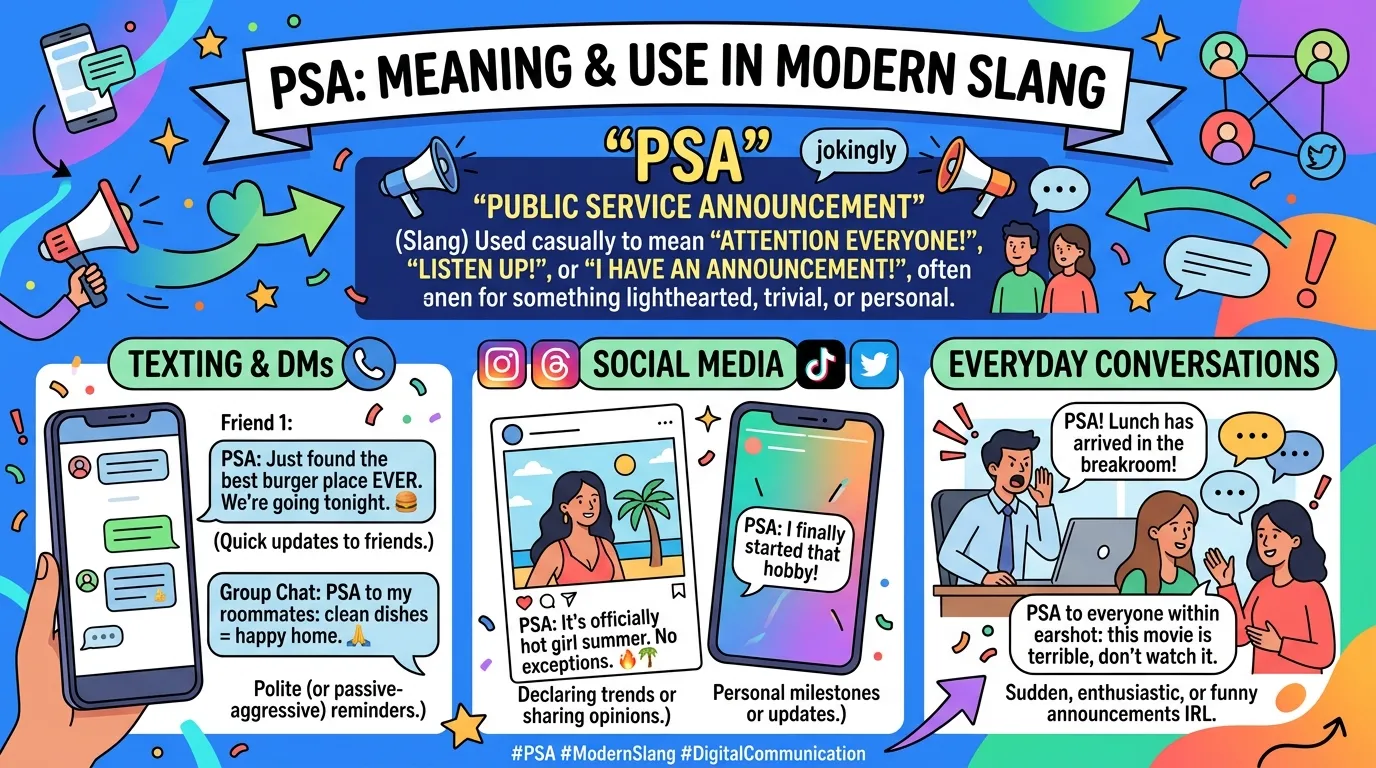
Have you ever opened a text, TikTok caption, Instagram post, or Reddit comment and seen someone write “PSA” before an important statement? If you wondered what it meant, you are not alone. The PSA meaning slang users see online is usually “public service announcement.” In casual digital communication, however, PSA has become a quick and flexible way to grab attention before sharing useful information, a warning, a reminder, an opinion, or something everyone should know.
For example, someone might post, “PSA: Bring a jacket tomorrow. It’s going to be cold.” They are not making an official government announcement. They are simply using PSA slang to say, “Here’s something important you should know.”
The term appears across text messages, TikTok, Instagram, Snapchat, Reddit, Discord, Facebook, X, gaming communities, workplace chats, and everyday conversations. Its tone can be serious, helpful, funny, sarcastic, or even dramatic depending on the context.
Understanding what PSA means in texting can help you interpret messages more accurately and avoid confusing it with other abbreviations.
In this guide, we will explain the PSA meaning in slang, where the expression came from, how people use it online, what it means on different platforms, common examples, similar expressions, mistakes to avoid, and what the term communicates emotionally.
What Does PSA Mean in Slang?
PSA usually means “public service announcement.”
In slang and casual online communication, PSA is commonly used before a message that the writer believes other people should notice, remember, or know.
A simple definition is:
PSA = Public Service Announcement; a quick way to introduce an important reminder, warning, tip, announcement, or piece of information.
The original phrase has a formal meaning. A public service announcement is generally a message intended to inform the public about an issue, behavior, safety concern, or useful information.
Online, the expression became much more casual.
Someone does not need to represent a government agency, organization, or public institution to use PSA. A person can write:
- “PSA: Check your email before you leave.”
- “PSA: This restaurant closes early on Sundays.”
- “PSA: Don’t forget your charger.”
- “PSA: The new update changed the settings.”
- “PSA: Stop putting ketchup on that.”
The last example shows how flexible the expression can be. PSA slang can introduce something genuinely important or something completely humorous.
PSA Meaning in Texting
When someone uses PSA in a text message, they generally want to make the next part of the message stand out.
For example:
Person 1: “PSA: The meeting starts at 9 instead of 10 tomorrow.”
Here, PSA means something like:
“Important announcement: please pay attention to this.”
Another example:
Person 1: “PSA, bring an umbrella. It’s raining like confused.”
The abbreviation makes the message feel more noticeable without requiring a long introduction.
In texting, PSA can therefore function as an informal attention-grabber.
Common PSA texting examples
Example 1: Reminder
“PSA: Your assignment is due tonight.”
Example 2: Warning
“PSA: Don’t use that website. It’s full of pop-ups.”
Example 3: Helpful information
“PSA: You can get free refills here.”
Example 4: Funny observation
“PSA: Eating pizza at midnight is always a good idea.”
Example 5: Friendly advice
“PSA: Wear comfortable shoes if you’re going downtown.”
The meaning stays essentially the same, but the tone changes according to the message.
PSA Meaning on Social Media
Social media helped make PSA much more common in casual communication.
On platforms such as TikTok, Instagram, Reddit, Facebook, and X, users often put PSA at the beginning of a caption, comment, or post.
The purpose is usually to signal:
“Pay attention. I have something you may want to know.”
A social media user might write:
“PSA: Always check the return policy before ordering online.”
Or:
“PSA for anyone traveling this weekend: The highway is under construction.”
The information may be useful to a large group of people, which connects directly to the original idea behind a public service announcement.
However, online PSA posts do not always contain serious public information.
People frequently use the expression for humor:
“PSA: Fries taste better when you steal them from your friend.”
That is not an actual public safety announcement. The exaggerated wording creates the joke.
PSA Meaning on TikTok
On TikTok, PSA can introduce a tip, opinion, warning, story, recommendation, or humorous statement.
You might see:
- “PSA for all my travelers…”
- “PSA: Stop doing this with your skincare.”
- “PSA: If you’re going to the concert, bring earplugs.”
- “Quick PSA before you buy this product.”
The phrase works especially well in short-form content because it immediately tells viewers that the creator is about to share something they consider worth knowing.
Why TikTok users say PSA
TikTok content moves quickly. Creators have only a short amount of time to capture attention.
Starting with “PSA” creates a simple mental signal:
Important information is coming.
It can also make an ordinary opinion sound more dramatic or entertaining.
For example:
“PSA: Not every trend looks good on everyone.”
The creator may be giving advice, expressing an opinion, or starting a discussion.
PSA Meaning on Instagram
On Instagram, PSA often appears in captions, Stories, comments, Reels, and direct messages.
For example:
“PSA: We’re closing at 3 PM today.”
A business could use PSA for a practical announcement.
An individual might use it more casually:
“PSA: Save this recipe before you lose it.”
Or:
“PSA: Your best friend deserves coffee today.”
On Instagram, the expression can therefore range from informative to playful.
PSA Meaning on Snapchat
On Snapchat, PSA is generally used in the same casual way as texting.
A person might send:
“PSA: Don’t forget we’re meeting at 7.”
Or post:
“PSA: The weather is freezing today.”
Because Snapchat communication is usually informal and conversational, PSA rarely feels overly formal in this context.
It simply acts as an attention-grabbing abbreviation.
PSA Meaning on Reddit
Reddit users often use PSA when they want to share information that could benefit other members of a community.
For example:
“PSA: Check your account settings after the latest update.”
Or:
“PSA for new players: Don’t spend all your resources early.”
This use is especially common in communities centered around:
- Gaming
- Technology
- Personal finance
- Travel
- Shopping
- Fitness
- Hobbies
- Entertainment
- Software
- Online services
Reddit’s community-based structure makes the original concept of a public announcement particularly useful.
PSA Meaning on Discord
On Discord, PSA can be used in group chats, servers, gaming communities, and private conversations.
A server moderator might write:
“PSA: The server rules have been updated.”
A gamer might say:
“PSA: The new patch changed the weapon stats.”
A friend could use it jokingly:
“PSA: Whoever ate my snacks owes me money.”
The abbreviation is flexible enough to work in both serious announcements and casual banter.
PSA Meaning in Gaming
Gaming communities frequently use PSA to warn or inform other players about something important.
For example:
“PSA: Don’t sell this item. You’ll need it for the next quest.”
Or:
“PSA: The boss has a new attack after the update.”
Gaming PSAs can involve:
- New patches
- Bugs
- Game mechanics
- Exploits
- Server problems
- Event schedules
- Item changes
- Strategy tips
- Safety concerns
- Account security
In this setting, PSA usually means “important information for other players.”
PSA Meaning in the Workplace
You may also see PSA in professional communication, especially in informal workplace chats such as Slack or Microsoft Teams.
For example:
“PSA: The conference room is unavailable this afternoon.”
Or:
“PSA: Please submit your timesheets by Friday.”
However, context matters.
In a formal email to executives, clients, or external partners, writing “PSA” may sound overly casual or ambiguous. A clearer phrase such as “Please note”, “Important update”, or “Reminder” may be more appropriate.
Professional example
Casual internal message:
“PSA: The office will close early today.”
More formal version:
“Please note that the office will close early today.”
Both communicate the same basic idea, but the second sounds more professional.
PSA Meaning in Dating and Relationships
PSA can also appear in dating conversations and relationship-related posts.
For example:
“PSA: Communication matters more than expensive gifts.”
Or:
“PSA: If someone likes you, you shouldn’t have to guess forever.”
These statements often have an advisory or opinion-based tone.
On dating apps and relationship-focused social media, PSA may introduce a personal rule, warning, or observation.
For example:
“PSA: Don’t ignore red flags just because someone is attractive.”
In this context, PSA is often less about making an official announcement and more about sharing advice with a broader audience.
Is PSA Always Serious?
No.
One of the most important things to understand about PSA slang meaning is that it can be completely serious or intentionally humorous.
Serious PSA
“PSA: Never share your password with strangers.”
The writer is giving genuine advice.
Helpful PSA
“PSA: The museum is free on Sundays.”
The writer is sharing useful information.
Funny PSA
“PSA: Never go grocery shopping while hungry.”
The writer is making a relatable joke.
Sarcastic PSA
“PSA: Apparently, replying to messages is still important.”
The writer is probably expressing frustration humorously.
Therefore, the surrounding message determines the emotional meaning.
PSA Tone: What Does It Sound Like?
The abbreviation itself is usually neutral, but the message following it determines the tone.
| Context | Typical Tone |
|---|---|
| Safety warning | Serious |
| Helpful tip | Friendly |
| Reminder | Neutral |
| Workplace update | Informal-professional |
| TikTok post | Casual |
| Meme | Funny |
| Argument | Sarcastic |
| Relationship advice | Advisory |
| Gaming | Informative |
| Reddit discussion | Community-focused |
This flexibility is one reason PSA remains useful in online communication.
PSA Meaning: Quick Summary Table
| Fact | Explanation |
|---|---|
| PSA meaning slang | Public service announcement |
| Original meaning | Public service announcement |
| Common online meaning | Important information, reminder, warning, or tip |
| Common use | Texting and social media |
| Tone | Serious, helpful, casual, funny, or sarcastic |
| Popularity | Common in online communication |
| Main purpose | Get attention before sharing information |
| Common platforms | TikTok, Instagram, Snapchat, Reddit, Discord, Facebook, X |
| Workplace use | Informal internal announcements |
| Related terms | FYI, heads-up, reminder, announcement, note |
Where Did PSA Come From?
The abbreviation PSA comes from the phrase “public service announcement.”
The concept predates social media by many decades.
Public service announcements were created to distribute information intended to benefit the public. They have historically appeared through media such as:
- Radio
- Television
- Newspapers
- Posters
- Public campaigns
- Community messaging
These announcements have covered topics such as public safety, health awareness, education, emergency preparedness, and community issues.
Over time, the abbreviation became familiar enough that people began using PSA outside official public campaigns.
The internet accelerated this evolution.
Instead of a government agency or nonprofit organization making a public announcement, an ordinary social media user could essentially say:
“Here is something everyone should know.”
That is how PSA slang developed into a casual digital expression.
How the Meaning of PSA Evolved Online
The evolution can be understood in three stages.
1. Formal public announcement
Originally, PSA referred primarily to an organized public message.
2. Internet community announcement
Online communities began using PSA for useful information shared with other users.
3. Casual and humorous expression
Today, people can use PSA before almost anything they want to emphasize.
This third stage explains why you may encounter funny or exaggerated PSAs that have nothing to do with public safety.
PSA vs. FYI
PSA and FYI can sometimes appear interchangeable, but they are not exactly the same.
FYI means “for your information.”
It usually introduces information that the recipient should know.
PSA has a stronger “pay attention” or “this is worth sharing” feeling.
Compare:
“FYI, the store closes at 8.”
This sounds like information being passed along.
“PSA: The store closes at 8.”
This sounds more like an announcement or reminder intended to catch attention.
Simple difference
FYI = Here is some information.
PSA = Here is something important or useful that people should know.
PSA vs. Heads-Up
Heads-up is another close expression.
For example:
“Heads-up: The meeting moved to Friday.”
“PSA: The meeting moved to Friday.”
Both can work, but they create slightly different impressions.
Heads-up feels more personal and conversational.
PSA feels more like a public announcement.
If you’re warning one friend, “heads-up” may sound more natural.
If you’re addressing a group, “PSA” can work especially well.
PSA vs. Announcement
An announcement is a broad term for information that is officially or publicly communicated.
PSA has a more specific cultural association with public information.
In casual online speech, though, the distinction becomes less important.
Someone might write:
“PSA: The event starts at 6.”
They are essentially saying:
“Announcement: The event starts at 6.”
The difference is mostly tone and style.
Common PSA Examples in Everyday Communication
Here are realistic examples showing how people might use PSA naturally.
Example 1: School
“PSA: The professor moved tomorrow’s class online.”
Example 2: Work
“PSA: The office Wi-Fi will be down after lunch.”
Example 3: Friends
“PSA: We’re leaving at 7, not 8.”
Example 4: Shopping
“PSA: This store has a huge sale today.”
Example 5: Travel
“PSA: Get to the airport early this weekend.”
Example 6: Food
“PSA: Never underestimate the power of a late-night pizza.”
Example 7: Social media
“PSA: Stop comparing your life to someone else’s highlight reel.”
Example 8: Gaming
“PSA: Save your rare items for the next event.”
Example 9: Technology
“PSA: Turn on two-factor authentication.”
Example 10: Relationships
“PSA: Healthy relationships require honest communication.”
How to Respond When Someone Says “PSA”
You usually do not need to respond in a special way.
Simply read the information that follows.
For example:
Friend: “PSA: Don’t forget dinner at 8.”
You: “Got it!”
Or:
Friend: “PSA: Bring your ID tonight.”
You: “Thanks for the reminder.”
If the PSA is humorous, you can respond naturally:
Friend: “PSA: Fries are a valid dinner.”
You: “Finally, someone understands me.”
The abbreviation itself does not require a particular response.
Is PSA Slang or an Acronym?
Technically, PSA is an acronym or initialism derived from “public service announcement.”
Whether it counts as “slang” depends on how the word is being used.
The original phrase is not slang. It is a standard term.
However, its casual internet usage can be considered part of informal digital language.
This distinction matters because PSA meaning slang generally refers to the informal way people use the abbreviation online, rather than the formal meaning of public service announcement.
Common Mistakes When Using PSA
Although PSA is simple, people sometimes use it awkwardly.
Mistake 1: Using it for every tiny message
If you send:
“PSA: I’m going to the kitchen.”
It may sound unnecessarily dramatic unless you’re joking.
PSA works best when the information has some relevance to the audience.
Mistake 2: Assuming it is always serious
A PSA can be humorous or sarcastic.
Always look at the context.
Mistake 3: Using it in highly formal writing
A formal report might be better with:
- Important notice
- Public announcement
- Please note
- Reminder
- Important information
Mistake 4: Confusing PSA with other meanings
PSA can mean different things in specialized contexts. The surrounding conversation usually makes the intended meaning clear.
For example, in medical or scientific discussions, PSA can refer to prostate-specific antigen, a blood-test marker. That is completely different from the slang use.
Therefore, never assume every PSA means “public service announcement.”
Other Meanings of PSA
Although “public service announcement” is the dominant meaning in casual online communication, PSA can have other meanings.
Prostate-Specific Antigen
In medicine, PSA commonly refers to prostate-specific antigen, a protein measured in a blood test.
This meaning is unrelated to internet slang.
Pounds per Square Inch
In some technical contexts, people may use PSA in ways related to pressure or equipment terminology, although PSI is the standard abbreviation for pounds per square inch.
Pressure-Sensitive Adhesive
In manufacturing and product discussions, PSA can refer to pressure-sensitive adhesive, the type of adhesive used on labels, tapes, stickers, and similar products.
These meanings are context-dependent.
If someone writes:
“PSA: Don’t forget your umbrella.”
they almost certainly mean public service announcement.
If someone is discussing medical testing, adhesives, or technical equipment, the intended meaning may be different.
Why Is PSA So Popular Online?
Several factors make PSA useful in digital communication.
It is short
Typing three letters is faster than writing “public service announcement.”
It grabs attention
PSA immediately signals that something important is coming.
It works in groups
The term naturally fits messages intended for multiple people.
It can be serious or funny
The same abbreviation works for warnings, tips, reminders, jokes, and opinions.
It is widely recognizable
Many internet users already understand what PSA means, so little explanation is necessary.
Is PSA Rude?
Generally, no.
PSA is not inherently rude, offensive, or disrespectful.
However, the wording that follows it can be rude.
For example:
“PSA: Stop being so annoying.”
The problem is the message, not the abbreviation itself.
A friendly PSA might say:
“PSA: Remember to drink some water today.”
Tone comes from the content, punctuation, relationship between the speakers, and surrounding conversation.
Is PSA Appropriate for Work?
Yes, but mainly in informal workplace communication.
It can be perfectly acceptable in a team Slack channel:
“PSA: The deadline has moved to Thursday.”
For external clients or highly formal documents, clearer wording is usually better.
Instead of:
“PSA: Your appointment has changed.”
you might write:
“Please note that your appointment has been rescheduled.”
The best choice depends on the audience.
How to Use PSA Naturally
If you want to use PSA yourself, follow these simple guidelines.
- Put PSA before the important information.
- Keep the message clear and concise.
- Use it when your audience benefits from knowing the information.
- Use a serious tone for serious topics.
- Feel free to use it humorously in casual conversations.
- Avoid overusing it in formal writing.
- Make sure the surrounding context makes the meaning clear.
A useful formula is:
PSA + important information
For example:
“PSA: The event starts one hour earlier tomorrow.”
Or:
PSA + humorous statement
“PSA: Coffee is not optional on Monday.”
SEO and Social Media Context: Why You See “PSA” So Often
Searches such as “what does PSA mean in texting,” “PSA meaning on TikTok,” “what does PSA mean on Instagram,” and “PSA slang meaning” have grown naturally alongside the popularity of short-form digital communication.
Internet language often favors abbreviations because users want to communicate quickly.
PSA is especially useful because it functions almost like a mini headline.
Instead of beginning with:
“I wanted to tell everyone something that I think is important…”
a person can simply write:
“PSA:”
The reader immediately knows to pay attention.
Frequently Asked Questions
What does PSA mean in texting?
In texting, PSA usually means “public service announcement.” It is commonly used before a reminder, warning, useful tip, announcement, or important piece of information.
What does PSA mean on TikTok?
On TikTok, PSA usually means “public service announcement,” but it is often used casually. A creator may use PSA to introduce advice, a warning, an opinion, a useful tip, or a humorous statement.
What does PSA mean on Instagram?
On Instagram, PSA generally means “public service announcement.” Users often put it before an important reminder, announcement, recommendation, or humorous observation.
Is PSA a slang word?
PSA itself comes from the standard phrase “public service announcement.” However, its informal use on social media and in texting can function as slang or internet shorthand.
What is the difference between PSA and FYI?
FYI means “for your information” and usually introduces information intended for a particular person or group. PSA has more of an announcement or attention-grabbing quality and often suggests that the information is useful to a broader audience.
Does PSA mean something bad?
No. PSA does not inherently have a negative meaning. It can introduce positive, neutral, serious, helpful, funny, or sarcastic information.
Can PSA be used at work?
Yes. PSA can be used in informal workplace chats, team channels, and internal messages. In formal communication, phrases such as “Please note” or “Important update” may sound more professional.
Why do people use PSA before jokes?
Using PSA before a joke makes the statement sound like an official announcement. This contrast can make an ordinary or silly observation funnier.
For example:
“PSA: Eating dessert before dinner is a lifestyle choice.”
The humor comes partly from treating a personal opinion like an official public announcement.
What does PSA mean besides public service announcement?
Depending on the context, PSA can also refer to prostate-specific antigen in medicine and pressure-sensitive adhesive in manufacturing. The surrounding subject usually makes the intended meaning clear.
Is PSA the same as an announcement?
Not exactly, but they overlap. An announcement is any message that communicates information publicly or to a group. PSA specifically comes from public service announcement and often carries the idea that the information is useful, important, or worth sharing.
Final Takeaway
So, what does PSA mean in slang? In most texts, social media posts, comments, and casual online conversations, PSA means “public service announcement.”
The expression has evolved from its formal use in public information campaigns into a flexible piece of internet language. Today, people use PSA slang to introduce:
- Important reminders
- Helpful tips
- Warnings
- Announcements
- Advice
- Community information
- Personal opinions
- Jokes
- Sarcastic observations
You can encounter it on TikTok, Instagram, Snapchat, Reddit, Discord, Facebook, X, gaming platforms, group chats, and workplace messaging apps.
The key is context. A serious PSA might warn people about a safety issue, while a funny PSA might simply announce that “coffee is necessary on Monday.”
If you see “PSA:” at the beginning of a message, the easiest interpretation is:
“Pay attention—here’s something you should know.”
That simple idea explains why PSA remains such a useful and recognizable abbreviation in modern digital communication.