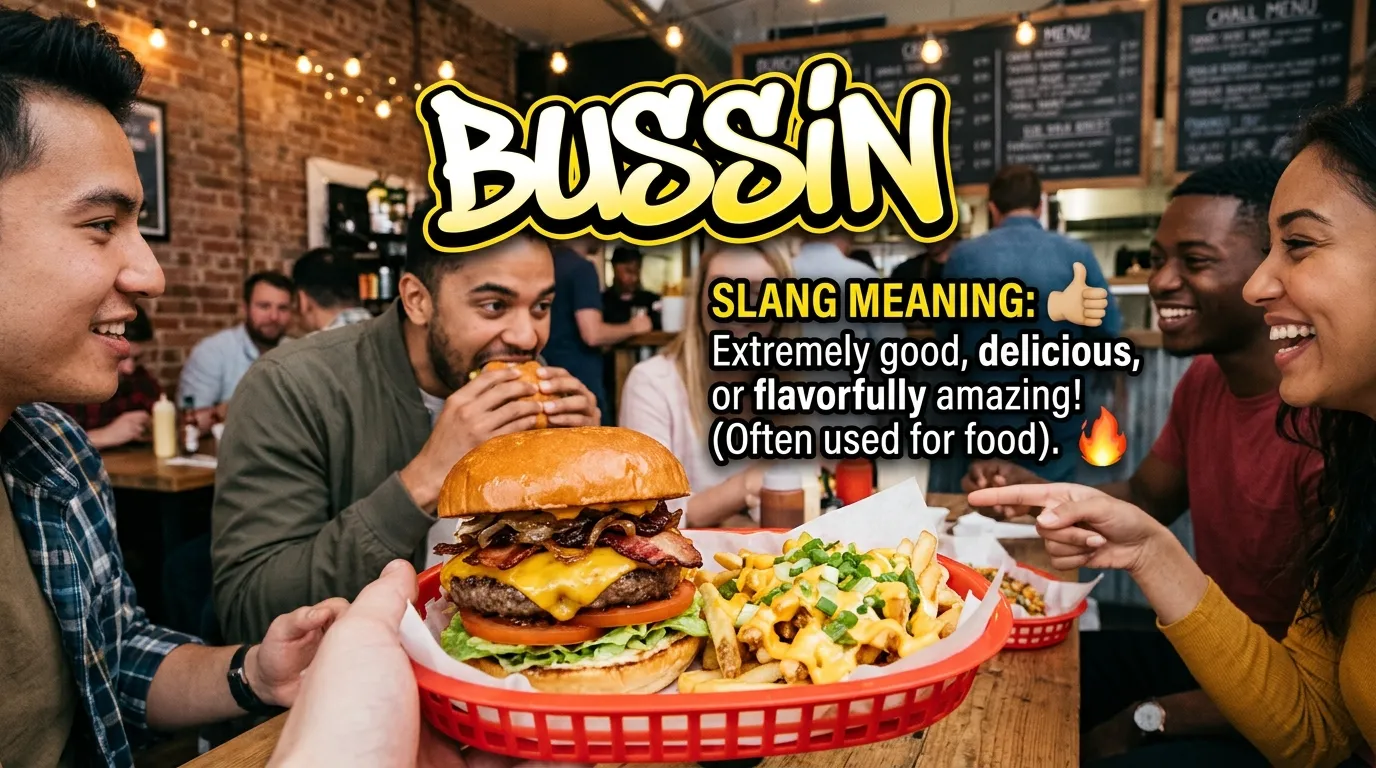
Have you ever seen someone take a bite of food and say, “This is bussin!”? If so, you may have wondered what bussin meaning slang actually refers to. In modern internet language, bussin is usually a strong compliment. It means something is extremely good, delicious, enjoyable, or impressive, especially when talking about food.
The expression became especially popular through TikTok, Twitter/X, Instagram, YouTube, Snapchat, and other social media platforms, where users began using it to describe food that tasted exceptionally good. A phrase such as “This chicken is bussin” generally means “This chicken tastes really good.”
However, bussin slang is not limited to food. Depending on the context, people can use it more broadly to describe something that is excellent, exciting, or satisfying. The tone is usually casual and enthusiastic.
You may also see variations such as “bussin bussin,” “that’s bussin,” “bussin fr,” or “this food is bussin.” These forms can add emphasis or excitement.
In this guide, we will explain the bussin meaning, where the slang came from, how it became popular, what it means on TikTok and other platforms, how to use it naturally, and how it differs from expressions such as “fire,” “slaps,” and “delicious.”
Quick Answer: What Does Bussin Mean in Slang?
Bussin is slang for something that is really good, excellent, or especially delicious.
It is most commonly used to praise food.
For example:
“These tacos are bussin!”
This means:
“These tacos are extremely good!”
The word is informal and strongly associated with social media, internet culture, younger speakers, and casual conversations.
When someone says “bussin bussin,” they are usually emphasizing that something is exceptionally good.
Bussin Definition at a Glance
| Feature | Meaning |
|---|---|
| Slang term | Bussin |
| Most common meaning | Extremely good or delicious |
| Most common context | Food |
| Tone | Casual, enthusiastic, playful |
| Common platforms | TikTok, Instagram, Snapchat, YouTube, Discord, X |
| Common phrase | “This is bussin!” |
| Emphasized form | “Bussin bussin” |
| Similar terms | Fire, slaps, delicious, amazing, gas |
| Formal English? | No |
| Typical use | Casual speech, texting, memes, social media |
What Does Bussin Mean?
The simplest bussin meaning slang definition is:
Bussin means exceptionally good, especially when describing food.
Imagine that your friend cooks homemade mac and cheese. You take one bite and immediately say:
“Yo, this mac and cheese is bussin!”
You are saying that the food tastes really, really good.
The word can communicate more excitement than simply saying “good.”
Compare these sentences:
- “The pizza is good.”
- “The pizza is really good.”
- “The pizza is amazing.”
- “The pizza is bussin!”
The last one has a distinctly casual and internet-influenced tone.
Although food remains the clearest use, people sometimes extend bussin to other enjoyable things. For example:
“That new song is bussin.”
Here, the speaker may mean the song is excellent or has a great sound.
Still, food is the context most strongly associated with the term.
Where Did the Slang Word Bussin Come From?
The exact linguistic history of bussin is not completely straightforward. Like many slang expressions, it developed through informal speech and online culture rather than being created at one clearly documented moment.
The term has connections to African American Vernacular English (AAVE) and earlier informal uses of “buss.” It existed before its huge social-media boom, but platforms such as TikTok helped bring the expression to a much wider internet audience.
The word became especially visible in online food content during the late 2010s and early 2020s. Food reviews, cooking videos, memes, reactions, and short-form videos helped turn “bussin” into a widely recognized internet slang term.
Why Did Bussin Become So Popular?
Several factors helped the word spread:
- Short-form video made slang easy to repeat.
- Food content became extremely popular online.
- Creators used “bussin” in humorous reactions.
- Memes made the expression recognizable.
- Younger internet users adopted and adapted it.
- TikTok helped move niche slang into mainstream online culture.
The important point is that TikTok did not necessarily invent the word. Rather, it played a major role in popularizing the expression with a much broader audience.
What Does Bussin Mean on TikTok?
On TikTok, bussin usually means really delicious, extremely good, or satisfying.
Food videos frequently use the term when someone reacts enthusiastically to a meal.
For example:
“POV: Your grandma makes the best fried chicken and it’s bussin.”
The intended meaning is that the food tastes exceptionally good.
You may also see:
- “Bussin fr”
- “This is bussin”
- “That meal was bussin”
- “Bussin bussin”
- “No cap, this is bussin”
Here, fr means “for real,” while no cap means “I’m being honest” or “I’m not exaggerating.”
Why Is Bussin So Common in Food Videos?
Food creates an easy situation for exaggerated slang. Instead of saying:
“The meal was very tasty.”
someone might say:
“Bro, this is bussin!”
The second sentence feels more energetic and conversational.
That makes the word especially suitable for short videos, captions, comments, memes, and reaction content.
What Does Bussin Mean in Texting?
In texting, bussin is generally used as an informal compliment.
For example:
Friend 1: “I finally tried that burger place.”
Friend 2: “Was it good?”
Friend 1: “Bro. Bussin.”
In this context, “bussin” means the food was excellent.
Someone might also text:
“These wings are bussin 🔥”
Or:
“Mom’s cooking is bussin tonight.”
Because texting is informal, slang like this can make the conversation feel playful and relaxed.
What Does Bussin Mean on Instagram?
On Instagram, bussin can appear in captions, comments, Reels, Stories, and direct messages.
A person might post a picture of a meal with the caption:
“Dinner was bussin.”
A follower might comment:
“That looks bussin 🔥”
The word works especially well with food photography and restaurant content because it immediately communicates enthusiasm.
However, Instagram users may also use the word more broadly to describe music, experiences, or other things they enjoy.
What Does Bussin Mean on Snapchat?
On Snapchat, bussin generally has the same meaning.
For example, someone might send a picture of their lunch and write:
“Bussin 😭🔥”
The combination of slang and emojis adds an emotional reaction. The exact emoji choice can change the tone, but the basic meaning remains positive.
A Snapchat message such as:
“This pizza is bussin”
normally means:
“This pizza tastes amazing.”
What Does Bussin Mean on Discord?
On Discord, the meaning depends heavily on the community.
In a gaming server, someone might use the word while discussing food:
“Just made some ramen. Bussin.”
In another community, members might use it jokingly to describe music, a game update, or something entertaining.
Because Discord communities often develop their own inside jokes, bussin can sometimes be used ironically.
That is an important part of internet slang: the same word can be sincere in one conversation and deliberately exaggerated in another.
What Does Bussin Mean on Reddit?
Reddit users may use bussin in food discussions, memes, comments, and casual conversations.
For example:
“I tried homemade Korean fried chicken last night. Absolutely bussin.”
Reddit also has many communities with different communication styles, so the word may appear sincerely or as part of a joke.
Context matters.
What Does Bussin Mean in Gaming?
In gaming communities, bussin is less specifically tied to food.
A gamer might say:
“This update is bussin.”
That could mean the update is excellent.
Or:
“The new soundtrack is bussin.”
Here, the speaker is praising the music.
However, if someone says:
“This pizza is bussin while I grind ranked.”
they are using the traditional food-related meaning.
Can Bussin Describe Something Other Than Food?
Yes.
Although food is the most recognizable context, bussin can be used more broadly as a positive expression.
Examples include:
“This playlist is bussin.”
“That beat is bussin.”
“The new game is bussin.”
“This coffee is bussin.”
The broader meaning is essentially:
“This is really good.”
Still, the word sounds most natural in informal settings. It is not a replacement for “excellent” in every situation.
What Does “Bussin Bussin” Mean?
“Bussin bussin” is an intensified version of bussin.
Repeating the word emphasizes the speaker’s enthusiasm.
For example:
“These tacos are bussin.”
means the tacos are really good.
But:
“These tacos are bussin bussin.”
suggests something closer to:
“These tacos are seriously amazing.”
The repetition is playful and informal.
You may see bussin bussin in TikTok captions, memes, comments, text messages, and casual conversations.
What Does “Bussin Fr” Mean?
“Bussin fr” combines two slang expressions.
- Bussin = extremely good
- Fr = for real
So:
“This ramen is bussin fr.”
means:
“This ramen is genuinely really good.”
The addition of fr emphasizes sincerity.
Other variations include:
- “Bussin fr”
- “Bussin ngl”
- “Actually bussin”
- “Lowkey bussin”
- “Bussin no cap”
Here, ngl means “not gonna lie,” while no cap means “no exaggeration” or “I am telling the truth.”
Is Bussin Always a Positive Word?
Usually, yes.
When used sincerely, bussin is positive slang. It expresses approval, enjoyment, or excitement.
However, internet slang can be used sarcastically.
For example, someone might eat terrible cafeteria food and say:
“Wow. This is bussin.”
If the speaker clearly dislikes the food, the statement may be sarcastic.
That means you should consider:
- The speaker’s tone
- The surrounding conversation
- Facial expressions
- Emojis
- Previous comments
- Whether the person is joking
The dictionary-style definition alone may not tell you whether someone is being sincere.
Is Bussin a Compliment?
Yes, bussin is generally a compliment.
If someone says:
“Your cooking is bussin.”
they are praising your cooking.
If someone says:
“That cake is bussin.”
they are praising the cake.
If someone says:
“This playlist is bussin.”
they are praising the playlist.
The word communicates strong approval in an informal way.
Bussin vs. Fire
Fire is another popular slang term meaning something is excellent or exciting.
| Bussin | Fire |
|---|---|
| Strongly associated with food | Used across many topics |
| Means extremely good or delicious | Means excellent, exciting, or impressive |
| Common in food videos | Common for music, clothes, sports, food, and more |
| Very casual | Very casual |
Examples:
“These wings are bussin.”
“That song is fire.”
You can sometimes use both:
“These wings are bussin. The sauce is fire.”
Bussin vs. Slaps
Slaps is another slang expression meaning something is exceptionally good.
It is particularly common when discussing:
- Music
- Songs
- Beats
- Food
- Entertainment
For example:
“This song slaps.”
means the song is excellent or has a powerful, enjoyable sound.
Meanwhile:
“This burger is bussin.”
focuses more naturally on how good the food tastes.
There is overlap, but the typical contexts differ.
Bussin vs. Delicious
These words have similar positive meanings, but their tone is very different.
Delicious is standard English.
Bussin is slang.
Compare:
“The soup is delicious.”
and:
“The soup is bussin.”
The first works in almost any setting.
The second sounds casual, playful, and internet-influenced.
For a restaurant review, school assignment, business email, or formal article, delicious is usually more appropriate.
For a text to a friend, bussin can sound natural.
Bussin vs. Amazing
“Amazing” is also much more flexible.
You can say:
“The concert was amazing.”
“Your presentation was amazing.”
“The food was amazing.”
Bussin is more strongly associated with casual enthusiasm, particularly around food.
Therefore, the two words can overlap without being interchangeable in every situation.
How to Use Bussin in a Sentence
Here are natural examples:
- “This pizza is bussin.”
- “Those tacos were bussin.”
- “My mom’s cooking is always bussin.”
- “This chicken sandwich is bussin fr.”
- “The fries are bussin today.”
- “That smoothie was bussin.”
- “This new playlist is bussin.”
- “Bro, this ramen is bussin.”
- “These cookies are bussin bussin.”
- “The food at that restaurant was seriously bussin.”
Conversation Example
Alex: “Did you try the new burger place?”
Jordan: “Yeah.”
Alex: “How was it?”
Jordan: “Bussin.”
Alex: “That good?”
Jordan: “Bussin bussin.”
This conversation uses repetition to show that Jordan really enjoyed the food.
Bussin in Dating Conversations
You may occasionally see bussin in dating texts or casual conversations.
For example:
“You said you could cook. Is it actually bussin?”
Or:
“Dinner was bussin 😭.”
In dating conversations, the word generally keeps its normal meaning. It can simply make the conversation sound more relaxed and playful.
However, slang is highly personal. Not everyone likes internet slang, so using it naturally matters more than forcing it into every message.
Bussin in Workplace Conversations
This is where context becomes particularly important.
Bussin is informal slang, so it may not fit professional communication.
A close group of coworkers who regularly use casual language might say:
“That lunch was bussin.”
But you probably would not write:
“The quarterly meeting was bussin.”
in a formal business email.
Instead, use words such as:
- Excellent
- Delicious
- Impressive
- Outstanding
- Enjoyable
- Successful
Professional communication should match the expectations of the audience.
Common Mistakes When Using Bussin
Using It in Formal Writing
Bussin is slang, so it is usually inappropriate for formal essays, academic papers, professional reports, and official correspondence.
Assuming It Only Means Food
Food is the strongest association, but the term can also describe music, entertainment, experiences, and other things.
Using It Without Understanding the Tone
The word is casual and often playful. Using it in a serious or formal setting can sound out of place.
Assuming Everyone Uses It the Same Way
Slang changes quickly. Age, community, region, culture, and online environment can affect how people understand a term.
Treating TikTok as the Original Source
TikTok played a major role in popularizing bussin, but the expression existed in informal language before its viral social-media era.
Is Bussin Still Popular?
Bussin became highly visible during the social-media slang boom of the early 2020s, especially through food-related TikTok content.
Like many internet expressions, its popularity can rise and fall. Some people continue to use it naturally, while others use it mainly as a meme or joke.
That does not make the word meaningless.
Internet slang often follows a cycle:
Niche use → viral popularity → mainstream adoption → meme usage → continued casual use or decline
Bussin has followed much of this pattern.
Its exact popularity can vary by platform and age group, but the term remains recognizable across much of internet culture.
Why Does Bussin Sound Funny or Exaggerated?
Part of the appeal comes from its strong emotional tone.
Instead of saying:
“This food is very tasty.”
someone can say:
“This is bussin!”
The shorter phrase has more personality.
Internet slang often works this way. A single unusual word can communicate enthusiasm, humor, community identity, and informality at the same time.
That makes slang particularly useful in:
- Memes
- Short videos
- Comments
- Group chats
- Gaming communities
- Casual conversations
Does Bussin Have a Negative Meaning?
By itself, bussin is normally positive.
A negative interpretation usually comes from sarcasm or context.
For example:
“Yeah, this cafeteria pizza is bussin.”
If the speaker says it while making a disgusted face, the phrase could be ironic.
So when interpreting slang, do not rely only on the individual word. Look at the entire message and situation.
Can Adults Say Bussin?
Yes.
There is no rule saying only teenagers can use the word. Anyone can understand or use slang.
However, slang can sound natural or unnatural depending on the speaker and situation.
If an adult says:
“This barbecue is bussin!”
in a casual setting, the meaning is clear.
But forcing trendy slang into every conversation can sound awkward.
The best approach is simple: use it when it fits your normal speaking style and the people around you understand the expression.
Is Bussin a Real Word?
Yes, bussin is a recognized slang expression, even though it is not standard formal vocabulary.
Languages contain much more than formal dictionary words. Slang, regional expressions, idioms, abbreviations, and informal phrases are all part of how people communicate.
Bussin has become widely recognizable because of its presence in internet culture and social media.
That does not mean it should replace standard English in every situation.
Summary of Bussin Meaning
| Question | Answer |
|---|---|
| What does bussin mean? | Extremely good, delicious, or enjoyable |
| What does bussin mean in slang? | A casual way to praise something |
| Is bussin positive? | Usually yes |
| Is it mainly about food? | Yes, although it can be used more broadly |
| What does bussin bussin mean? | Extremely or exceptionally good |
| What does bussin fr mean? | Genuinely very good |
| Where is it common? | TikTok, Instagram, Snapchat, YouTube, Discord, X, Reddit, texts |
| Is it formal English? | No |
| Is it still understood online? | Yes, particularly in casual internet culture |
| Similar slang | Fire, slaps, gas, goated |
| Standard alternatives | Delicious, excellent, amazing, impressive |
Frequently Asked Questions
What does bussin mean in simple words?
Bussin means really good, especially when describing food. If someone says, “This burger is bussin,” they mean the burger tastes extremely good.
What does bussin mean on TikTok?
On TikTok, bussin usually means delicious or exceptionally good. It became especially popular through food videos, cooking content, memes, and reaction videos.
What does bussin bussin mean?
Bussin bussin is an intensified form of bussin. It means something is really, really good. Repeating the word adds emphasis and makes the expression more playful.
What does bussin fr mean?
Bussin fr means “really good, for real.” The abbreviation “fr” means “for real,” so it emphasizes that the speaker genuinely likes something.
Is bussin a compliment?
Yes. In normal usage, bussin is a compliment. It shows that someone thinks food, music, entertainment, or another experience is especially good.
Is bussin only used for food?
No. Food is the most common association, but people can use bussin for music, games, entertainment, drinks, and other enjoyable things. The broader meaning is similar to “really good.”
Is bussin appropriate in a professional email?
Usually not. Bussin is informal slang. In professional communication, words such as excellent, delicious, impressive, or outstanding are generally more appropriate.
Is bussin the same as fire?
They overlap because both can express strong approval. However, bussin is especially associated with food, while fire can describe music, clothes, performances, sports, food, and many other things.
Where did bussin come from?
The expression existed in informal language before it became a major internet trend. It has connections to African American English and earlier uses of “buss.” Social media, especially TikTok and food-related content, helped popularize the modern slang term widely.
Can bussin be used sarcastically?
Yes. Like many slang expressions, bussin can be used ironically. Someone might call terrible food “bussin” as a joke. The surrounding context and tone determine whether the speaker is sincere.
Final Takeaway
The bussin meaning slang definition is simple: bussin means extremely good, especially when talking about food.
If someone says:
“This chicken is bussin.”
they are probably saying:
“This chicken tastes amazing.”
The expression became especially popular through social media and short-form video culture, with TikTok playing a major role in spreading it to a much wider audience. Today, you may encounter bussin on TikTok, Instagram, Snapchat, YouTube, Discord, Reddit, X, gaming communities, group chats, and everyday casual conversations.
You may also see variations such as “bussin bussin,” “bussin fr,” and “this is bussin.”
The most important thing to remember is its tone. Bussin is casual slang, not formal English. It works naturally when talking with friends, posting online, reacting to food, or participating in internet culture. In professional or academic writing, standard alternatives such as delicious, excellent, amazing, or impressive are usually better.
So the next time someone says, “This food is bussin,” you can confidently understand the message: they think the food is seriously good.