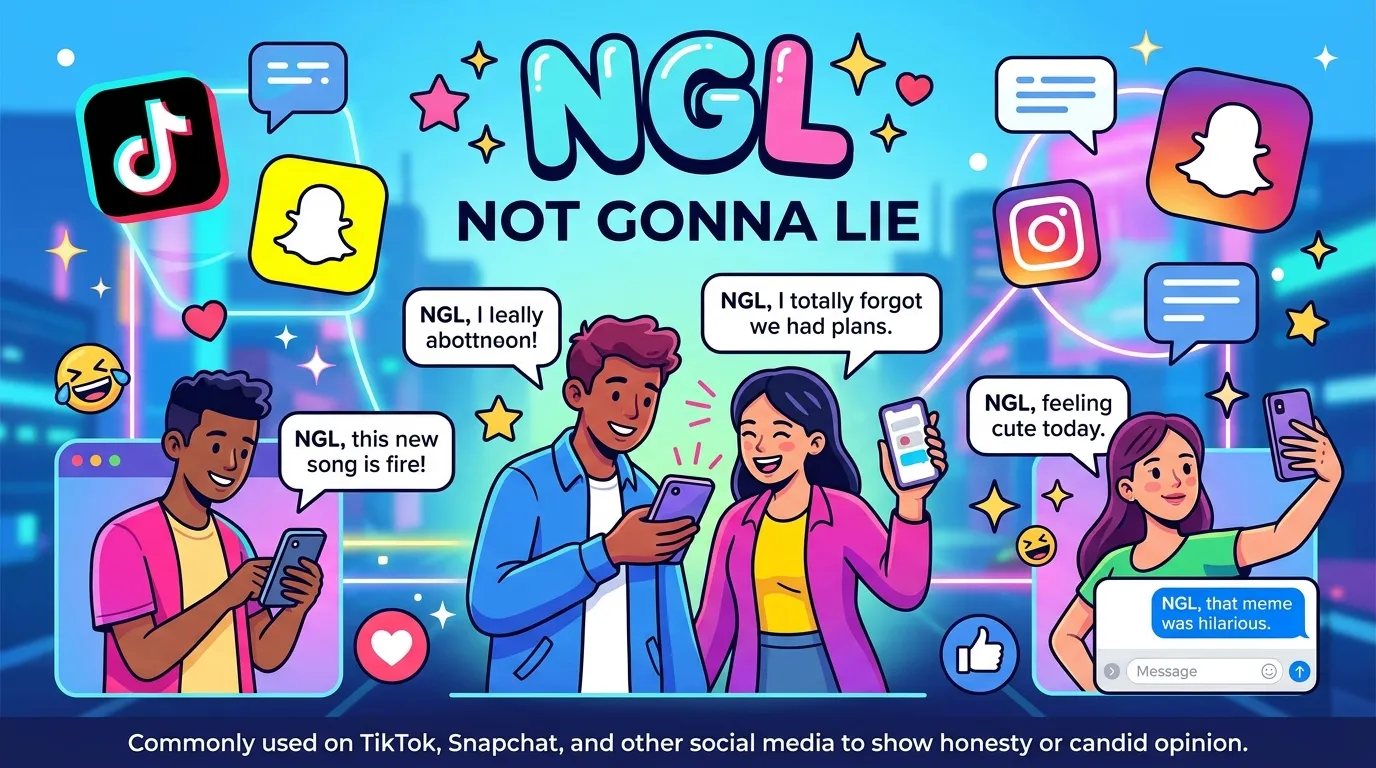
Have you ever received a text that says “NGL, I actually liked it” or seen someone comment “NGL this is amazing” on TikTok? If you wondered what those three letters mean, you’re not alone. NGL slang meaning is one of the most common questions people have when they encounter modern texting abbreviations and social media slang.
NGL usually means “not gonna lie.” People use it to introduce an honest opinion, confession, reaction, or statement. It often signals that the person is about to say what they genuinely think, even if the statement is surprising, embarrassing, critical, or unexpected.
For example, if someone says, “NGL, I was nervous before the presentation,” they’re simply saying, “Not gonna lie, I was nervous.”
The abbreviation is especially common in text messages, TikTok, Instagram, Snapchat, Discord, Reddit, X, YouTube comments, and everyday online conversations. It can make a message feel more casual and personal.
In this guide, you’ll learn the complete NGL slang meaning, where it came from, how people use it, what it means on different social platforms, how it compares with phrases like TBH and IMO, and when you should or shouldn’t use it.
What Does NGL Mean in Slang?
NGL means “not gonna lie.”
It is an informal internet abbreviation used when someone wants to express an honest thought, feeling, reaction, or opinion.
The phrase can be used at the beginning, middle, or sometimes near the end of a sentence.
Simple definition
NGL = Not Gonna Lie
In standard English, the equivalent would usually be:
- Honestly
- To be honest
- I have to admit
- Truthfully
- I won’t lie
- If I’m being honest
However, NGL sounds much more casual than these traditional expressions.
Examples
- NGL, that movie was really good.
- NGL I was scared at first.
- That outfit is fire, NGL.
- NGL, I didn’t expect you to win.
- NGL, this food looks amazing.
The abbreviation doesn’t necessarily mean that everything said before it was a lie. Instead, it emphasizes that the following statement is intended to be honest or sincere.
NGL Meaning in Text Messages
In texting, NGL is primarily used as a quick way to say “not gonna lie.”
Because texting often favors shorter expressions, abbreviations such as NGL save time while still communicating tone.
Consider this conversation:
Alex: Did you like the new restaurant?
Sam: NGL, I loved it.
Here, Sam could have written:
“Not gonna lie, I loved it.”
But NGL makes the message shorter and more casual.
NGL can introduce different types of statements
People use it before:
- Opinions
- Compliments
- Criticism
- Confessions
- Surprising reactions
- Personal feelings
- Embarrassing admissions
- Jokes
- Agreement or disagreement
For example:
Opinion:
“NGL, I think the old version was better.”
Confession:
“NGL, I forgot about the homework.”
Compliment:
“NGL, you look great today.”
Surprise:
“NGL, I didn’t think you’d actually do it.”
Criticism:
“NGL, that ending was disappointing.”
The common idea is honesty or emphasis.
NGL Meaning on Social Media
The meaning of NGL generally stays the same across social media platforms.
Whether you see it on TikTok, Instagram, Snapchat, Reddit, Discord, or X, it usually means “not gonna lie.”
However, the way people use it can change slightly depending on the platform.
NGL on TikTok
TikTok users frequently use NGL in captions, comments, and video text.
Examples include:
- NGL, this trend is actually fun.
- NGL this might be my favorite song.
- NGL, I wasn’t expecting that ending.
- NGL, this recipe looks incredible.
On TikTok, NGL can make a comment sound more conversational and spontaneous.
Someone might say:
“NGL, I watched this five times.”
The abbreviation emphasizes that the person genuinely enjoyed the content.
NGL on Instagram
On Instagram, NGL can appear in:
- Comments
- Captions
- Direct messages
- Stories
- Replies
For example:
“NGL, your vacation photos are beautiful.”
Or:
“NGL this is probably my favorite picture of you.”
It’s particularly useful in casual conversations between friends and followers.
NGL on Snapchat
Snapchat conversations are usually informal, so NGL fits naturally into the platform’s communication style.
For example:
“NGL, that was hilarious 😂”
Or:
“NGL, I thought you were joking.”
Because Snapchat messages are generally short and conversational, abbreviations like NGL are common.
NGL on Discord
Discord users may use NGL in gaming chats, community servers, private messages, and casual conversations.
Examples:
- NGL, that boss fight was brutal.
- NGL your build is pretty good.
- NGL I thought we were going to lose.
- That update is weird, NGL.
In gaming communities, NGL can make an opinion sound informal rather than overly serious.
NGL on Reddit
Reddit users often use NGL when giving personal opinions or reactions.
For example:
“NGL, I prefer the original game.”
Or:
“NGL, this is one of the funniest comments I’ve seen today.”
Because Reddit discussions can involve strong opinions, NGL may be used to make a statement feel more personal and conversational.
NGL Meaning in Dating and Relationships
NGL is also common in dating conversations.
Someone may use it when expressing attraction, nervousness, affection, or disappointment.
For example:
“NGL, I was nervous to meet you.”
Or:
“NGL, I’ve been thinking about you all day.”
A person might also use it while flirting:
“NGL, you looked really good tonight.”
In these situations, NGL can emphasize sincerity. It may make a statement feel more spontaneous because the speaker appears to be openly admitting something.
However, the abbreviation itself doesn’t automatically make a statement romantic or flirty. Context determines the meaning.
NGL Meaning in Gaming
Gaming communities use NGL frequently because gamers often communicate quickly through chat.
Examples include:
“NGL, that weapon is overpowered.”
“NGL, I didn’t think we’d win.”
“That was the hardest level, NGL.”
“NGL, your aim is nonsensical.”
In these examples, NGL simply introduces or emphasizes an honest assessment.
It can be especially useful when someone is admitting something that might surprise other players.
NGL in Everyday Conversation
Although NGL started as an internet-style abbreviation, the phrase “not gonna lie” itself is common in everyday spoken English.
A person might say:
“Not gonna lie, I’m tired.”
Online, that same sentence becomes:
“NGL, I’m tired.”
This shows why the abbreviation is so popular. It represents a phrase people already use naturally in conversation.
Where Did NGL Come From?
NGL comes directly from the phrase “not gonna lie.”
The expression existed in spoken and written English before the abbreviation became popular online. As internet communication developed, people began shortening frequently used phrases.
This is similar to other texting abbreviations such as:
- TBH = To Be Honest
- IMO = In My Opinion
- IDK = I Don’t Know
- IKR = I Know, Right?
- BTW = By The Way
- FR = For Real
- LOL = Laughing Out Loud
NGL belongs to this broader culture of digital shorthand.
Its popularity grew alongside texting, instant messaging, social media, online communities, and short-form content.
Why Do People Say NGL?
People use NGL for several reasons.
To emphasize honesty
The most obvious purpose is to signal sincerity.
“NGL, I really enjoyed that.”
The speaker is emphasizing that the opinion is genuine.
To introduce a confession
NGL can make an admission feel more natural.
“NGL, I forgot your birthday.”
To soften criticism
Sometimes NGL makes criticism sound less formal or aggressive.
“NGL, I don’t really like that design.”
It doesn’t guarantee that the criticism will sound polite, but it frames it as personal opinion.
To emphasize a compliment
NGL can also make praise feel spontaneous.
“NGL, you did an amazing job.”
To express surprise
“NGL, I didn’t expect that at all.”
The abbreviation draws attention to the speaker’s genuine reaction.
NGL Meaning: Summary Table
| Fact | Explanation |
|---|---|
| NGL meaning | Not gonna lie |
| Full phrase | Not gonna lie |
| Main use | Expressing honesty or a genuine opinion |
| Type | Internet/texting slang |
| Tone | Casual, conversational |
| Common platforms | TikTok, Instagram, Snapchat, Reddit, Discord, texting |
| Common contexts | Opinions, confessions, reactions, compliments |
| Formal? | No |
| Related terms | TBH, honestly, FR, IMO |
| Typical position | Often at the beginning or end of a sentence |
NGL vs TBH: What’s the Difference?
NGL and TBH are extremely similar.
- NGL = Not Gonna Lie
- TBH = To Be Honest
Both can introduce an honest opinion or personal reaction.
Example
NGL, I love this song.
TBH, I love this song.
The basic meaning is almost identical.
The difference is mostly in phrasing and tone.
NGL can sound like a casual admission.
TBH can sound slightly more direct or opinion-focused.
In many conversations, you can replace one with the other without significantly changing the meaning.
NGL vs IMO
IMO means “in my opinion.”
Unlike NGL, IMO specifically identifies something as the speaker’s personal viewpoint.
Compare:
NGL, this game is difficult.
This emphasizes honesty.
IMO, this game is difficult.
This emphasizes that the statement is a personal opinion.
A person can also use both:
“NGL, IMO, the original game was better.”
That is grammatically understandable but somewhat repetitive. In casual online writing, people generally don’t need both.
NGL vs FR
FR usually means “for real.”
It can express agreement, emphasis, or seriousness.
For example:
“NGL, that was the best episode.”
“FR, that was amazing.”
They aren’t exact replacements.
NGL focuses more on honesty or admission, while FR often emphasizes agreement, seriousness, or authenticity.
Positive and Negative Uses of NGL
NGL isn’t inherently positive or negative.
Its meaning depends entirely on the statement that follows it.
Positive examples
- NGL, you look amazing.
- NGL, this is my favorite song.
- NGL, you did a great job.
- NGL, that was really fun.
Negative examples
- NGL, I didn’t like the movie.
- NGL, this update made the game worse.
- NGL, I’m disappointed.
- NGL, that was a bad decision.
Neutral examples
- NGL, I’m pretty tired.
- NGL, I forgot about it.
- NGL, I don’t know the answer.
Therefore, NGL itself doesn’t communicate a positive or negative attitude. The surrounding words do.
Does NGL Always Mean the Person Was Lying Before?
No.
This is an important misunderstanding.
When someone says:
“NGL, I actually enjoyed it.”
They’re not necessarily saying they previously lied about disliking it.
NGL is usually just a conversational phrase that emphasizes sincerity.
It’s similar to saying:
“Honestly…”
or:
“I have to admit…”
The phrase shouldn’t automatically be interpreted as an accusation of previous dishonesty.
How to Use NGL Correctly
Using NGL is simple, but context matters.
Use NGL in casual communication
It’s appropriate for:
- Texting friends
- Social media comments
- Group chats
- Gaming chats
- Casual DMs
- Online communities
- Informal conversations
Avoid it in formal writing
You generally shouldn’t write:
“NGL, I believe the company should reconsider this proposal.”
in a formal business report.
Instead, write:
“I believe the company should reconsider this proposal.”
Similarly, academic papers, legal documents, professional reports, and formal applications generally call for standard language.
Don’t overuse it
Using NGL in every sentence can make your writing feel repetitive.
For example:
NGL, I like this. NGL, the color is good. NGL, the design is nice.
One use is enough.
Real-Life NGL Conversation Examples
Conversation 1: Friends
Mia: Did you like the concert?
Jake: NGL, it was incredible.
Conversation 2: Movie discussion
Alex: What did you think about the ending?
Sam: NGL, I didn’t see it coming.
Conversation 3: Compliment
Chris: How’s my new haircut?
Taylor: NGL, it looks really good.
Conversation 4: Gaming
Player 1: Can we beat this level?
Player 2: NGL, it’s going to be difficult.
Conversation 5: Dating
Person 1: Were you nervous yesterday?
Person 2: NGL, I definitely was.
Conversation 6: Social media
Comment: NGL, this might be your best video yet.
These examples show how flexible the abbreviation can be.
Common Mistakes With NGL
Mistake 1: Thinking NGL has only one tone
NGL can introduce a compliment, criticism, joke, confession, or neutral observation.
Its tone depends on context.
Mistake 2: Assuming it means “I was lying”
NGL doesn’t necessarily indicate that someone previously lied.
It’s primarily an honesty marker.
Mistake 3: Using it in formal documents
NGL is internet slang. Standard alternatives are better in professional writing.
Mistake 4: Confusing NGL with another abbreviation
Some abbreviations can have multiple meanings in different communities. However, in ordinary social media and texting conversations, NGL overwhelmingly refers to “not gonna lie.”
Mistake 5: Treating every NGL statement as objectively true
NGL indicates that someone is presenting something as honest or sincere. It doesn’t prove that the statement is factually correct.
For example:
“NGL, this is the best restaurant in the world.”
That’s still an opinion.
Is NGL Rude?
Usually, no.
NGL is a neutral and casual abbreviation.
However, the statement following it can be rude.
Compare:
“NGL, you look great.”
This is positive.
“NGL, that outfit looks terrible.”
This could be insulting.
So if someone reacts negatively to an NGL message, the problem is usually the content or wording rather than the abbreviation itself.
Is NGL a Good Way to Start a Sentence?
Yes, especially in informal communication.
Examples:
- NGL, I’m impressed.
- NGL, that was funny.
- NGL, I expected more.
- NGL, I miss those days.
It works particularly well when the speaker wants to create a conversational tone.
Can NGL Be Used at the End of a Sentence?
Yes.
For example:
“That was actually pretty good, NGL.”
This placement is common in casual internet language.
The meaning remains essentially the same.
Compare:
“NGL, that was pretty good.”
and
“That was pretty good, NGL.”
Both communicate the same basic idea.
The first version introduces the statement with NGL, while the second adds emphasis after the statement.
Is NGL Still Popular?
NGL remains recognizable internet slang because it represents a phrase that is already common in everyday speech: “not gonna lie.”
Internet slang constantly changes. New abbreviations and expressions appear, while others become less common. However, abbreviations based on ordinary conversational phrases tend to remain easy to understand because users can connect the abbreviation to a familiar expression.
NGL is therefore relatively intuitive once you know what the letters represent.
Related Slang Terms You Should Know
If you’re learning internet slang, NGL is worth understanding alongside several related abbreviations.
TBH
TBH = To Be Honest
Used to introduce an honest opinion or reaction.
IMO
IMO = In My Opinion
Used when giving a personal viewpoint.
IMHO
IMHO = In My Humble Opinion
A more playful variation of IMO.
FR
FR = For Real
Used for emphasis, agreement, or sincerity.
IDK
IDK = I Don’t Know
A common way to express uncertainty or lack of knowledge.
IKR
IKR = I Know, Right?
Used when strongly agreeing with someone.
BTW
BTW = By The Way
Used to introduce additional information.
How NGL Changes the Tone of a Message
One interesting feature of NGL is how much it can affect conversational tone.
Compare:
“I like this.”
with:
“NGL, I like this.”
The second version can feel more spontaneous and personal.
Now compare:
“I don’t like this.”
with:
“NGL, I don’t really like this.”
The second version can sound more like a personal admission.
This doesn’t mean NGL automatically makes criticism polite. It simply creates a conversational frame around the statement.
NGL and Internet Culture
NGL is part of a larger shift toward informal digital communication.
People online frequently shorten phrases because:
- Messages are faster to type.
- Social platforms encourage concise communication.
- Internet communities develop shared vocabulary.
- Abbreviations can make conversations feel more relaxed.
- Users often imitate language they see in comments and posts.
NGL also works well because it mirrors natural speech. People frequently say “not gonna lie” before sharing a genuine thought.
The abbreviation simply compresses that phrase into three letters.
NGL in Professional Communication
There is an important distinction between understanding NGL and using NGL professionally.
You may encounter NGL in:
- Workplace group chats
- Informal Slack conversations
- Messages between coworkers
- Social media posts from businesses
- Casual professional communities
Whether it’s appropriate depends on the workplace culture.
For formal emails, reports, proposals, presentations, and client communication, it’s safer to use standard expressions such as:
- Honestly
- To be honest
- I have to admit
- In my view
- I believe
For example:
Casual:
“NGL, this deadline is tight.”
Professional:
“This deadline is quite tight.”
Frequently Asked Questions
What does NGL stand for in texting?
NGL stands for “not gonna lie.” It’s used in texts to introduce an honest opinion, confession, reaction, compliment, or personal statement.
What does NGL mean on TikTok?
On TikTok, NGL generally means “not gonna lie.” Users commonly put it in comments, captions, and messages when they want to emphasize a genuine reaction or opinion.
What does NGL mean on Snapchat?
On Snapchat, NGL means “not gonna lie.” It is usually used in casual conversations to introduce an honest thought or reaction.
Is NGL the same as TBH?
NGL and TBH have very similar meanings. NGL means “not gonna lie,” while TBH means “to be honest.” Both can introduce a sincere opinion or admission, although their wording and conversational tone can differ slightly.
Is NGL positive or negative?
NGL can be either positive, negative, or neutral. The abbreviation itself doesn’t have a positive or negative meaning. The words that follow it determine the overall tone.
Can I use NGL in a formal email?
It’s generally better to avoid NGL in formal emails. Because it is internet slang, expressions such as “honestly,” “to be honest,” or “I believe” are more appropriate in professional writing.
What does “NGL, I love it” mean?
“NGL, I love it” means “Not gonna lie, I love it.” The person is emphasizing that their positive reaction is genuine.
What does “NGL bro” mean?
“NGL bro” usually means something like “Not gonna lie, bro…” It is an informal way to introduce an honest comment or reaction, especially between friends or people communicating casually online.
Can NGL be used at the end of a sentence?
Yes. For example, “That was really funny, NGL.” This has essentially the same meaning as “NGL, that was really funny.”
Does NGL mean someone is telling the truth?
NGL signals that the speaker intends to sound honest or sincere, but it doesn’t prove that their statement is objectively true. It is a conversational expression, not a guarantee of factual accuracy.
Final Takeaway
The most common NGL slang meaning is simple: NGL means “not gonna lie.”
It’s an informal internet abbreviation used to introduce an honest opinion, confession, reaction, compliment, criticism, or personal feeling. You’ll commonly see it in text messages, TikTok comments, Instagram captions, Snapchat conversations, Discord chats, Reddit posts, gaming communities, and casual DMs.
The easiest way to understand NGL is to mentally replace it with “honestly” or “not gonna lie.”
For example:
“NGL, that movie was amazing.”
means:
“Not gonna lie, that movie was amazing.”
NGL can appear at the beginning or end of a sentence, and its tone can be positive, negative, or neutral depending on the surrounding message. It’s closely related to slang expressions such as TBH, IMO, FR, and IMHO, but NGL specifically carries the idea of making an honest admission or emphasizing sincerity.
Use NGL freely in casual online conversations, but avoid it in formal academic, business, or professional writing. Most importantly, remember that NGL expresses the speaker’s claimed sincerity—it doesn’t automatically make an opinion a fact.
Once you know that NGL = “not gonna lie,” you’ll be able to understand one of the most common abbreviations used in modern online communication.