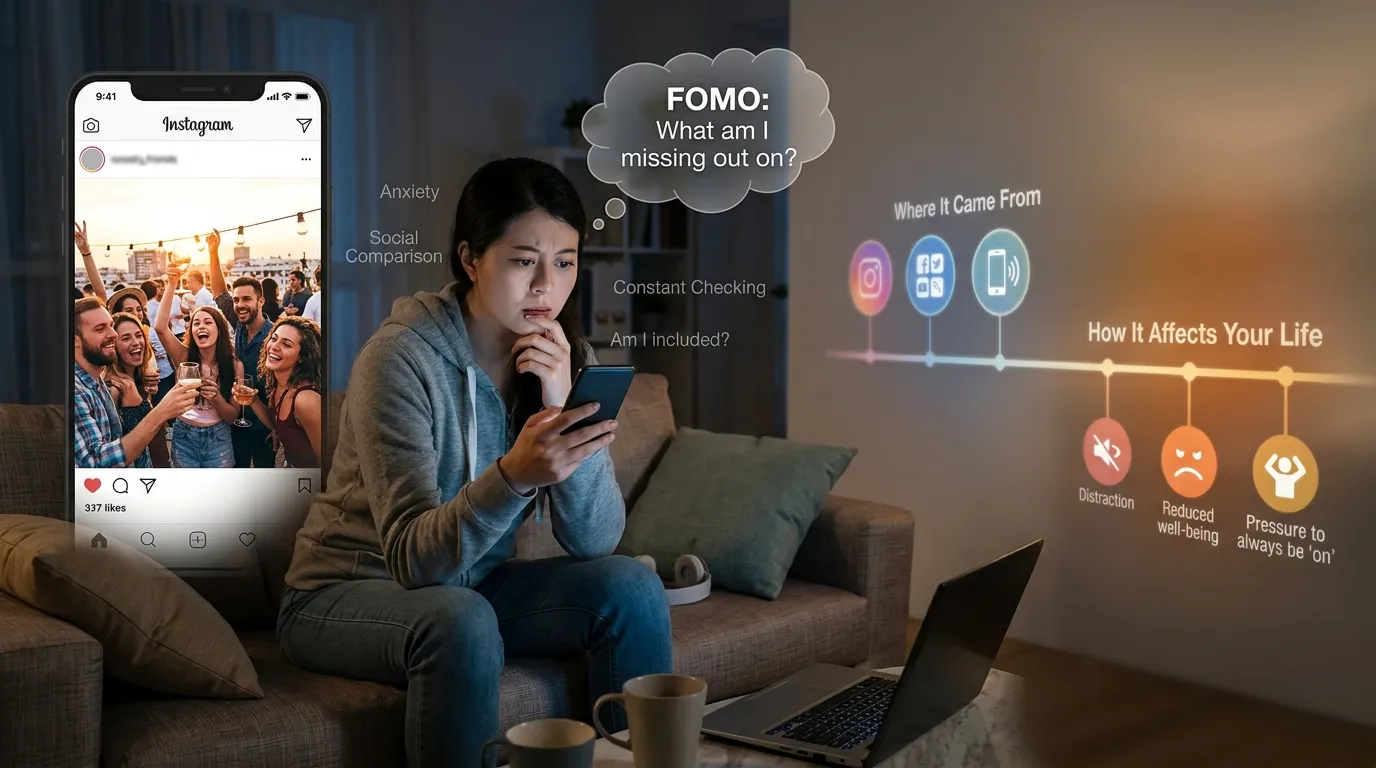
Have you ever scrolled through social media and suddenly felt like everyone else was having more fun, achieving bigger goals, or living a better life than you? That uncomfortable feeling has a name: FOMO.
FOMO meaning has become one of the most searched internet slang terms because it affects millions of people every day. Whether you’re browsing TikTok, checking Instagram Stories, reading posts on Reddit, chatting on Discord, or simply seeing friends post vacation photos, the fear of missing out can influence your emotions and even your decisions.
In today’s always-connected digital world, understanding FOMO, fear of missing out, social media anxiety, internet slang, text messaging abbreviations, and online culture is more important than ever. While the term is commonly used as slang in conversations and social media captions, it also has real psychological significance.
In this guide, you’ll learn exactly what FOMO means, where it originated, how it’s used in texting and social media, why people experience it, its psychological effects, common examples, differences between FOMO and similar terms, practical ways to overcome it, and much more.
Whether you’ve seen someone say, “I’ve got major FOMO,” or you’re simply curious about the term, this guide covers everything you need to know.
FOMO Meaning (Quick Answer)
FOMO stands for Fear Of Missing Out.
It describes the feeling that other people are having rewarding experiences without you or that you’re missing opportunities, events, conversations, or exciting moments.
People often use FOMO to describe:
- Missing a party
- Not joining friends on a trip
- Seeing exciting events online
- Missing limited-time sales
- Feeling left out of conversations
- Not participating in trending social media challenges
Example
“Everyone went to the concert without me. I’ve got serious FOMO.”
FOMO at a Glance
| Feature | Details |
|---|---|
| Meaning | Fear Of Missing Out |
| Full Form | Fear Of Missing Out |
| Type | Internet slang & psychological term |
| Tone | Casual, emotional |
| Origin | Early 2000s |
| Popular On | TikTok, Instagram, Snapchat, Reddit, Discord, Facebook, X (Twitter) |
| Common Uses | Texting, social media, marketing, psychology |
| Opposite | JOMO (Joy of Missing Out) |
| Popularity | Extremely High |
What Does FOMO Mean?
At its core, FOMO means feeling anxious that someone else is enjoying something you’re not part of.
The feeling often includes thoughts like:
- “Everyone else is having fun.”
- “I should have gone.”
- “I’m missing something important.”
- “What if this is a once-in-a-lifetime opportunity?”
- “Everyone knows something I don’t.”
FOMO isn’t just about parties.
It can involve:
- Career opportunities
- Relationships
- Investments
- Technology
- Travel
- Education
- Shopping
- Gaming
- Social media trends
The Origin of FOMO
Although people have experienced the fear of missing out for centuries, the abbreviation FOMO became popular in the early 2000s.
The rise of:
- Snapchat
- Smartphones
made people constantly aware of what others were doing.
Psychologists later began studying FOMO as a real emotional experience connected to:
- Social comparison
- Anxiety
- Low self-esteem
- Smartphone addiction
- Social media usage
Today, FOMO is recognized worldwide and appears in everyday conversations, business marketing, and academic research.
Why Do People Experience FOMO?
Several psychological factors contribute to FOMO.
1. Social Comparison
Humans naturally compare themselves to others.
When everyone seems happier online, it’s easy to feel left behind.
2. Limited Opportunities
People fear missing:
- Concerts
- Promotions
- Discounts
- Vacations
- Investments
- Viral moments
This creates urgency.
3. Social Belonging
Everyone wants to feel included.
Being excluded can trigger emotional discomfort.
4. Constant Notifications
Phones make it easy to know what everyone else is doing in real time.
The more updates people receive, the stronger FOMO can become.
FOMO Meaning in Text Messages
In texting, FOMO usually expresses regret about missing an event or opportunity.
Examples
Friend:
We’re all going bowling tonight.
You:
I can’t come. Major FOMO already.
Text
I saw your vacation pictures.
Now I’ve got FOMO.
Message
Don’t make me miss this!
The FOMO is real.
FOMO Meaning on Social Media
Social media is where FOMO appears most often.
Someone posts vacation photos.
Comment:
“You’re giving me FOMO!”
Meaning:
I wish I were there too.
TikTok
Someone shares a viral event.
Caption:
“If you missed this festival, the FOMO is going to hurt.”
Snapchat
Friends post stories from a party.
You feel left out.
That’s FOMO.
Old classmates share reunion pictures.
Someone comments:
“Seeing these gave me serious FOMO.”
X (Twitter)
People tweet:
“The FOMO is unreal today.”
Meaning:
They’re worried about missing something exciting.
FOMO Meaning on Reddit
On Reddit, people often discuss FOMO in communities about:
- Investing
- Relationships
- Careers
- Gaming
- Self-improvement
- Travel
Example:
“I bought the stock because of FOMO.”
This means they invested because they feared missing potential profits.
FOMO Meaning on Discord
Gamers commonly use FOMO.
Examples:
Everyone unlocked the new skin.
I’ve got FOMO.
Or:
I skipped the event and now I’m regretting it.
FOMO in Gaming
Gaming companies frequently create FOMO using:
- Limited skins
- Seasonal rewards
- Exclusive events
- Battle passes
- Time-limited challenges
Players often feel pressure to log in before rewards disappear.
FOMO in Dating
Dating apps can increase FOMO.
Examples include:
- Wondering if someone better is available.
- Feeling left out when friends enter relationships.
- Constantly swiping for fear of missing the “perfect” match.
FOMO in the Workplace
FOMO isn’t limited to social life.
Employees experience it when they fear missing:
- Promotions
- Networking events
- Important meetings
- Career opportunities
- Industry conferences
FOMO in Shopping
Retailers intentionally create FOMO.
Examples include:
- Limited-time offers
- Flash sales
- “Only 3 left!”
- Countdown timers
- Exclusive product drops
These tactics encourage quick purchasing decisions.
Common Examples of FOMO
Example 1
“I wasn’t invited to dinner.”
Result:
FOMO.
Example 2
“My friends are traveling through Europe.”
Result:
Travel FOMO.
Example 3
“Bitcoin went up after I didn’t buy it.”
Result:
Investment FOMO.
Example 4
“I missed the limited sneaker release.”
Result:
Shopping FOMO.
Example 5
“Everyone is talking about the new Netflix show.”
Result:
Entertainment FOMO.
Real-Life Conversations Using FOMO
Conversation 1
Sarah:
We’re all going hiking tomorrow.
Emma:
I have work.
Sarah:
You’ll have FOMO after seeing the photos.
Conversation 2
Alex:
Did you buy tickets?
Ryan:
No.
Alex:
They’re sold out now.
Ryan:
I’ve got major FOMO.
Conversation 3
Chris:
Everyone’s playing the new game.
Ben:
I haven’t downloaded it yet.
Chris:
You’re missing out!
Positive and Negative Sides of FOMO
Positive
- Encourages trying new experiences
- Helps people stay socially connected
- Motivates personal growth
- Inspires travel and learning
- Promotes participation in communities
Negative
- Anxiety
- Stress
- Overspending
- Poor decision-making
- Smartphone addiction
- Burnout
- Low self-esteem
Balance is key.
Common Mistakes About FOMO
Many people misunderstand FOMO.
Myth 1
FOMO only happens on social media.
Reality:
It also occurs in careers, education, investing, and relationships.
Myth 2
Only young people experience FOMO.
Reality:
Adults of all ages can experience it.
Myth 3
FOMO is always unhealthy.
Reality:
A little motivation can be positive.
FOMO vs Similar Terms
| Term | Meaning |
|---|---|
| FOMO | Fear of missing out |
| JOMO | Joy of missing out |
| YOLO | You Only Live Once |
| FOBO | Fear of Better Options |
| OMO | Fear of Missing Opportunities |
| FOMU | Fear of Missing Updates |
JOMO: The Opposite of FOMO
JOMO means Joy Of Missing Out.
Instead of worrying about missing events, people enjoy their own time.
Examples include:
- Reading a book instead of attending a crowded party.
- Taking a break from social media.
- Spending quiet time with family.
- Choosing rest over constant activity.
JOMO encourages mindfulness and contentment.
Tips to Overcome FOMO
Limit Social Media
Reduce unnecessary scrolling.
Focus on Your Goals
Remember that everyone has different priorities and timelines.
Practice Gratitude
Appreciate what you already have.
Be Present
Enjoy your current experiences instead of worrying about what you’re missing.
Avoid Constant Comparisons
People usually share only the highlights of their lives online.
Learn to Say No
Not every invitation or trend deserves your attention.
Is FOMO a Real Psychological Issue?
Yes.
Research suggests that excessive FOMO can be associated with:
- Increased stress
- Anxiety
- Sleep problems
- Lower life satisfaction
- Excessive smartphone use
- Social media dependency
While occasional FOMO is normal, persistent feelings may affect mental well-being. If it becomes overwhelming, reducing screen time, practicing mindfulness, or talking with a mental health professional may help.
Is FOMO Still Popular?
Absolutely.
Despite being around for years, FOMO remains one of the most commonly used internet slang terms because:
- Social media keeps growing.
- Online communities never stop.
- Digital marketing relies on urgency.
- Viral trends change daily.
- Limited-time events are everywhere.
It continues to be part of everyday conversations both online and offline.
Frequently Asked Questions (FAQ)
1. What does FOMO stand for?
FOMO stands for Fear Of Missing Out, describing anxiety about missing rewarding experiences, opportunities, or events.
2. Is FOMO a slang word?
Yes. It began as internet slang but is now also recognized as a psychological concept and a common expression in everyday language.
3. Where is FOMO most commonly used?
FOMO is widely used in text messages, TikTok, Instagram, Snapchat, Reddit, Discord, gaming communities, workplaces, marketing, and everyday conversations.
4. Is experiencing FOMO normal?
Yes. Most people experience it occasionally. It becomes a concern only when it causes significant stress or affects daily life.
5. What is the opposite of FOMO?
The opposite is JOMO, which stands for Joy Of Missing Out. It emphasizes finding happiness in choosing not to participate in every event or trend.
6. Can businesses use FOMO in marketing?
Yes. Businesses often create urgency through limited-time offers, exclusive launches, countdown timers, and low-stock messages to encourage purchases. Ethical marketing should avoid creating unnecessary pressure or misleading scarcity.
7. How can I stop feeling FOMO?
You can reduce FOMO by limiting social media use, focusing on personal goals, practicing gratitude, avoiding unhealthy comparisons, and being mindful of the present moment.
8. Does FOMO only relate to social media?
No. People experience FOMO in investing, careers, education, relationships, shopping, travel, entertainment, and many other areas of life.
9. Is FOMO common among younger people?
Younger adults often report higher levels of FOMO because of frequent social media use, but people of all ages can experience it.
10. Can FOMO ever be helpful?
In moderation, yes. It can motivate people to explore new experiences, stay connected with friends, or seize meaningful opportunities. The key is making thoughtful decisions rather than reacting out of fear.
Conclusion
Understanding FOMO meaning goes beyond knowing that it stands for Fear Of Missing Out. It reflects a powerful emotional response that has become increasingly common in today’s connected world. Whether it appears while scrolling through social media, watching friends share memorable experiences, considering a career opportunity, or deciding whether to join the latest trend, FOMO can influence how we think and act.
The good news is that FOMO doesn’t have to control your decisions. By recognizing that online posts often show only the highlights, focusing on your own goals, practicing gratitude, and embracing moments of rest, you can develop a healthier relationship with technology and social comparison. Sometimes the best experiences come not from chasing every opportunity but from fully enjoying the ones you choose.
Ultimately, FOMO is a reminder that connection matters—but so does balance. Understanding its meaning and impact empowers you to make more intentional choices, enjoy the present, and live with greater confidence instead of constantly worrying about what you might be missing.