Have you ever seen someone write, “I low-key love this song,” “I’m low-key tired,” or “She has a low-key crush on him” and wondered what they really meant? If so, you’re not alone. The phrase low key meaning slang can seem confusing because it doesn’t always mean exactly the same thing as the traditional adjective low-key.
In modern informal English, low-key usually means somewhat, secretly, subtly, quietly, or without making a big deal about something. Depending on the sentence, it can describe a relaxed situation or show that someone has a feeling they aren’t expressing openly. For example, “I’m low-key excited” means “I’m actually pretty excited, but I’m not making a huge deal about it.”
The term has become common in text messages, TikTok, Instagram, Snapchat, Discord, Reddit, gaming chats, dating conversations, and everyday speech. It can also appear as lowkey or low key, especially in casual online writing.
Understanding the phrase matters because the meaning often depends on context. Low-key crush, low-key obsessed, and keep it low-key may all communicate slightly different ideas.
So, what does low-key mean in slang? Let’s break it down in simple terms.
What Does Low Key Mean in Slang?
In slang and informal online communication, low-key usually means somewhat, secretly, subtly, or to a moderate degree.
The simplest way to understand it is:
Low-key = quietly or secretly, without making something too obvious or intense.
For example:
- “I low-key like her.” = I kind of like her, but I’m not openly saying it.
- “I’m low-key nervous.” = I’m somewhat nervous.
- “That movie was low-key amazing.” = That movie was surprisingly or quietly amazing.
- “Let’s keep the party low-key.” = Let’s keep the party relaxed and not too elaborate.
- “He’s low-key funny.” = He’s funny, perhaps more than people realize.
Merriam-Webster defines the informal adverbial use as meaning moderate or limited and also describes it as happening without seeking much attention or recognition.
The important point is that low-key doesn’t always mean secret. Sometimes it simply softens a statement.
For example:
“I low-key want pizza.”
This might mean:
- I kind of want pizza.
- I really do want pizza, but I’m saying it casually.
- I don’t want to make a big deal about wanting pizza.
The surrounding conversation tells you which shade of meaning fits best.
Low-Key Meaning in Simple English
If you want a quick definition, think of these words:
- Somewhat
- Kind of
- A little
- Quietly
- Secretly
- Subtly
- Casually
- Without drawing attention
- In a relaxed way
- Not making a big deal about it
However, these words aren’t perfect substitutes in every sentence.
For example:
“I low-key have a crush on him.”
Here, low-key can suggest that the speaker has a crush but isn’t openly admitting or displaying it.
But:
“We had a low-key weekend.”
Here, it means the weekend was relaxed, simple, quiet, or not very eventful.
That difference is one of the most important things to understand about the phrase.
Low-Key as an Adjective vs. Slang Adverb
One reason low-key meaning slang can be confusing is that the expression has two closely related uses.
Low-key as an adjective
As an adjective, low-key traditionally describes something that is restrained, quiet, understated, simple, or not flashy.
Examples:
- We had a low-key dinner at home.
- She’s a low-key person who doesn’t like attention.
- It was a low-key birthday party.
- They planned a low-key wedding.
- I want a low-key weekend.
In these examples, low-key describes the overall nature of a person, event, or situation.
Low-key as an adverb
In modern slang, low-key can work as an adverb.
Examples:
- I low-key love this.
- I’m low-key worried.
- He low-key wants to go.
- She low-key hates that show.
- I’m low-key excited for tomorrow.
Here, low-key modifies the feeling or action.
Merriam-Webster notes that this adverbial use developed into informal meanings such as “somewhat,” “casually,” and “in a subdued way.”
Low-Key Meaning on Social Media
On social media, low-key is often used to express an opinion or emotion without making it sound overly serious.
People may write:
“Low-key, this is the best thing I’ve seen today.”
This doesn’t necessarily mean the person is hiding their opinion. It can simply make the statement sound casual.
Social media examples include:
- “Low-key obsessed with this outfit.”
- “This restaurant is low-key underrated.”
- “I low-key want to move here.”
- “That was low-key hilarious.”
- “I’m low-key scared.”
- “Low-key thinking about deleting Instagram.”
- “She’s low-key famous.”
- “This song is low-key a masterpiece.”
The phrase works well online because it adds a conversational, informal tone.
It can also make a strong statement feel less aggressive. Compare:
“This is the best pizza ever.”
with:
“This is low-key the best pizza ever.”
The second version sounds more relaxed and conversational.
What Does Low-Key Mean in Texting?
In texting, low-key often means kind of, secretly, or honestly but casually.
Consider this conversation:
Friend: Are you excited about the concert?
You: I’m low-key excited 😂
The speaker is excited but isn’t expressing the emotion dramatically.
Another example:
Friend: Do you like Sarah?
You: Low-key 😭
Here, low-key probably means yes, I kind of like her, but I don’t want to fully admit it.
Common texting examples
“I low-key miss you.”
= I miss you, although I’m saying it casually or indirectly.
“I’m low-key mad.”
= I’m somewhat angry, or I’m trying not to show how angry I am.
“I low-key want to go.”
= I actually want to go, but I’m not strongly announcing it.
“That was low-key embarrassing.”
= That was somewhat embarrassing or more embarrassing than I want to admit.
“I low-key knew this would happen.”
= I had a feeling this would happen, but I didn’t openly say it.
What Does “Low-Key Crush” Mean?
A low-key crush is a crush that someone is keeping relatively quiet or not openly expressing.
For example:
“I have a low-key crush on my coworker.”
This generally means:
I like my coworker romantically, but I’m keeping those feelings private or understated.
It doesn’t necessarily mean the person has told nobody. It simply suggests that the attraction isn’t being openly displayed.
Low-key crush examples
- “I have a low-key crush on him.”
- “She’s my low-key crush.”
- “I think he has a low-key crush on you.”
- “I’ve had a low-key crush on her for months.”
In dating conversations, low-key crush can sound playful, shy, or slightly teasing.
What Does “Low-Key Obsessed” Mean?
Low-key obsessed is a popular expression that combines the softer tone of low-key with the stronger word obsessed.
It usually means:
“I’m really into this, but I’m saying it in a casual or playful way.”
For example:
“I’m low-key obsessed with this new show.”
The person probably isn’t literally obsessed in a clinical sense. They’re saying they really enjoy the show.
Other examples:
- “I’m low-key obsessed with her new album.”
- “He’s low-key obsessed with that game.”
- “I’m low-key obsessed with this coffee shop.”
- “We’re low-key obsessed with this trend.”
This is a good example of how slang can soften or playfully contradict the literal meaning of a word.
What Does “Keep It Low-Key” Mean?
Keep it low-key means keep something simple, quiet, private, relaxed, or not overly public.
For example:
“Let’s keep the birthday dinner low-key.”
That could mean having a small dinner rather than throwing a huge party.
Another example:
“We’re dating, but we’re keeping it low-key.”
Here, it may mean the couple isn’t making the relationship highly public.
The exact meaning depends on context.
“Keep it low-key” can mean:
- Don’t attract attention.
- Don’t make it a huge event.
- Keep things relaxed.
- Don’t tell everyone.
- Avoid unnecessary drama.
- Keep something private.
This is why low-key can overlap with the idea of on the down low, although the two expressions aren’t always interchangeable.
Low-Key Meaning on TikTok
TikTok has helped make many slang expressions more visible to a broad audience, and low-key frequently appears in captions, comments, videos, memes, and spoken content.
Typical TikTok-style uses include:
- “Low-key me every Monday.”
- “This trend is low-key hilarious.”
- “Low-key want this so bad.”
- “I’m low-key scared to try it.”
- “Low-key the best purchase I’ve made.”
- “He low-key ate that.”
The word often functions as a tone marker. It tells the reader that the speaker is making a statement in a casual, understated, or slightly playful way.
It’s worth remembering that low-key isn’t exclusively Gen Z slang. The expression has much older roots, while its modern slang use developed over time.
Low-Key Meaning on Instagram
On Instagram, you may see low-key in captions, comments, Stories, Reels, and DMs.
For example:
Caption:
“Low-key missing summer ☀️”
Comment:
“Low-key obsessed with this outfit 🔥”
DM:
“Low-key wanna come with you 😂”
In these situations, the expression makes the message sound casual and conversational.
It can also make a direct compliment feel less intense:
“You look amazing.”
versus:
“Low-key, you look amazing.”
The second can sound more playful, teasing, or understated.
Low-Key Meaning on Snapchat
Snapchat conversations are usually informal, so low-key fits naturally into snaps and chats.
Examples:
- “Low-key miss our old school days.”
- “I’m low-key tired.”
- “Low-key wanna go out tonight.”
- “That snap was low-key funny.”
- “I have a low-key crush on him.”
In Snapchat conversations, the phrase often communicates feelings without making them sound overly serious.
Low-Key Meaning on Discord and in Gaming
Gamers and Discord users may use low-key to describe opinions, reactions, strategies, or feelings.
Examples:
- “That boss is low-key impossible.”
- “I’m low-key addicted to this game.”
- “This build is low-key broken.”
- “I low-key carried that match.”
- “That update is low-key good.”
- “I’m low-key scared to queue again.”
In gaming, low-key can also add humor.
For example:
“I low-key carried the whole team.”
The player may be jokingly suggesting they performed much better than everyone else.
Low-Key Meaning on Reddit
On Reddit, low-key commonly appears in informal comments and discussions.
Examples:
- “This is low-key one of the best games I’ve played.”
- “I low-key agree with OP.”
- “That ending was low-key depressing.”
- “This subreddit is low-key hilarious.”
- “I’m low-key surprised this worked.”
Because Reddit discussions can range from serious debates to memes, the meaning depends heavily on the surrounding conversation.
Low-Key Meaning in Dating
In dating, low-key can be especially useful because it lets people express attraction without sounding too intense.
For example:
“I low-key like you.”
This can mean:
“I like you, but I’m nervous or not ready to say it directly.”
Other examples:
- “I low-key want to ask her out.”
- “He’s my low-key crush.”
- “I low-key miss talking to you.”
- “We’re keeping things low-key.”
- “I low-key think she’s into me.”
The phrase doesn’t guarantee romantic interest. Context and tone still matter.
If someone texts “I low-key miss you”, they probably are expressing some level of longing. But whether it’s romantic, friendly, or nostalgic depends on the relationship.
Low-Key Meaning at Work
Although low-key is informal slang, the adjective can appear in workplace conversations when the environment is relaxed.
For example:
“We’re having a low-key team lunch.”
That’s natural in casual workplace speech.
However, using slang such as:
“I low-key hate this meeting.”
in a formal email to your manager may not be appropriate.
Better professional alternatives
Instead of “I low-key disagree,” you could say:
- “I have some concerns about that.”
- “I’m not completely convinced.”
- “I have a slightly different view.”
- “I’d like to suggest another approach.”
The traditional adjective low-key is generally more workplace-friendly than the slang adverbial form.
The Difference Between Low-Key and High-Key
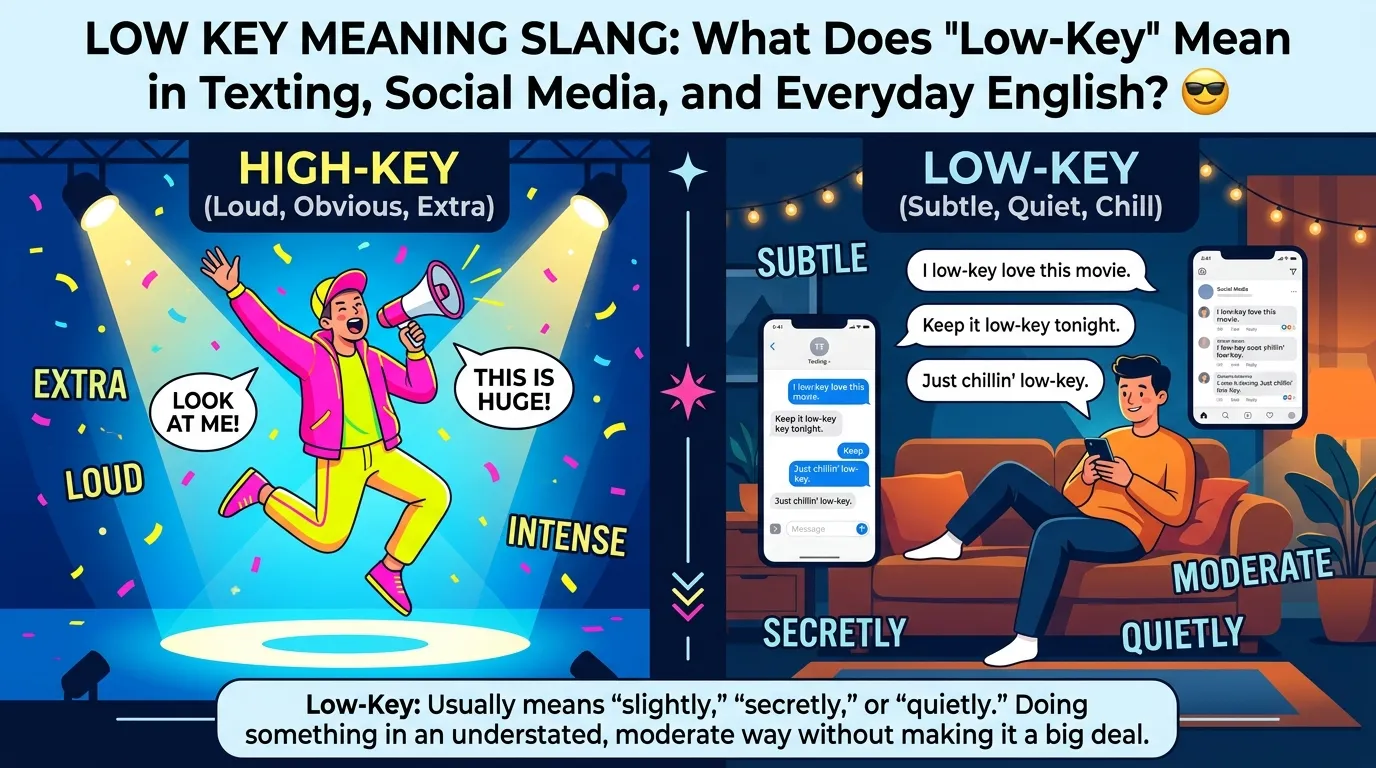
One of the most useful ways to understand low-key is to compare it with high-key.
| Expression | Common slang meaning | Example |
|---|---|---|
| Low-key | Somewhat, subtly, quietly, casually | “I low-key like this song.” |
| High-key | Very, openly, seriously, intensely | “I high-key love this song.” |
Merriam-Webster describes high-key as meaning “truly,” “completely,” or “intensely,” making it an informal counterpart to low-key’s softer sense.
Compare:
Low-key:
“I’m low-key excited.”
High-key:
“I’m high-key excited.”
The first sounds restrained. The second emphasizes the intensity of the emotion.
Interestingly, people can even combine them:
“I’m low-key high-key stressed.”
This playful expression essentially means:
“I’m actually very stressed, but I’m expressing it in a somewhat casual or humorous way.”
Low-Key vs. Secretly
These words can overlap, but they aren’t identical.
Secretly usually means something is intentionally hidden.
Low-key can suggest secrecy, but it can also mean somewhat, subtly, or casually.
Compare:
- “I secretly like him.” → I don’t want people to know.
- “I low-key like him.” → I kind of like him, and I may not be openly expressing it.
The second sentence doesn’t necessarily imply complete secrecy.
Low-Key vs. Quietly
Quietly focuses more directly on how something is done.
“She quietly left the room.”
Low-key is broader.
“She had a low-key birthday.”
That means the birthday was likely simple, relaxed, or not flashy.
Low-Key vs. Understated
Understated is a more formal word.
Low-key is more conversational.
For example:
“He has an understated style.”
and:
“He has a low-key style.”
Both can suggest a style that isn’t flashy, but the second sounds more casual.
Low-Key vs. Chill
These expressions sometimes overlap.
Chill often means relaxed, easygoing, or calm.
Low-key can mean relaxed, but it can also mean somewhat or secretly.
For example:
“We’re having a chill night.”
means the night is relaxed.
“I low-key want to leave.”
means the speaker somewhat wants to leave, or is expressing the desire subtly.
So, chill and low-key aren’t always interchangeable.
The Origin and History of Low-Key
The history of low-key is much older than today’s internet slang.
Dictionary.com traces the expression to the 19th century, when low key could refer to a low musical pitch or a subdued tone of voice. Its meaning later expanded to describe things that were quiet, restrained, or understated.
Etymonline similarly dates the adjective to around the late 19th century while noting earlier uses involving a quiet voice or deep musical tone.
The expression also developed a technical meaning in art and photography. In photography, a low-key image is characterized by predominantly dark tones and relatively little contrast. Merriam-Webster notes that this technical sense was established by the late 19th century.
Over time, the word moved beyond technical descriptions.
It began to describe:
- Quiet situations
- Restrained behavior
- Unflashy people
- Simple events
- Subdued styles
- Moderate intensity
Then came the modern slang use.
How Low-Key Became Internet Slang
The modern adverbial use of low-key became increasingly visible in informal internet language.
Merriam-Webster notes that this use can mean something like “kinda,” “somewhat,” or “in a subdued way,” and traces examples of the newer usage in informal online communication.
Dictionary.com also describes the shift toward using low-key as an adverb, especially to communicate something with limited intensity or discretion.
The term is also associated with African American English and hip-hop-influenced slang, before spreading much more broadly through internet culture and mainstream informal English. Merriam-Webster’s discussion of high-key specifically notes the use of low-key and high-key as slang adverbs in African American English and hip-hop contexts from the early 2010s.
This history is important because modern slang rarely appears from nowhere. Words often move from specialized language into communities, music, popular culture, social media, and finally everyday speech.
Low-Key Spelling: Low-Key, Low Key, or Lowkey?
You may see all three forms:
- low-key
- low key
- lowkey
All appear in informal communication.
Low-key
This is the standard hyphenated spelling and is often the safest choice in edited writing.
Example:
“I’m low-key excited.”
Low key
People also write the expression as two separate words, particularly in casual texting.
Example:
“I low key want to go.”
Lowkey
This closed form is especially common online.
Example:
“I lowkey love this.”
For formal or edited writing, low-key is generally the clearest choice. In texts, comments, and social media, lowkey is common.
Is Low-Key Positive or Negative?
Low-key itself isn’t positive or negative. Its emotional meaning comes from the word or phrase around it.
Positive examples
- “This restaurant is low-key amazing.”
- “I low-key love this.”
- “She’s low-key talented.”
- “That was low-key the best day ever.”
Negative examples
- “I’m low-key annoyed.”
- “That movie was low-key terrible.”
- “This situation is low-key stressful.”
- “I’m low-key worried.”
Neutral examples
- “We’re keeping the wedding low-key.”
- “He has a low-key personality.”
- “I low-key want coffee.”
So don’t assume that low-key always makes a statement positive or negative.
Common Misconceptions About Low-Key
Misconception 1: Low-key always means secretly
Not necessarily.
“I low-key love this song” can mean I really like it but I’m saying it casually, not necessarily that I’m hiding the fact.
Misconception 2: Low-key always means a little
Not always.
The phrase can soften a statement without strictly reducing the literal intensity.
For example:
“I low-key love you.”
could still communicate a strong feeling, even though the speaker is expressing it in an understated way.
Misconception 3: Low-key is only Gen Z slang
No.
The expression has a long history in English. Its modern slang use is newer, but low-key existed long before TikTok, Instagram, or texting.
Misconception 4: Low-key and high-key are exact opposites in every situation
Not always.
They can work as opposites in slang:
- low-key = somewhat/subtly
- high-key = intensely/openly
But the traditional meanings of the words are broader.
How to Use Low-Key Correctly
If you’re new to the expression, follow these simple tips.
Use it before a feeling or opinion
“I low-key like it.”
Use it to soften a statement
“That was low-key embarrassing.”
Use it for relaxed situations
“We’re having a low-key night.”
Use it for understated attraction
“I have a low-key crush on him.”
Don’t force it into formal writing
Instead of:
“I low-key disagree with the proposal.”
a professional version could be:
“I have some reservations about the proposal.”
Real-Life Conversation Examples
Example 1: Friends
Alex: Are you coming out tonight?
Sam: Maybe. I’m low-key tired.
Meaning: Sam is somewhat tired and may not want to go out.
Example 2: Dating
Mia: Do you like him?
Sara: Low-key 😂
Meaning: Sara probably likes him but is being shy or playful about it.
Example 3: Social media
Friend: Did you like the new song?
You: Low-key obsessed with it.
Meaning: You really like the song, but you’re expressing it casually.
Example 4: Gaming
Player 1: How was the new update?
Player 2: Low-key good.
Meaning: The update was better than expected or quietly impressive.
Example 5: Weekend plans
Friend: Are you throwing a huge party?
You: Nah, keeping it low-key.
Meaning: The gathering will be simple, relaxed, and probably small.
Quick Summary Table: Low Key Meaning Slang
| Fact | Explanation |
|---|---|
| Primary slang meaning | Somewhat, subtly, quietly, or casually |
| Another common meaning | Secretly or without drawing attention |
| Traditional adjective meaning | Quiet, restrained, understated, or relaxed |
| Common spelling | Low-key, low key, lowkey |
| Pronunciation | LOH-kee |
| Tone | Informal, casual, conversational |
| Common platforms | TikTok, Instagram, Snapchat, Reddit, Discord, texting |
| Dating meaning | Quiet or understated attraction |
| “Keep it low-key” | Keep something simple, private, or relaxed |
| Opposite slang | High-key |
| Related words | Subtle, chill, discreet, understated, casual, moderate |
| Historical roots | Musical tone, voice, and later photography/art |
| Modern slang development | Expanded into an adverb expressing subtlety or moderate intensity |
Frequently Asked Questions About Low Key Meaning Slang
What does low-key mean in slang?
In slang, low-key usually means somewhat, subtly, secretly, casually, or without making a big deal about something. For example, “I low-key like this song” means the speaker likes it but is expressing the feeling in a casual or understated way.
What does lowkey mean in texting?
In texting, lowkey commonly means kind of, secretly, or casually. The exact meaning depends on context. “I lowkey miss you” can mean “I miss you but I’m saying it indirectly,” while “I’m lowkey tired” can simply mean “I’m somewhat tired.”
What does low-key mean on TikTok?
On TikTok, low-key is commonly used to make an opinion or emotion sound casual, understated, or slightly hidden. Examples include “low-key obsessed,” “low-key want this,” and “low-key hilarious.”
What does low-key crush mean?
A low-key crush means a romantic attraction that someone is keeping relatively quiet or expressing in an understated way. It doesn’t necessarily mean the crush is completely secret.
What does keep it low-key mean?
Keep it low-key means to keep something simple, relaxed, private, quiet, or not overly attention-grabbing. For example, “Let’s keep the party low-key” suggests having a relaxed gathering rather than a huge event.
Is low-key the same as secretly?
Not exactly. Secretly strongly suggests that something is hidden. Low-key can suggest secrecy, but it can also mean somewhat, subtly, moderately, or casually.
Is low-key a good or bad word?
Neither. Low-key is neutral. The surrounding words determine whether the overall statement is positive, negative, or neutral. “Low-key amazing” is positive, while “low-key annoying” is negative.
What is the opposite of low-key slang?
The closest slang opposite is high-key. Low-key can mean subtly or somewhat, while high-key can mean openly, seriously, or intensely. Merriam-Webster describes high-key as an informal expression meaning “truly,” “completely,” or “intensely.”
Is low-key one word or two?
You may see low-key, low key, and lowkey in informal English. The hyphenated form is especially useful in edited writing, while lowkey is common in online slang and texting.
Is low-key formal English?
The traditional adjective low-key can be perfectly normal English, especially when describing something restrained or understated. The slang adverbial use is much more informal, so it may not fit formal business writing or academic work.
Final Thoughts
The easiest way to remember low key meaning slang is this:
Low-key usually means somewhat, subtly, quietly, casually, or without making something too obvious.
But context matters.
When someone says “I low-key love this,” they may mean they really like it but are expressing that feeling casually. When someone says “I have a low-key crush,” they’re probably describing an attraction that isn’t openly expressed. And when someone says “Let’s keep it low-key,” they usually mean they want something relaxed, simple, private, or free from unnecessary attention.
The phrase has also traveled a long way. Low-key existed in English long before modern internet culture, with historical connections to musical tone, subdued speech, and later photography. Its modern slang use developed as the expression expanded into informal speech and online communication.
Today, you’ll encounter it in texts, TikTok comments, Instagram captions, Snapchat chats, Reddit discussions, Discord servers, gaming conversations, dating messages, and everyday speech.
So the next time someone says, “I low-key miss you,” don’t automatically assume they’re hiding something. They may simply be expressing a real feeling in a softer, more casual way.
In short, low-key is all about keeping the intensity down—or at least making it sound that way.