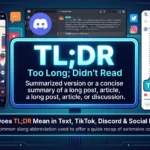
If you’ve spent any time on the internet, you’ve probably come across TL;DR at the beginning or end of a long post, article, Reddit comment, email, or social media discussion. But what does TLDR meaning actually refer to, and why has this simple abbreviation become one of the internet’s most widely used communication tools?
In today’s fast-paced digital world, people want information quickly. That’s where TL;DR, TLDR, too long didn’t read, internet slang, text abbreviations, social media slang, online communication, and digital shorthand come into play. Whether you’re scrolling through Reddit, reading a lengthy blog, browsing TikTok comments, chatting on Discord, or responding to work emails, understanding TLDR helps you communicate more effectively.
Originally used as a humorous response to overly long posts, TLDR has evolved into a helpful summary that saves readers time. Today, writers, marketers, students, professionals, and social media users regularly include a TLDR section to highlight the most important information.
In this comprehensive guide, you’ll learn exactly what TLDR means, where it came from, how to use it correctly, when to use it professionally, common mistakes to avoid, real-world examples, and why it remains one of the internet’s most useful abbreviations.
What Does TLDR Mean?
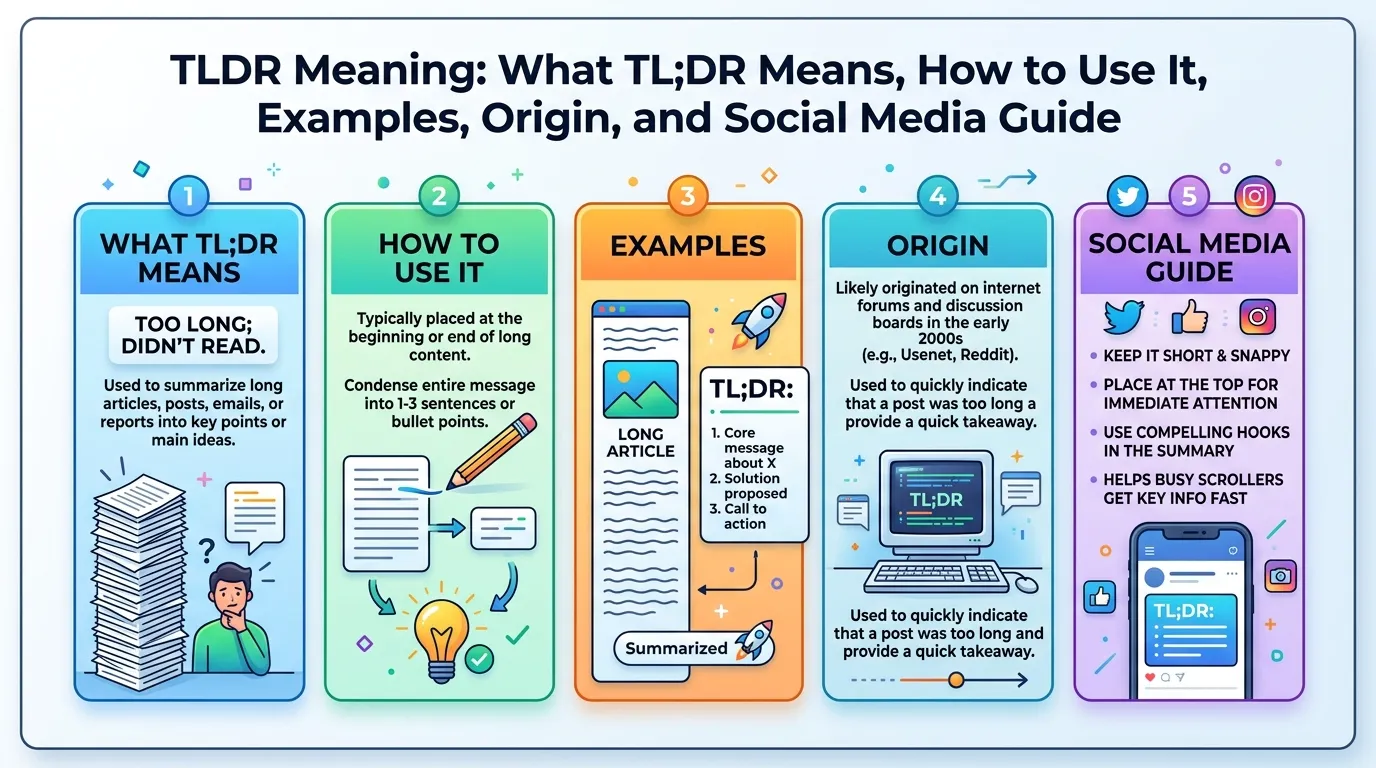
TLDR (or TL;DR) stands for:
Too Long; Didn’t Read
Quick Definition
TLDR is an internet abbreviation used to provide a short summary of a longer piece of content.
It may also jokingly suggest that a piece of writing is so long that someone didn’t read the entire thing.
Today, it’s most commonly used as a helpful summary rather than an insult.
Example:
The meeting lasted two hours and covered dozens of topics.
TLDR: We approved the budget and delayed the product launch.
TLDR Meaning at a Glance
| Feature | Details |
|---|---|
| Meaning | Too Long; Didn’t Read |
| Type | Internet slang / abbreviation |
| Origin | Early internet forums |
| Primary Purpose | Summarize long content |
| Tone | Casual, neutral, sometimes humorous |
| Common Platforms | Reddit, Discord, TikTok, Instagram, X, Facebook |
| Professional Use | Increasingly accepted |
| Similar Terms | Summary, In Short, Key Takeaways, Briefly |
What Does TLDR Actually Mean?
There are two primary meanings depending on context.
Meaning 1: A Summary (Most Common)
This is the version most people use today.
The writer includes:
TLDR: followed by a short summary.
Example:
Article:
- 2,500 words
- Multiple sections
- Detailed explanations
Ending:
TLDR: Exercise three times a week, eat protein, sleep eight hours, and stay consistent.
Readers immediately understand the key points.
Meaning 2: “I Didn’t Read It”
Originally, TLDR was often used as a sarcastic reply.
Example:
Person A:
“I wrote a 20-paragraph explanation…”
Person B:
“TLDR.”
Meaning:
“Your message was too long, so I didn’t read it.”
Today, this use is less common because it can sound rude.
Origin and History of TLDR
TLDR emerged during the early days of internet discussion boards in the late 1990s and early 2000s.
Back then, online forums often featured lengthy discussions.
Some users jokingly responded:
“TL;DR”
meaning
“Too long; didn’t read.”
Eventually, writers started adding their own TLDR summaries before readers could complain.
Over time, this transformed the abbreviation from criticism into a useful writing technique.
Today, many websites intentionally include TLDR sections because readers appreciate quick summaries.
Why Is There Sometimes a Semicolon?
You’ll see both versions:
- TLDR
- TL;DR
Both are correct.
Originally, the semicolon separated:
Too Long;
Didn’t Read
Over time, many people dropped the punctuation because typing became faster on phones and social media.
Today:
- TLDR ✔
- TL;DR ✔
Both are widely accepted.
Why Has TLDR Become So Popular?
Several trends explain its popularity.
Short Attention Spans
People consume enormous amounts of information every day.
Quick summaries save time.
Mobile Reading
Many readers skim content on smartphones.
A TLDR helps them understand the main idea immediately.
Social Media Culture
Platforms encourage short-form communication.
Users appreciate concise information.
Professional Communication
Even business emails often include:
TLDR:
followed by:
- Action items
- Deadlines
- Decisions
This improves efficiency.
How to Use TLDR Correctly
Using TLDR is simple.
Option 1: At the Beginning
TLDR:
“This guide explains how to use ChatGPT effectively.”
Then comes the full article.
Option 2: At the End
After a long explanation:
TLDR:
- Update the software.
- Restart the device.
- Try again.
Option 3: In Emails
Example:
TLDR:
- Budget approved
- Meeting moved to Friday
- Submit reports by Monday
This saves coworkers time.
TLDR Meaning in Text Messages
In texting, TLDR usually summarizes a long story.
Example:
“I argued with my landlord for two hours.
TLDR: Everything got resolved.”
Another example:
“TLDR: I’m running late.”
TLDR Meaning on Reddit
Reddit probably uses TLDR more than any other platform.
Long posts often end with:
TLDR:
followed by one or two sentences.
Example:
“I spent six months restoring an old truck.
TLDR: It finally works.”
Readers appreciate the summary.
TLDR Meaning on TikTok
TikTok creators often use TLDR in captions.
Example:
Video:
Five-minute explanation.
Caption:
TLDR:
Don’t buy fake products online.
It gives viewers the key takeaway instantly.
TLDR Meaning on Instagram
Instagram users frequently include TLDR after long captions.
Example:
Long personal story.
Ending:
TLDR:
I quit my job and started my own business.
TLDR Meaning on Snapchat
Snapchat messages are usually short.
Still, TLDR sometimes appears after longer chats.
Example:
TLDR:
“I’m staying home tonight.”
TLDR Meaning on Discord
Discord communities often discuss:
- Gaming
- Programming
- Technology
- School
- Hobbies
Moderators frequently summarize announcements.
Example:
TLDR:
- New rules
- Updated channels
- Event starts Friday
TLDR Meaning in Gaming
Gamers use TLDR after explaining:
- Strategies
- Patch notes
- Character builds
Example:
TLDR:
“This weapon is stronger after the latest update.”
TLDR Meaning in Workplace Communication
TLDR has become increasingly accepted in professional settings.
Example:
Weekly report
TLDR:
- Sales increased 14%
- Three new clients
- Marketing campaign launches Monday
Busy managers appreciate this format.
TLDR Meaning in Emails
Many professionals begin emails with:
TLDR:
followed by the essential message.
Example:
TLDR:
Need approval by Wednesday.
The detailed explanation follows.
TLDR Meaning in School
Students often use TLDR when summarizing:
- Research papers
- Lecture notes
- Study guides
Example:
TLDR:
“The Civil War began in 1861 due to multiple political and economic conflicts.”
TLDR in Everyday Conversations
Friends sometimes say:
“TLDR?”
Meaning:
“Can you give me the short version?”
Example:
Person A:
“So first we drove two hours…”
Person B:
“TLDR?”
Person A:
“We got lost but eventually made it.”
Real Conversation Examples
Example 1
Alex:
“I wrote a five-page review.”
Jordan:
“Can I get the TLDR?”
Alex:
“The product is good but overpriced.”
Example 2
Emma:
“I’ve been explaining everything for twenty minutes.
TLDR:
I’m moving to Chicago.”
Example 3
Manager:
“TLDR:
The deadline has moved to Friday.”
Positive and Negative Connotations
Positive
- Helpful
- Efficient
- Reader-friendly
- Saves time
- Improves communication
Negative
Sometimes TLDR may sound dismissive.
Example:
Person A:
“I shared something emotional.”
Person B:
“TLDR.”
That response can seem insensitive.
Consider asking politely instead.
Common Situations Where TLDR Is Useful
Use TLDR for:
- Blog posts
- Long emails
- Reddit discussions
- Reports
- School assignments
- News summaries
- Product reviews
- Tutorials
- Documentation
- Meeting notes
Situations Where You Should Avoid TLDR
Avoid using TLDR when:
- Someone shares personal feelings
- Formal legal documents
- Medical records
- Academic citations
- Sensitive conversations
Context matters.
Common Mistakes People Make
Using It to Mock Someone
This can appear rude.
Instead, politely ask for a summary.
Making the Summary Too Long
A TLDR should stay concise.
Forgetting Key Information
Include the main takeaway.
Using It Everywhere
Not every message needs a TLDR.
TLDR vs Similar Terms
| Term | Meaning | Difference |
|---|---|---|
| TLDR | Too Long; Didn’t Read | Internet slang |
| Summary | Brief explanation | More formal |
| In Short | Condensed version | Professional |
| Key Takeaways | Main points | Business writing |
| Briefly | Quick explanation | General writing |
| Executive Summary | Business overview | Formal reports |
Modern Trends Around TLDR
The popularity of TLDR continues growing because of:
- AI-generated summaries
- Busy lifestyles
- Mobile browsing
- Long-form newsletters
- Podcasts
- Video summaries
- Productivity culture
Many websites now include TLDR sections automatically.
Why Writers Should Use TLDR
Adding a TLDR can:
- Improve readability
- Increase user satisfaction
- Help readers skim content
- Reduce bounce rates
- Highlight important information
- Improve accessibility
- Support better user experience
For SEO-focused content, a concise summary can also help readers quickly determine whether the article answers their question.
Related Internet Slang
People searching for TLDR also look for:
- IMO
- IMHO
- BTW
- BRB
- AFK
- TTYL
- FYI
- IYKYK
- SMH
- FOMO
- ICYMI
- ELI5
These abbreviations help make online conversations faster and more efficient.
Frequently Asked Questions
Is TLDR considered rude?
Not necessarily. When used to provide a summary, it’s helpful. When used as a reply implying you didn’t read someone’s message, it may come across as dismissive or impolite.
Is TLDR professional?
Yes. Many workplaces now use TLDR in emails, reports, meeting notes, and project updates to highlight key information. However, consider your organization’s culture before using internet abbreviations in formal communications.
Should I write TLDR or TL;DR?
Both forms are correct. The version with the semicolon reflects the original phrase, while “TLDR” is a simplified modern spelling commonly used on social media and messaging apps.
Where should I place a TLDR?
You can place it at the beginning of a document to preview the main point or at the end to summarize everything you’ve explained. Both approaches are widely accepted.
What is the opposite of TLDR?
There is no official opposite, but people often use terms like “full version,” “detailed explanation,” “long read,” or “deep dive” to indicate more comprehensive content.
Can TLDR be used in text messages?
Absolutely. It’s commonly used to summarize long stories, explain situations quickly, or provide the main point in a conversation.
Why do Reddit users use TLDR so often?
Reddit discussions can become very lengthy. Adding a TLDR makes posts easier to scan and helps readers understand the key point without reading every detail.
Does TLDR improve readability?
Yes. A clear TLDR section helps readers identify the most important information quickly, especially in long articles, reports, emails, or online discussions.
Can I use TLDR in blog posts?
Yes. Many blogs include a TLDR or “Quick Answer” section near the beginning or end of an article to improve user experience and satisfy readers who want an immediate answer.
Conclusion
Understanding TLDR meaning is essential for anyone who communicates online. Originally shorthand for “Too Long; Didn’t Read,” TLDR has evolved from a sarcastic internet response into one of the web’s most practical communication tools. Today, it’s widely used across text messages, Reddit, TikTok, Instagram, Discord, gaming communities, workplaces, blogs, and emails to provide quick, easy-to-read summaries of longer content.
When used thoughtfully, TLDR improves readability, respects your audience‘s time, and helps ensure that important information doesn’t get lost in lengthy explanations. Whether you’re writing a blog post, sending a professional email, posting on social media, or simply explaining something to a friend, adding a concise TLDR can make your message clearer and more effective.
In short, TLDR means “Too Long; Didn’t Read,” but its real value lies in helping people communicate smarter, faster, and more efficiently in today’s information-rich digital world.