Have you ever walked away from a conversation feeling confused, questioning your memory, or wondering if you were “overreacting”? If so, you may have encountered gaslighting. Today, the term is used widely in conversations about psychological manipulation, emotional abuse, toxic relationships, mental health, and even workplace dynamics. However, many people misunderstand what gaslighting really means.
Understanding the gaslighting meaning is essential because it helps people recognize unhealthy behaviors before they become emotionally damaging. Whether the manipulation comes from a romantic partner, family member, friend, coworker, or public figure, gaslighting can slowly undermine confidence, distort reality, and make victims doubt their own thoughts and feelings.
In this comprehensive guide, you’ll learn the exact gaslighting meaning, where the term originated, how it evolved, common signs, real-life examples, differences between gaslighting and ordinary disagreements, and practical strategies to respond effectively. You’ll also discover how gaslighting appears on social media, in workplaces, online conversations, and everyday life.
If you’ve searched for what does gaslighting mean, gaslighting examples, gaslighting in relationships, or how to recognize gaslighting, this guide provides everything you need in one place.
What Does Gaslighting Mean?
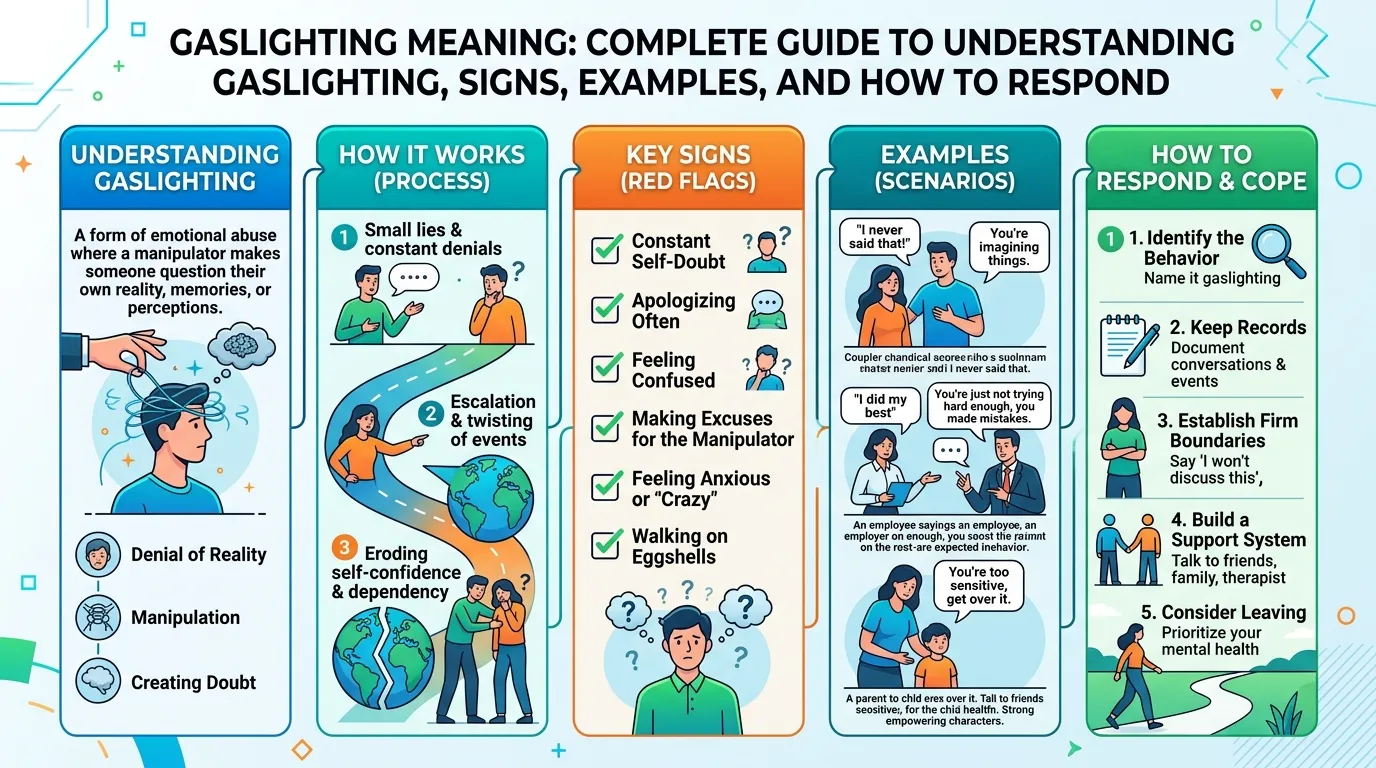
Gaslighting is a form of psychological manipulation in which one person repeatedly causes another person to question their own memory, perception, judgment, or reality.
Instead of simply lying, the gaslighter consistently denies facts, twists events, minimizes feelings, or shifts blame until the other person begins doubting themselves.
Simple Definition
Gaslighting means manipulating someone into questioning their own reality, memories, or perceptions.
It often happens gradually rather than all at once, making it difficult to recognize until significant emotional harm has occurred.
Quick Summary Table
| Feature | Details |
|---|---|
| Meaning | Psychological manipulation that makes someone doubt reality |
| Word Type | Noun and verb |
| Origin | 1938 play Gas Light |
| Popularity | Extremely common in psychology and social media |
| Tone | Negative |
| Common Contexts | Relationships, workplace, politics, friendships, families |
| Related Terms | Manipulation, emotional abuse, narcissism, coercive control |
| Opposite | Honest communication, validation, emotional support |
The Origin of the Word Gaslighting
The term comes from the 1938 British play Gas Light, later adapted into famous films.
In the story, a husband secretly dims the gas-powered lights in their home. When his wife notices the lights flickering, he insists she is imagining it.
Over time, he manipulates many situations to convince her she is losing her sanity.
Eventually, the phrase gaslighting became a psychological term describing any pattern of manipulation that causes someone to doubt reality.
Today, the word is recognized worldwide and appears frequently in discussions about emotional abuse and healthy relationships.
Why Is It Called Gaslighting?
The name literally comes from the gas lamps in the original story.
The husband changes the lighting but repeatedly tells his wife nothing has changed.
This repeated denial makes her question her own observations.
Modern gaslighting follows the same pattern:
- Something clearly happens.
- The manipulator denies it.
- The victim becomes confused.
- Self-doubt increases.
- The manipulator gains more control.
How Gaslighting Works
Gaslighting usually develops slowly.
Instead of one dramatic lie, it involves many small acts of manipulation over weeks, months, or even years.
The process often looks like this:
- The manipulator lies.
- They deny obvious facts.
- They dismiss emotions.
- They blame the victim.
- They isolate the victim.
- The victim begins doubting themselves.
- The manipulator gains emotional control.
The longer it continues, the harder it becomes to recognize.
Common Signs of Gaslighting
Some warning signs include:
- Constantly questioning your memory
- Frequently apologizing for things you didn’t do
- Feeling confused after conversations
- Losing confidence in your judgment
- Feeling like you’re always “too sensitive”
- Believing you’re the problem in every conflict
- Being afraid to express opinions
- Depending on another person to tell you what happened
Common Gaslighting Phrases
Gaslighters often use similar language.
Examples include:
- “That never happened.”
- “You’re imagining things.”
- “You’re chaotic.”
- “You’re too emotional.”
- “You’re overreacting.”
- “You’re remembering it wrong.”
- “Everyone agrees with me.”
- “You’re making things up.”
- “I never said that.”
- “You always twist my words.”
Individually, these phrases are not always gaslighting. What matters is the repeated pattern of manipulation and denial.
Examples of Gaslighting in Everyday Life
Romantic Relationships
Partner A says:
“I clearly told you I would be home by 6.”
Partner B replies:
“You never said that. You’re making things up again.”
If this happens repeatedly despite evidence, it may be gaslighting.
Family
Parent:
“I never criticized you. You’re just too sensitive.”
Even though the child clearly remembers repeated criticism.
Friendships
Friend:
“I was only joking.”
They repeatedly use this after hurtful comments to invalidate your feelings.
Workplace
Manager:
“I never assigned that task.”
Even though several coworkers heard the instructions.
Repeated denial can undermine an employee’s confidence.
Social Media
Someone spreads misinformation and later insists they never posted it despite screenshots.
Repeated denial may be considered gaslighting.
Gaslighting in Romantic Relationships
Relationship gaslighting often includes:
Emotional Manipulation
Making someone feel guilty for normal emotions.
Denying Reality
Refusing to acknowledge events that happened.
Blame Shifting
Making every disagreement seem like your fault.
Isolation
Discouraging contact with supportive friends or family.
Undermining Confidence
Repeatedly suggesting you’re forgetful or irrational.
Gaslighting in Families
Parents, siblings, or relatives sometimes engage in gaslighting.
Examples include:
- Rewriting childhood events
- Denying harmful behavior
- Invalidating emotions
- Comparing siblings unfairly
- Making one family member appear unstable
Family gaslighting can have long-lasting emotional effects because it often begins during childhood.
Gaslighting in the Workplace
Workplace gaslighting may involve:
- Denying instructions
- Taking credit for someone else’s work
- Publicly questioning competence
- Rewriting project history
- Ignoring documented evidence
- Making employees doubt performance
Healthy workplaces encourage transparency rather than manipulation.
Gaslighting on Social Media
The internet has introduced new forms of manipulation.
Examples include:
- Denying public statements
- Editing previous posts
- Pretending harmful comments never existed
- Distorting online conversations
- Using followers to pressure someone into doubting themselves
Because digital communication leaves records, screenshots often become important evidence.
Gaslighting in Text Messages
Gaslighting frequently appears through texting.
Example:
Person A:
“You promised we’d meet today.”
Person B:
“I never promised that.”
Later, Person B deletes earlier messages.
Repeated manipulation through text can create confusion just like face-to-face conversations.
Gaslighting on TikTok, Instagram, Reddit, Discord, and Snapchat
The term has become extremely popular across social platforms.
People commonly use it when discussing:
- Toxic dating experiences
- Narcissistic relationships
- Friendship conflicts
- Workplace stories
- Family trauma
- Celebrity controversies
However, many users now overuse the word to describe ordinary disagreements.
Not every argument is gaslighting.
Gaslighting vs Lying
| Gaslighting | Lying |
|---|---|
| Intends to distort reality | Hides the truth |
| Happens repeatedly | Can happen once |
| Creates self-doubt | May not affect confidence |
| Psychological manipulation | Simple deception |
| Seeks emotional control | Often seeks immediate benefit |
Every gaslighter lies.
Not every liar gaslights.
Gaslighting vs Disagreement
Healthy disagreement includes:
- Respect
- Listening
- Different opinions
- Honest misunderstandings
Gaslighting includes:
- Repeated denial
- Manipulation
- Blame shifting
- Reality distortion
- Emotional control
People can honestly remember events differently without gaslighting.
The defining feature is the intent or consistent pattern of causing someone to distrust their own perception.
Gaslighting vs Emotional Abuse
Gaslighting is often considered one form of emotional abuse.
Emotional abuse includes many behaviors such as:
- Humiliation
- Threats
- Silent treatment
- Intimidation
- Isolation
- Verbal attacks
- Gaslighting
Gaslighting focuses specifically on making someone doubt reality.
Why Do People Gaslight?
People may gaslight for different reasons, including:
- Desire for control
- Avoiding accountability
- Protecting their self-image
- Winning arguments
- Maintaining power
- Manipulative personality traits
Some individuals use gaslighting intentionally, while others may repeat unhealthy communication patterns they learned growing up. Regardless of intent, repeated gaslighting can still be harmful.
Psychological Effects of Gaslighting
Long-term gaslighting can contribute to:
- Anxiety
- Chronic self-doubt
- Low self-esteem
- Depression
- Emotional exhaustion
- Difficulty making decisions
- Loss of confidence
- Social withdrawal
The severity depends on factors such as duration, frequency, and the nature of the relationship.
How to Respond to Gaslighting
If you believe someone is gaslighting you, these strategies may help:
Keep Records
Save important emails, text messages, or notes about conversations.
Trust Evidence
Rely on documented facts rather than repeated denials.
Set Boundaries
Clearly state what behavior you will and will not accept.
Talk to Trusted People
Friends, family, or professionals can provide perspective.
Avoid Endless Arguments
Gaslighting often involves circular conversations designed to create confusion.
Seek Professional Support
If the behavior is persistent or part of an abusive relationship, a licensed mental health professional can help you evaluate the situation and develop a plan for support and safety.
Common Misconceptions About Gaslighting
Every Lie Is Gaslighting
False.
Gaslighting involves a broader pattern of manipulation.
Every Disagreement Is Gaslighting
False.
People naturally remember events differently.
Only Romantic Partners Gaslight
False.
Gaslighting can occur in families, workplaces, friendships, schools, and other settings.
Only Narcissists Gaslight
False.
Although gaslighting is often discussed alongside narcissistic behavior, people with different personalities or motives may engage in gaslighting.
Related Terms
Several concepts are closely related to gaslighting:
- Emotional abuse
- Manipulation
- Psychological abuse
- Coercive control
- Love bombing
- Stonewalling
- Blame shifting
- Projection
- Invalidating feelings
- Toxic relationship
Understanding these related terms provides a fuller picture of unhealthy interpersonal dynamics.
Real-Life Conversation Examples
Example 1
Alex: You yelled at me yesterday.
Jordan: That never happened. You’re imagining it.
Example 2
Taylor: I remember us agreeing on Friday.
Morgan: No, you’re confused again.
Example 3
Chris: Your comments hurt me.
Sam: You’re way too sensitive. Everyone else thinks you’re fine.
Is Gaslighting Always Intentional?
Not necessarily.
Some people consciously manipulate others to gain control.
Others may deny events or invalidate feelings without realizing the impact of their behavior.
Regardless of intent, if someone repeatedly causes another person to question their own reality through denial and manipulation, the behavior can still be harmful.
Why the Word Gaslighting Became So Popular
The term has become increasingly common because conversations about mental health and emotional well-being are more visible than ever.
Several factors contributed to its popularity:
- Greater awareness of emotional abuse
- Mental health education
- Social media discussions
- Relationship advice content
- Workplace wellness initiatives
- Increased public discussion of manipulation tactics
As awareness has grown, experts have also emphasized the importance of using the term accurately rather than applying it to every disagreement or mistake.
Frequently Asked Questions
What is the simplest definition of gaslighting?
Gaslighting is a pattern of psychological manipulation that causes someone to doubt their own memory, perceptions, or sense of reality.
Is gaslighting emotional abuse?
Gaslighting is widely recognized as a form of emotional or psychological abuse because it seeks to undermine another person’s confidence in their own experiences and judgment.
Can gaslighting happen accidentally?
Some people may invalidate others without intending to manipulate them. However, gaslighting generally refers to a repeated pattern that results in someone questioning their reality, regardless of whether the behavior is fully intentional.
What are the first signs of gaslighting?
Early signs include constant confusion, self-doubt, frequent apologizing, feeling “too sensitive,” and relying on someone else to tell you what really happened.
Can friends gaslight each other?
Yes. Gaslighting can occur in friendships, especially if one friend repeatedly denies events, dismisses concerns, or manipulates the other’s perception of reality.
Is forgetting something the same as gaslighting?
No. Everyone forgets details sometimes. Gaslighting involves repeated manipulation or denial that causes another person to question their own perception, not ordinary memory lapses.
Why is gaslighting difficult to recognize?
It often develops gradually. Small instances of denial or blame can accumulate over time, making it harder for the person experiencing it to identify the pattern.
Can someone recover from gaslighting?
Yes. Many people recover by rebuilding trust in their own judgment, reconnecting with supportive relationships, setting healthy boundaries, and, when needed, working with a qualified mental health professional.
How can I tell the difference between gaslighting and a misunderstanding?
A misunderstanding is usually resolved through open communication and mutual respect. Gaslighting is characterized by a persistent pattern of denying reality, invalidating experiences, and shifting blame to create self-doubt.
Final Thoughts
Understanding the gaslighting meaning is more than learning a popular buzzword—it’s about recognizing a harmful pattern of psychological manipulation that can affect relationships, families, friendships, workplaces, and online interactions. True gaslighting is not simply lying, disagreeing, or remembering events differently. It involves repeated behaviors that cause someone to question their own reality, confidence, and judgment.
By recognizing the warning signs, understanding how gaslighting works, and knowing the difference between manipulation and ordinary conflict, you can better protect your emotional well-being and support others who may be experiencing similar situations. Healthy relationships are built on honesty, accountability, empathy, and mutual respect—not confusion, denial, or control. The more accurately we understand and use the term gaslighting, the better equipped we are to foster healthier communication and stronger, more trusting relationships.