The internet has transformed the way people communicate, and one of the most recognizable parts of online culture is the meme. Whether you’re scrolling through social media, chatting with friends, or browsing forums, you’ve likely encountered countless memes every day. But what is the actual meme meaning internet users refer to, and why have memes become such a powerful form of communication?
In today’s digital world, memes are more than just funny pictures. They are a way to share ideas, express emotions, comment on current events, and even influence culture. Understanding the meme meaning internet culture embraces can help you better navigate social media trends and online conversations.
This guide explores everything you need to know about internet memes, including their definition, history, types, uses, examples, and common misconceptions.
What Is a Meme on the Internet?
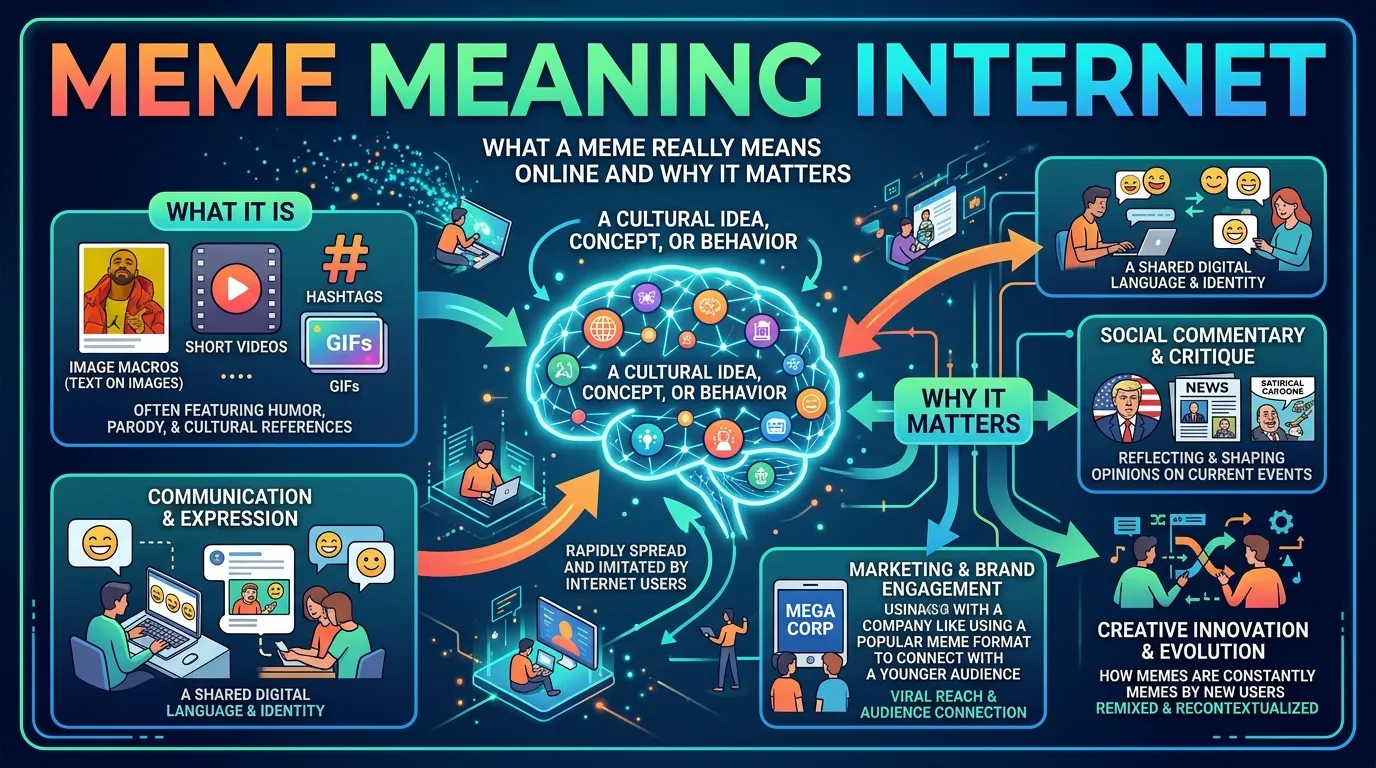
A meme is a piece of content—such as an image, video, phrase, GIF, or joke—that spreads rapidly online and is often modified by different users.
In simple terms:
A meme is a shared idea or joke that people copy, remix, and distribute across the internet.
Memes usually contain:
- Humor
- Relatable situations
- Cultural references
- Trending topics
- Viral elements
For example, a picture of a confused person with a funny caption can quickly become a meme when thousands of people create their own versions using the same image template.
Meme Meaning Internet Explained
When people search for “meme meaning internet,” they generally want to know how the word “meme” is used online.
On the internet, a meme refers to:
| Aspect | Meaning |
|---|---|
| Humor | Funny content shared online |
| Communication | Expressing feelings through images or jokes |
| Culture | Shared online experiences |
| Trends | Viral content spreading quickly |
| Creativity | User-generated adaptations |
Memes act as a kind of digital language. Sometimes a single meme can communicate an emotion more effectively than an entire paragraph.
For example:
- A laughing meme = “That’s hilarious.”
- A facepalm meme = “That was a bad idea.”
- A crying meme = “I’m sad” or “I’m laughing too hard.”
The Origin of the Word “Meme”
Many people assume memes were invented with social media, but the term actually predates the internet.
The word meme was introduced in 1976 by:
Richard Dawkins
In his book:
The Selfish Gene
Dawkins used the word “meme” to describe an idea, behavior, or cultural practice that spreads from person to person, similar to how genes spread biologically.
Examples of traditional memes included:
- Catchphrases
- Fashion trends
- Songs
- Cultural traditions
The internet later adopted the term because online content spreads in a similar way.
How Memes Became Popular Online
The rise of internet memes happened gradually.
Early Internet Era (1990s)
Popular early memes included:
- Dancing Baby
- Hamster Dance
- All Your Base Are Belong To Us
These were among the first viral internet phenomena.
Social Media Boom (2000s)
Platforms like:
allowed memes to spread much faster.
Modern Meme Culture (2010s–Today)
Today memes spread through:
- Social media
- Messaging apps
- Short-form videos
- Online communities
- Streaming platforms
A meme can now become globally famous within hours.
Why Memes Are So Popular
Memes dominate internet culture because they combine several powerful elements.
1. Easy to Understand
Most memes communicate a message instantly.
Users can understand the joke within seconds.
2. Highly Relatable
Memes often focus on:
- School life
- Work struggles
- Relationships
- Family situations
- Everyday frustrations
People enjoy seeing their experiences reflected humorously.
3. Quick Entertainment
Unlike long articles or videos, memes provide instant enjoyment.
4. Easy to Share
Sharing a meme usually takes one click.
This simplicity fuels viral growth.
5. Community Building
Memes help people connect through shared experiences and inside jokes.
Different Types of Internet Memes
Not all memes look the same.
Here are some common categories.
Image Memes
These are the classic meme format.
Example:
- A picture with text at the top and bottom
- Reaction images
- Edited photographs
Video Memes
Short videos that become widely shared.
Examples include:
- Funny clips
- Edited scenes
- Remix videos
GIF Memes
Animated images used to express reactions.
Common emotions include:
- Surprise
- Excitement
- Anger
- Confusion
Text Memes
Some memes consist entirely of text.
Examples:
- Viral tweets
- Funny screenshots
- Popular phrases
Audio Memes
These involve sounds, music clips, or catchphrases.
Popular on short-form video platforms.
Reaction Memes
Reaction memes are used to respond to situations.
Examples:
- Shocked face
- Confused expression
- Celebratory reactions
Common Meme Examples
While meme trends constantly change, many formats remain recognizable.
Examples include:
- Distracted Boyfriend
- Drake Hotline Bling
- Woman Yelling at Cat
- Success Kid
- This Is Fine
These templates are frequently reused with new captions and contexts.
How Memes Spread Across the Internet
The viral nature of memes follows a predictable pattern.
Step 1: Creation
Someone creates original content.
Step 2: Sharing
The content gets posted online.
Step 3: Engagement
People react, comment, and repost.
Step 4: Adaptation
Others create their own versions.
Step 5: Viral Growth
The meme spreads across multiple platforms.
Step 6: Decline
Interest fades as newer memes emerge.
Memes as a Form of Communication
One reason memes matter is their ability to communicate complex ideas quickly.
For example, memes can express:
- Happiness
- Frustration
- Anxiety
- Sarcasm
- Irony
Instead of writing:
“I am overwhelmed with work today.”
Someone might simply send a meme showing a stressed character.
The meaning is instantly understood.
The Role of Humor in Memes
Humor is the foundation of most successful memes.
Memes often use:
- Exaggeration
- Irony
- Satire
- Wordplay
- Unexpected comparisons
The funniest memes usually combine relatability with surprise.
Meme Culture and Social Media
Modern social media thrives on meme culture.
Popular meme-sharing platforms include:
Many social trends begin as memes before becoming mainstream.
How Businesses Use Memes
Brands increasingly use memes for marketing.
Benefits include:
- Higher engagement
- Increased shares
- Better audience connection
- More visibility
- Stronger brand personality
However, successful meme marketing requires understanding internet culture.
Forced or outdated memes can have the opposite effect.
Memes and Generational Communication
Different generations use memes differently.
Generation Z
- Heavy meme usage
- Fast adoption of trends
- Visual communication style
Millennials
- Strong connection to classic meme formats
- Frequent social media sharing
Generation X and Older Users
- Increasing meme usage
- Often engage with simpler formats
Memes have become a cross-generational communication tool.
Psychological Reasons People Love Memes
Researchers suggest several reasons why memes are appealing.
Emotional Relief
Humor helps reduce stress.
Social Connection
Sharing memes creates feelings of belonging.
Identity Expression
People use memes to showcase:
- Interests
- Opinions
- Personality
Instant Gratification
Memes provide quick entertainment.
Educational and Informational Memes
Not all memes are purely for humor.
Educational memes can teach:
- Science concepts
- Historical facts
- Language skills
- Study tips
Teachers and educators increasingly use memes to engage students.
Political and Social Memes
Memes often play a role in public discussions.
They can:
- Raise awareness
- Encourage debate
- Criticize policies
- Spread information
Because memes are highly shareable, they can influence public opinion.
Common Misconceptions About Memes
Many people misunderstand memes.
Misconception 1: Memes Are Just Pictures
False.
Memes can be:
- Images
- Videos
- Audio clips
- GIFs
- Text posts
Misconception 2: Memes Are Only for Teenagers
False.
People of all ages create and share memes.
Misconception 3: Every Viral Post Is a Meme
Not necessarily.
A meme usually gets copied, modified, and recreated.
Misconception 4: Memes Have No Real Value
False.
Memes influence:
- Communication
- Marketing
- Politics
- Education
- Popular culture
Related Internet Slang and Concepts
Understanding memes becomes easier when you know related terms.
| Term | Meaning |
|---|---|
| Viral | Content spreading rapidly |
| GIF | Animated image |
| Trend | Popular online activity |
| Reaction Image | Picture expressing emotion |
| Shitpost | Intentionally absurd content |
| Copypasta | Text repeatedly copied online |
| Hashtag | Keyword used for categorization |
| Internet Culture | Shared online behaviors and trends |
How to Create a Good Meme
Want to make your own meme?
Follow these tips:
Keep It Simple
The message should be obvious immediately.
Be Relatable
Focus on common experiences.
Use Current Trends
Trending topics often gain more attention.
Know Your Audience
Different communities prefer different humor styles.
Avoid Overcomplicating
The best memes are usually short and straightforward.
The Future of Internet Memes
Memes continue evolving alongside technology.
Future trends may include:
- AI-generated memes
- Interactive memes
- Augmented reality memes
- Personalized meme experiences
- More video-based meme formats
As online communication changes, memes will likely remain a central part of digital culture.
Frequently Asked Questions (FAQs)
What does meme mean on the internet?
A meme is a piece of content—such as an image, video, phrase, or GIF—that spreads online and is often modified by users for humor, commentary, or communication.
Why are memes so popular?
Memes are popular because they are funny, relatable, easy to understand, and simple to share across social media platforms.
Who invented the word meme?
The term was created by Richard Dawkins in 1976 to describe ideas that spread culturally from person to person.
Are memes always funny?
No. While many memes are humorous, some are educational, inspirational, political, or informational.
What makes a meme go viral?
Factors include:
- Relatability
- Humor
- Timing
- Shareability
- Cultural relevance
Can businesses use memes for marketing?
Yes. Many brands use memes to engage audiences, increase visibility, and create more relatable content.
What’s the difference between a meme and a viral post?
A viral post becomes popular quickly, while a meme is usually copied, adapted, and recreated by many users in different ways.
Conclusion
Understanding the meme meaning internet users talk about is essential for navigating today’s digital world. Memes are no longer just funny pictures—they are a powerful form of communication, cultural expression, and online interaction. From their origins in academic theory to their role in social media, marketing, education, and entertainment, memes have become one of the internet’s most influential tools.
Whether you’re sharing a reaction image, creating original content, or simply enjoying the latest viral trend, memes help people connect through humor, creativity, and shared experiences. To make the most of meme culture, stay aware of current trends, understand the context behind popular formats, and remember that the best memes are often the simplest and most relatable. As internet culture continues to evolve, memes will remain a key part of how people communicate online.