In today’s fast-moving digital world, abbreviations and slang are everywhere. If you’ve ever received a message saying “PM me” or noticed someone using “PM” in a text conversation, you may have wondered what it actually means. Understanding the PM meaning in text is important because it can completely change how you communicate online.
Whether you’re chatting on Instagram, texting friends, gaming online, or using apps like Snapchat, WhatsApp, Facebook, or Discord, the abbreviation PM appears constantly. While it may look simple, it actually has multiple meanings depending on the context.
This guide explains everything you need to know about PM meaning in text messages, including its different definitions, examples, social media usage, common misunderstandings, and similar texting abbreviations. By the end, you’ll confidently understand when and how to use PM in conversations.
What Does PM Mean in Text?
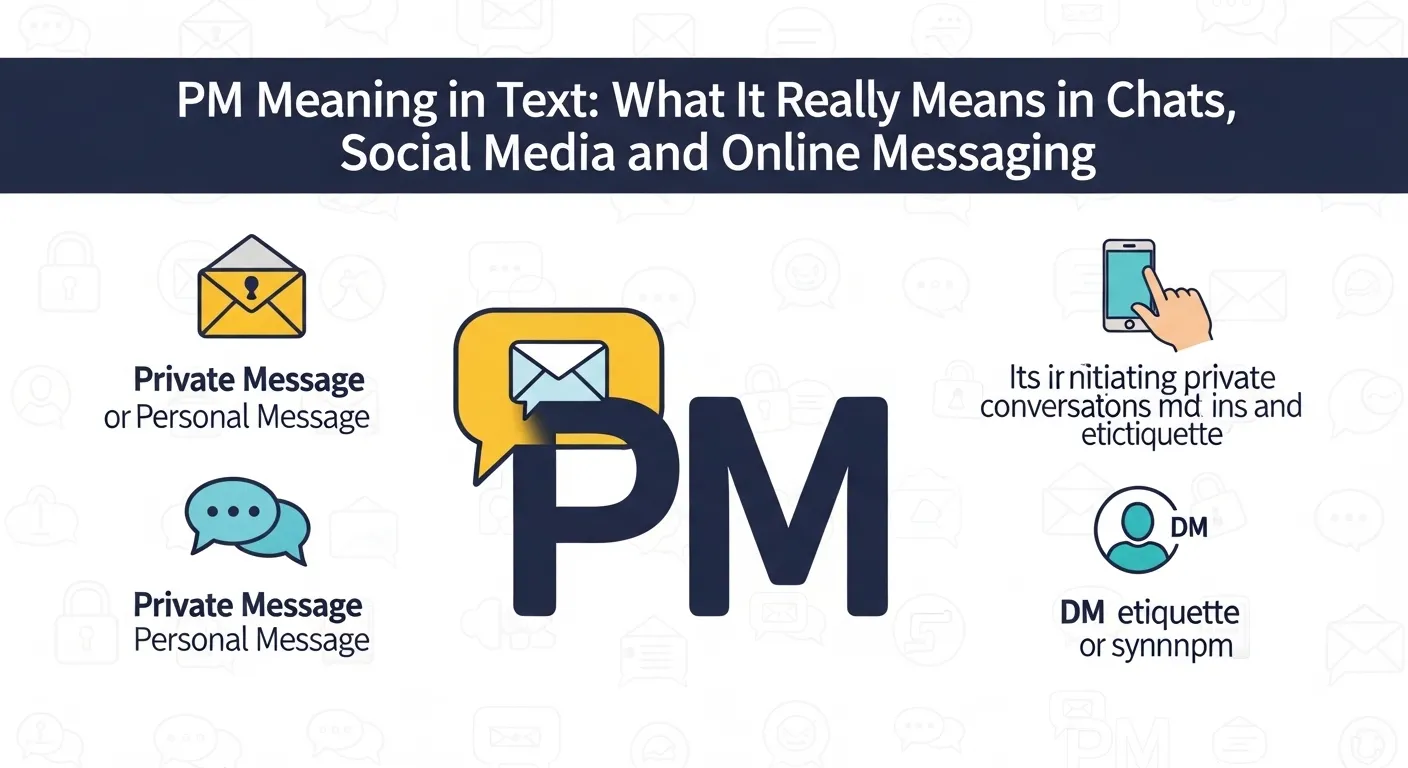
The abbreviation PM most commonly stands for:
- Private Message
- Personal Message
- Post Meridiem (time after noon)
The meaning depends on how it is used in a sentence or conversation.
For example:
- “PM me your number” → means send me a private message
- “The meeting starts at 7 PM” → refers to time in the evening
Because texting and online messaging are so popular, the most common modern usage is Private Message.
PM Meaning in Text Messaging
In texting, PM usually means Private Message.
A private message is a direct conversation between two people that other users cannot see publicly.
Example Conversations
Example 1
Friend: “I’ll send the details publicly later.”
You: “Just PM me instead.”
Meaning: Send the information privately.
Example 2
Instagram Comment: “Where did you buy that?”
Reply: “PM me and I’ll send the link.”
Meaning: Start a private chat.
Example 3
Gaming Chat: “Need help leveling up? PM me.”
Meaning: Contact privately for more information.
Why People Use PM in Texts
People use PM because it is:
- Quick and convenient
- Easy to type
- Widely recognized online
- Useful for private conversations
- Common across many apps and platforms
Instead of typing “send me a private message,” people simply write “PM me.”
PM Meaning on Social Media
The meaning of PM stays mostly the same across social media platforms. It generally refers to sending a private or direct message.
Here’s how it works on different platforms.
PM Meaning on Facebook
On Facebook, PM means sending a private message through Messenger.
Example
“PM me for pricing.”
This means the person wants to discuss prices privately instead of publicly in comments.
Businesses often use PMs for:
- Customer support
- Product inquiries
- Personal details
- Booking information
PM Meaning on Instagram
On Instagram, PM usually means direct messaging someone privately.
Although Instagram officially calls it a DM (Direct Message), many users still say PM.
Example
“PM me your favorite songs.”
Meaning: Send the list through private chat.
PM Meaning on Snapchat
On Snapchat, PM refers to chatting privately rather than posting publicly on Stories.
Example
“She PM’d me after seeing my Story.”
Meaning: She sent a private message.
PM Meaning on TikTok
TikTok users often use PM when asking followers to contact them privately.
Example
“PM me if you want the tutorial.”
This usually means:
- Send a direct message
- Ask privately for more information
PM Meaning in Gaming
In online gaming communities, PM is extremely common.
Gamers use PM to:
- Discuss strategies
- Exchange usernames
- Share links privately
- Avoid public spam
Example
“PM me your gamer tag.”
Meaning: Send it privately.
Popular gaming platforms where PM is used include:
- Discord
- Steam
- Roblox
- Xbox Live
- PlayStation Network
PM Meaning in Time
Besides messaging, PM also has another major meaning:
PM = Post Meridiem
This is used when telling time.
PM refers to the hours after midday and before midnight.
PM Time Range
- 12:00 PM = Noon
- 11:59 PM = One minute before midnight
Difference Between AM and PM
| Abbreviation | Meaning | Time Range |
|---|---|---|
| AM | Ante Meridiem | Midnight to before noon |
| PM | Post Meridiem | Noon to before midnight |
Examples of PM in Time
- “Dinner is at 8 PM.”
- “The movie starts at 6:30 PM.”
- “Call me after 5 PM.”
In these examples, PM refers to evening or afternoon time.
How to Know Which PM Meaning Is Intended
The context usually makes the meaning obvious.
If the conversation is about messaging:
PM = Private Message
Example
“PM me your address.”
If the conversation is about schedules or clocks:
PM = Evening time
Example
“The appointment is at 3 PM.”
Common Texting Examples of PM
Here are some realistic examples of how people use PM in modern texting.
| Text Message | Meaning |
|---|---|
| “PM me later.” | Send me a private message later |
| “I’ll PM you the details.” | I’ll send the information privately |
| “The party starts at 9 PM.” | The party starts at night |
| “Can you PM the notes?” | Send the notes privately |
| “She texted me at 11 PM.” | She texted late at night |
PM vs DM: What’s the Difference?
Many people confuse PM and DM because they are very similar.
PM = Private Message
DM = Direct Message
In most situations, they mean almost the same thing.
However, DM has become more popular on platforms like:
- Twitter/X
- TikTok
PM is still commonly used on:
- Forums
- Gaming communities
- Older internet platforms
PM vs DM Comparison Table
| Feature | PM | DM |
|---|---|---|
| Full Form | Private Message | Direct Message |
| Meaning | Private conversation | Direct private conversation |
| Common Platforms | Facebook, forums | Instagram, Twitter |
| Usage Style | Traditional | Modern social media slang |
Is PM Outdated?
Not at all.
Even though DM is trendy, PM is still widely understood and used globally.
Many people continue using PM because:
- They’ve used it for years
- It’s short and recognizable
- Some platforms still use the term
Both PM and DM are acceptable in online communication.
Other Meanings of PM
Although Private Message and Post Meridiem are the most common meanings, PM can also stand for other things in certain situations.
Less Common PM Meanings
| PM Meaning | Usage |
|---|---|
| Project Manager | Business/workplace |
| Prime Minister | Politics |
| Preventive Maintenance | Engineering |
| Product Manager | Corporate settings |
Context is extremely important.
PM Meaning in Business Communication
In work environments, PM often means Project Manager.
Example
“The PM approved the design.”
Meaning: The project manager approved it.
This is very different from texting slang.
PM Meaning in Professional Emails
In professional communication, PM may refer to:
- A private message
- A project manager
- Evening time
Example
“Please PM me the report before 5 PM.”
Interestingly, this sentence uses PM twice with two different meanings.
History of PM in Online Communication
The use of PM dates back to:
- Early internet forums
- Online chat rooms
- Bulletin board systems (BBS)
- Instant messaging services
Before modern social media apps existed, users communicated through private messages on websites and forums.
That’s why PM became a universal internet term.
Why Internet Slang Like PM Became Popular
Online abbreviations became popular because they:
- Save time
- Speed up conversations
- Fit character limits
- Create casual communication styles
Examples include:
- LOL
- BRB
- IMO
- DM
- PM
- TTYL
PM remains one of the most commonly recognized abbreviations online.
Common Misunderstandings About PM
1. Thinking PM Always Means Time
Some people assume PM only refers to evening hours.
However, in texting and social media, PM usually means private message.
2. Confusing PM and DM
While similar, some platforms officially prefer one term over the other.
For example:
- Instagram uses DM
- Facebook commonly uses PM
Still, people often use them interchangeably.
3. Assuming PM Is Formal
PM is actually very casual in online communication.
It’s commonly used among:
- Friends
- Gamers
- Influencers
- Businesses
- Communities
When You Should Use PM
You should use PM when:
- You want privacy
- Information is personal
- Details shouldn’t be public
- Continuing a conversation privately
Good Uses for PM
- Sharing phone numbers
- Sending addresses
- Discussing payments
- Giving account details
- Talking confidentially
When You Should Avoid PM
Avoid private messaging if:
- The discussion should stay public
- The platform discourages unsolicited messages
- The person is uncomfortable
- The topic is inappropriate
Always respect privacy and boundaries online.
Popular Variations Related to PM
Here are some similar abbreviations and terms.
| Abbreviation | Meaning |
|---|---|
| DM | Direct Message |
| IM | Instant Message |
| Msg | Message |
| Inbox | Private messaging area |
| Chat | Real-time conversation |
Examples of PM in Everyday Life
Social Media Influencer
“PM me for collaboration inquiries.”
Online Marketplace
“Interested buyers should PM me.”
Student Group Chat
“PM me the homework answers.”
Gaming Server
“PM moderators for help.”
PM Meaning for Different Age Groups
Interestingly, PM usage can vary by generation.
Younger Users
Often prefer:
- DM
- Snap
- Chat
Older Internet Users
More likely to say:
- PM
- Message me
- Inbox me
Both generations generally understand PM.
SEO and Trending Search Terms Related to PM
People searching for PM meaning in text also often search for:
- What does PM mean in texting?
- PM meaning on Snapchat
- PM vs DM
- What is a private message?
- PM meaning on Instagram
- What does PM me mean?
- PM abbreviation meaning
- Internet slang PM
These related keywords help users better understand modern texting culture.
Frequently Asked Questions (FAQs)
1. What does PM mean in texting?
In texting, PM usually means Private Message. It refers to sending a message privately instead of publicly.
2. What does “PM me” mean?
“PM me” means “send me a private message.”
Example:
“PM me your email address.”
3. Is PM the same as DM?
Almost. PM means Private Message, while DM means Direct Message. Both refer to private online conversations.
4. What does PM mean in time?
In time formatting, PM stands for Post Meridiem, meaning after noon.
Example:
7 PM = evening.
5. Is PM still used today?
Yes. Although DM is becoming more popular on social media, PM is still widely used online.
6. What platforms use PM?
PM is commonly used on:
- Forums
- Discord
- Gaming chats
- Messaging apps
7. Can PM have multiple meanings?
Yes. PM can mean:
- Private Message
- Post Meridiem
- Project Manager
- Prime Minister
The context determines the correct meaning.
Tips for Understanding Text Abbreviations Like PM
Here are some quick tips to understand internet slang better:
Look at Context
Check whether the conversation is about:
- Messaging
- Time
- Work
- Social media
Pay Attention to Platform
Different apps use different terminology.
For example:
- Instagram → DM
- Facebook → PM
Ask When Unsure
If confused, simply ask:
“What do you mean by PM?”
Most people will clarify quickly.
Final Thoughts
Understanding the PM meaning in text helps you communicate more confidently online. In most digital conversations, PM stands for Private Message, allowing users to chat privately away from public comments or group discussions. However, PM can also mean Post Meridiem when discussing time, along with several professional meanings depending on context.
As texting slang and internet communication continue evolving, abbreviations like PM remain essential parts of online culture. Whether you’re messaging friends, browsing social media, gaming online, or working professionally, knowing the meaning of PM can prevent confusion and improve communication.
Next time someone says “PM me,” you’ll know exactly what they mean.